Feeling alters the visible world
Expressionist artists used distortion and intense color to make inner experience visible. The term covers several groups and places rather than a neat unified style. Portraits, landscapes, and city scenes could all become charged with unease, urgency, or joy. The usual period given for Expressionism is early 1900s, but dates are guides to overlapping activity rather than firm doors that opened and shut everywhere at once. The term groups artists for the convenience of discussion. It cannot explain a work before we have looked at that work. A useful first move is to ask what problem the name makes visible: a new audience, a disputed subject, a way of organizing space, or a change in what artists thought images could do. Only then can we decide how well a particular painting, print, or design belongs within the account.
The world around the work
Expressionism names several related but distinct early twentieth-century efforts, especially in German-speaking Europe. Rapid urban change, new psychology, and political instability helped make inherited naturalism feel inadequate to some artists. Munch and Kandinsky both allow visible form to carry an intense experience, yet the paths they followed were different. Munch returned to subjects in prints as well as paintings, testing how line and color could alter a familiar image. Kandinsky moved from recognizable landscape toward less literal arrangements. Their works reached viewers through exhibitions and printed media across different cities. Expressionism names a range of approaches, not a shared set of instructions.
Distortion and urgent color
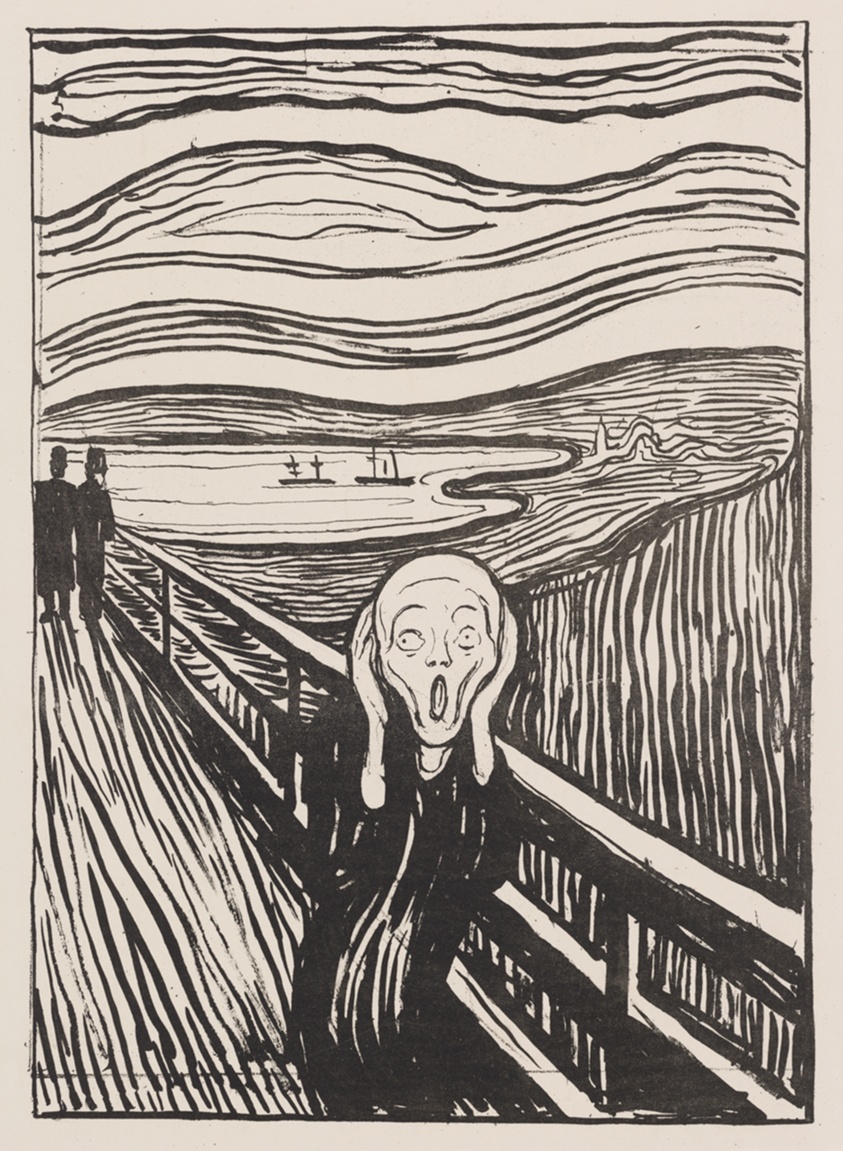
Color may intensify beyond observed appearance; a street can tilt or a face can become angular. Such departures are purposeful visual choices, not evidence that artists had abandoned careful looking. Distortion can direct attention to an experience. The Scream (lithograph) makes these choices visible in a particular object. Its own composition, medium, and subject offer a more useful test of the movement than a checklist of traits. Compare it with another work in this guide and the differences in scale or handling begin to matter as much as the resemblance.
Many places, many approaches
Kandinsky’s early landscapes and later abstractions show one path from expressive color toward independent form. Munch’s recurring images of anxiety and loss show another. Groups including Die Brücke and Der Blaue Reiter approached community, city life, and spirituality in different ways. Among the names readers may encounter are Wassily Kandinsky, Edvard Munch. Such lists help us begin, yet they can imply that artists acted as a single mind. A closer view reveals individual training, friendships, rivalries, access, and ambition. Two works made in the same decade may disagree about what an image owes its viewer. That disagreement is not a problem for the history; it is evidence that the label names a live conversation. Follow one artist into another period and the edges of the category become clearer still.
Artists within Expressionism
Kandinsky argued that color and form could communicate without depicting a recognizable subject. His paintings moved from vivid landscapes toward increasingly independent shapes and lines. Lines and colors can suggest pressure, direction, or sound without illustrating a named object. His writing proposes analogies with music, though a painting need not be decoded like a score. Landscape with Two Poplars gives that practice a concrete form. Two poplars stand among strong bands of color and contour. Kandinsky keeps a visible landscape while pushing it toward a less literal arrangement.
Edvard Munch used painting and printmaking to explore anxiety, love, illness, and the uncertainty of modern life. Raised in Norway, he developed recurring motifs rather than treating each image as an isolated event. The Scream is the most reproduced, but his career also includes portraits, landscapes, and long cycles of images about relationships and loss. A wavering line or compressed space can make a setting feel unsettled. In printmaking, Munch used the resistance of a plate, stone, or block as part of the image rather than merely transferring a painted idea. The Scream (lithograph) gives that practice a concrete form. The bridge rails drive sharply toward the foreground figure while two people remain distant behind. Munch sets the open mouth against bands of sky and water that seem to move around it. In this black lithograph the pressure comes from line and contrast, reminding us that the well-known subject exists in materially different versions.
The label risks treating every intense image as a private emotional confession. It is more useful to examine exhibitions, prints, shared ideas, and the social conditions that shaped who could make and see these works. The artists shown in this guide offer a starting point, not a complete roll call. The surviving objects and records have their own uneven histories: some were preserved and studied closely, while others disappeared from view. That imbalance is one reason to keep looking beyond a short list of celebrated names.
Expressionism in different materials
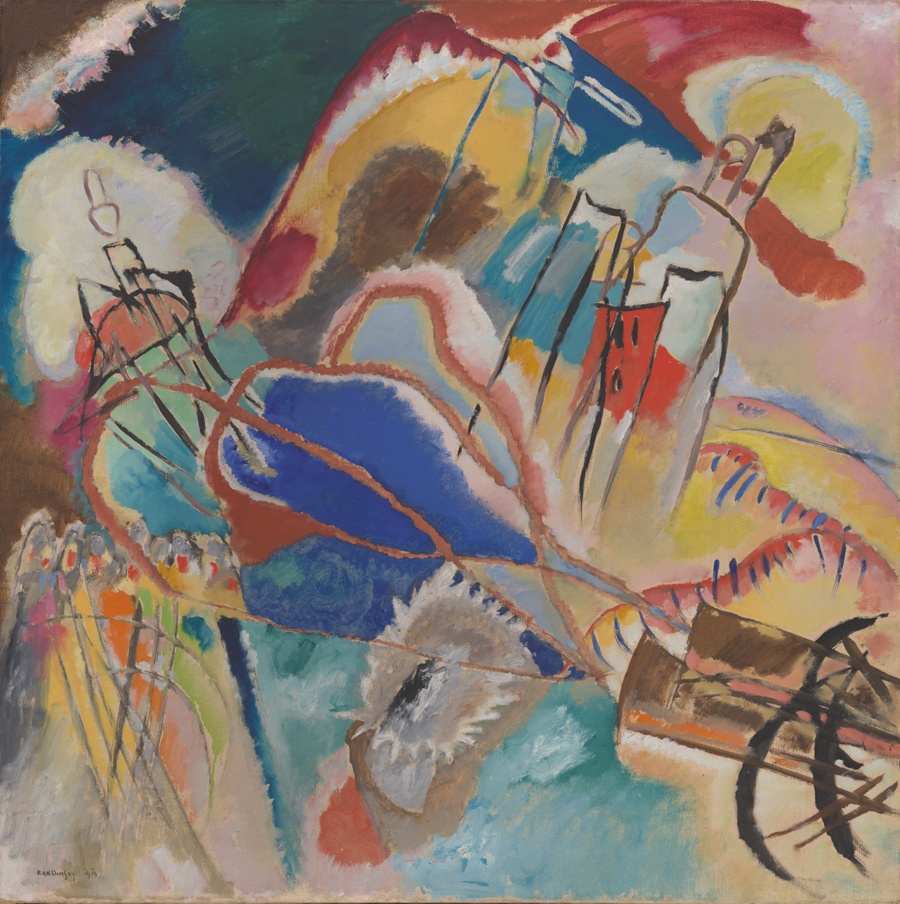
The force of a woodcut line differs from the saturated surface of a painting. Posters, prints, and stage design helped charged images reach audiences outside the private studio. A stark lithograph of The Scream draws its force from dark line and repeated bands, while an oil painting by Kandinsky can make color relations seem to move across the surface. A print’s repeatability and a canvas’s physical presence create different encounters. Compare the edge of a mark in each image and then read the stated medium. The two processes let the artists press feeling into form by different means, even when a survey places both under one broad heading.
Improvisation No. 30 (Cannons) is recorded as oil on canvas. Kandinsky scatters energetic lines and color areas across the canvas. The title’s reference to cannons offers one route into the image, but its force comes from the movement of forms across the surface. Recognition and abstraction remain in conversation rather than resolving into one reading. This particular object makes material decisions easier to see than a list of stylistic traits does. Follow its source record for the stated medium and dimensions, then return to the image to notice where that process leaves its mark. A movement takes on more than one form because people worked with different tools, surfaces, and intended audiences.
How Expressionism reached viewers
Expressionist images circulated through exhibitions, journals, portfolios of prints, and artists’ groups in different cities. A woodcut’s sharp contrast and reproducibility could carry an urgent image to readers who would never see a painting. Munch’s print versions and Kandinsky’s shifting approach show that a subject could be reworked across media. These routes helped intensity become public, but they also make the term “Expressionism” too broad to explain any one artist’s choices.
Questions behind the label
The label risks treating every intense image as a private emotional confession. It is more useful to examine exhibitions, prints, shared ideas, and the social conditions that shaped who could make and see these works. The word “expression” can tempt us to treat a picture as a direct transcript of private emotion. A carefully composed line or color area is still an artistic choice, and an artist’s biography cannot settle every meaning. Munch’s versions of one subject and Kandinsky’s changing landscapes give evidence of sustained work, revision, and public communication. Look at what the image actually makes visible before supplying a diagnosis or a single emotional label.
Look closely with an actual work
The Scream (lithograph) offers one close-looking example. Munch recasts the familiar figure and wavering landscape in a stark black lithograph, revealing the subject as a series of related objects rather than one painting. The bridge rails drive sharply toward the foreground figure while two people remain distant behind. Munch sets the open mouth against bands of sky and water that seem to move around it. In this black lithograph the pressure comes from line and contrast, reminding us that the well-known subject exists in materially different versions. Place it beside Landscape with Two Poplars. Kandinsky makes two poplars part of a strongly colored landscape, revealing the route from observed scenery toward abstraction. Two poplars stand among strong bands of color and contour. Kandinsky keeps a visible landscape while pushing it toward a less literal arrangement. Their source records give dates, media, and collections that can be checked. Those facts do not decide what either image means, but they keep the comparison tied to actual objects. Notice one visual decision that the two works share and one that belongs to only one artist. The result may support the movement name, complicate it, or do both at once.
What came after Expressionism
Expressionist methods echo through theater, film, illustration, and later painting. A tilted street or charged color remains a way to ask how an external world can be pictured through human experience. Later accounts of Expressionism often favor a few dramatic works and may fold separate groups into one story. Munch’s prints and Kandinsky’s experiments traveled through reproductions that changed their scale and surface. Their influence is real, but it cannot be traced from a familiar motif alone. The exact object, its medium, and the audience it first addressed make a firmer starting point for understanding why its intensity lasted.