A life across painting and print
Edvard Munch used painting and printmaking to explore anxiety, love, illness, and the uncertainty of modern life. Raised in Norway, he developed recurring motifs rather than treating each image as an isolated event. The Scream is the most reproduced, but his career also includes portraits, landscapes, and long cycles of images about relationships and loss. Edvard Munch (1863–1944) worked in Norway. Illness and loss marked Munch’s family life, but his images grew within an active artistic network rather than in isolation. He studied in Kristiania, spent time in Paris and Berlin, and developed subjects that could be repeated across paintings and prints. Place and period are more than background here. In the works below, Edvard Munch turns the conditions of a working life into decisions about image and material.
Lines of emotional pressure
A wavering line or compressed space can make a setting feel unsettled. In printmaking, Munch used the resistance of a plate, stone, or block as part of the image rather than merely transferring a painted idea. The linked objects make this process tangible. Begin with The Scream (lithograph), then follow a change of subject or medium to see how Edvard Munch adjusted the approach.
Images that return in new forms
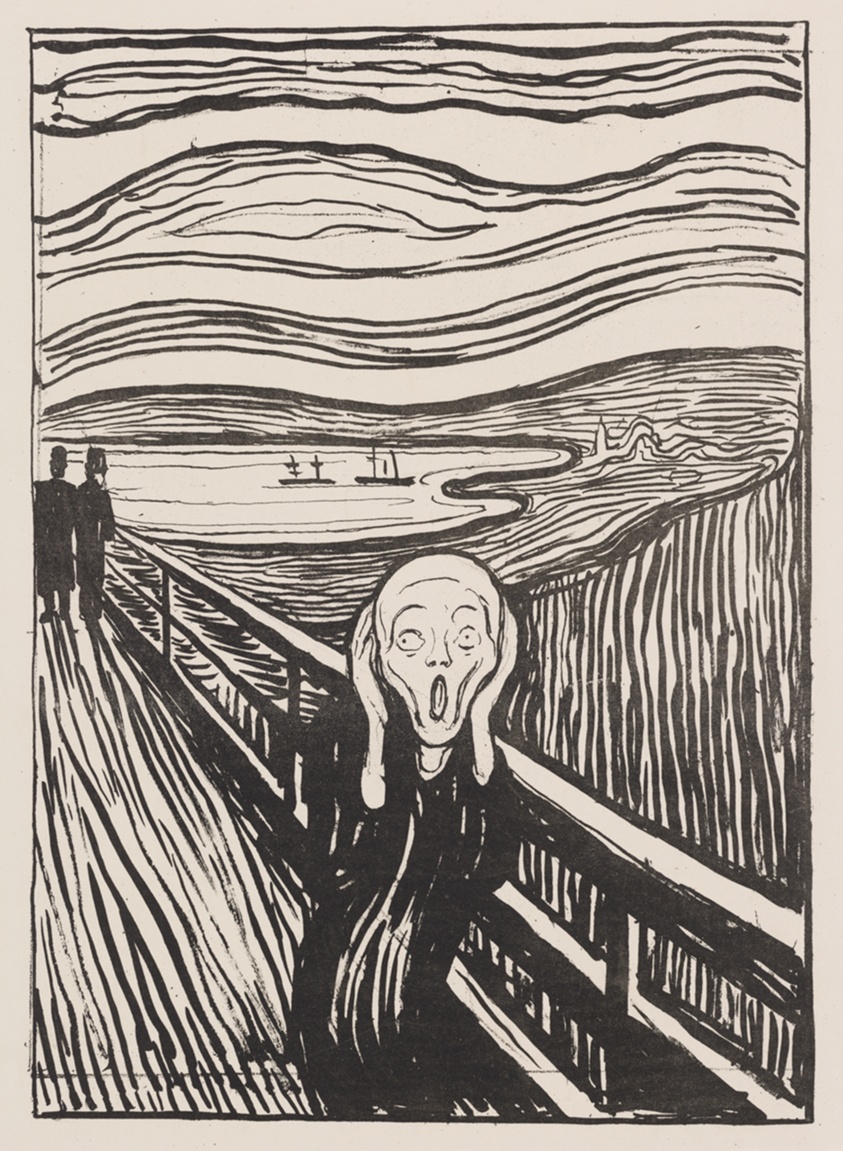
The Scream exists in several versions and media. The black lithograph in this atlas makes its figure, bridge, distant people, and rolling landscape legible through line alone, changing the effect of a subject often remembered in color. A project can move through studies, changes of material, and new audiences before it becomes the image later viewers remember. The Scream (lithograph) belongs to that working life. Its medium and scale set limits as well as opportunities for Edvard Munch. Compare it with a second object below and watch for a different solution to a related visual problem. The contrast brings the maker’s ongoing work into view more clearly than a summary of celebrated achievements.
Expressionism and its limits
Edvard Munch is associated with Expressionism. Expressionist artists used distortion and intense color to make inner experience visible. The term covers several groups and places rather than a neat unified style. Portraits, landscapes, and city scenes could all become charged with unease, urgency, or joy. Artists working near one another do not make identical demands on an image. The period associated with Edvard Munch brought particular materials and audiences into reach, but The Scream (lithograph) remains a singular object. Compare its viewpoint and surface with a second maker’s work. You may find an artistic conversation, a disagreement, or simply two different uses of the same medium. The movement is most illuminating when those distinctions remain intact.
A closer look at The Scream (lithograph)
Munch recasts the familiar figure and wavering landscape in a stark black lithograph, revealing the subject as a series of related objects rather than one painting. The bridge rails drive sharply toward the foreground figure while two people remain distant behind. Munch sets the open mouth against bands of sky and water that seem to move around it. In this black lithograph the pressure comes from line and contrast, reminding us that the well-known subject exists in materially different versions. Now set it beside The Girl by the Window. Munch places a solitary girl near a window, using an interior to explore distance between a figure and the outside world. The girl stands near a window but seems held within a dim room. Munch makes the boundary between interior and outside world emotionally charged. Both works are linked below this profile, with their own object records and images. They reward comparison because they show Edvard Munch making different decisions, sometimes with a different material, even when a familiar concern carries across the two.
Munch beyond The Scream
Munch returned to the same composition in different media, changing what a subject could express through color, line, and texture. His print of The Scream shows that the familiar image is not a single painting: it is an idea worked through distinct objects. His achievement is broader than a symbol of fear, and it asks how a public image can carry private feeling. Its fame can shrink his work to a single expression of anxiety. The longer career also includes intimate portraits and repeated images of love, separation, and the natural world. A third work, Two Women on the Shore, complicates any account built from a single celebrated picture. Munch joins two women and a shoreline in a multi-block woodcut, making mood and relationship depend on simplified color and form. Two women share a shoreline yet remain distinct in color and posture. Munch uses the woodcut's separate blocks to make the relationship feel stark and open-ended. This object has its own subject and material even when it is placed within a celebrated career. That specificity keeps the later story of Edvard Munch honest.
The Scream in lithographic form makes a famous subject depend on black line instead of painted color. The Girl by the Window uses a dim room to hold emotional distance, while Two Women on the Shore simplifies a relationship through the demands of woodcut. These works demonstrate why Munch returned to printmaking. A change of process could sharpen, quiet, or remake the feeling of an image.
Explore Expressionism ↗
