
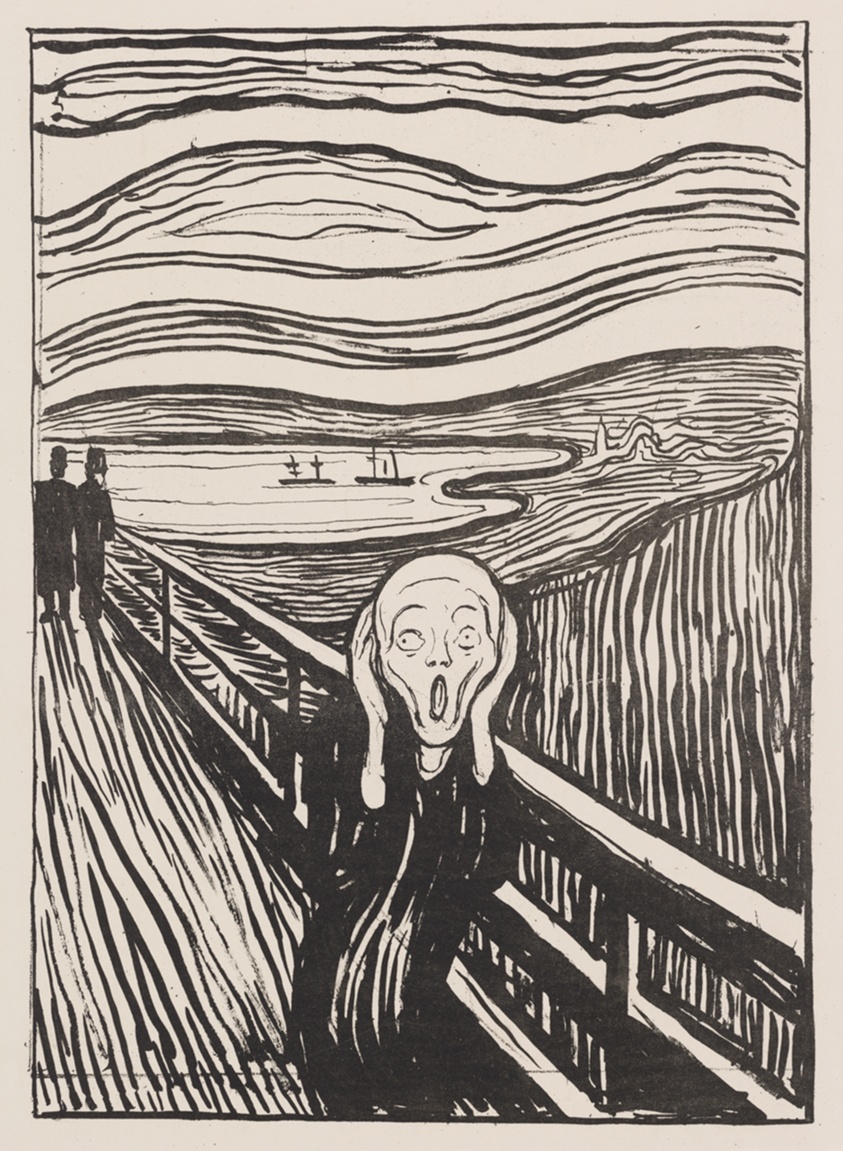
The Scream (lithograph) in its time
Munch recasts the familiar figure and wavering landscape in a stark black lithograph, revealing the subject as a series of related objects rather than one painting. The Scream (lithograph) is dated 1895 and is held by Art Institute of Chicago. The source record names it “The Scream.” The source tells us which object this is. Looking at The Scream (lithograph) reveals decisions that no short catalogue line could contain.
Inside the composition
The bridge rails drive sharply toward the foreground figure while two people remain distant behind. Munch sets the open mouth against bands of sky and water that seem to move around it. In this black lithograph the pressure comes from line and contrast, reminding us that the well-known subject exists in materially different versions. A first glance at The Scream (lithograph) may be drawn to its subject. Look again at the spaces around that subject. Their proportions and pauses give the visible forms a particular pace.
How it was made
The collection records The Scream (lithograph) as lithograph in black ink on cream card. In The Scream (lithograph), materials help determine how marks could be laid down and how the result met its first viewers. The collection entry describes the surface on which those choices were made. In The Scream (lithograph), process and appearance meet; the materials in the record help explain what kind of surface carried these choices. Compare The Scream (lithograph) with another work by the artist. Its medium and size can help explain why the two works meet the eye differently.
Edvard Munch and this work
Edvard Munch used painting and printmaking to explore anxiety, love, illness, and the uncertainty of modern life. Raised in Norway, he developed recurring motifs rather than treating each image as an isolated event. The Scream is the most reproduced, but his career also includes portraits, landscapes, and long cycles of images about relationships and loss. Black line carries much of the pressure that color supplies in other versions of The Scream. The familiar open mouth belongs here to a particular printed object with its own contrast and reach. For Edvard Munch, The Scream (lithograph) brought a subject into contact with a chosen material. The career gives context to the object; the object can also complicate the familiar account of the career. Another image by the same maker may use a related method toward another end, or change the method altogether. Another work from the same career may answer those questions differently. The pace of The Scream (lithograph) deserves attention; another work by Edvard Munch may move the eye quite differently. The other works linked from Edvard Munch’s profile give The Scream (lithograph) a useful company: their differences make this image more specific.
The world around The Scream (lithograph)
Illness and loss marked Munch’s family life, but his images grew within an active artistic network rather than in isolation. He studied in Kristiania, spent time in Paris and Berlin, and developed subjects that could be repeated across paintings and prints. The date attached to The Scream (lithograph), 1895, is more than a period marker. It places the work among the people and circumstances in which its first audience could encounter it. With The Scream (lithograph), the source entry anchors attribution and materials; it does not settle every possible reading of the work.
Image and object record
Art Institute of Chicago identifies The Scream (lithograph) as a work by Edvard Munch from 1895 and records its medium as lithograph in black ink on cream card. The collection credits the object to Clarence Buckingham Collection. Follow the linked object record for its catalogue entry and any further notes on its history.

