
Two Women on the Shore in its time
Munch joins two women and a shoreline in a multi-block woodcut, making mood and relationship depend on simplified color and form. Two Women on the Shore is dated 1898 and is held by Art Institute of Chicago. The source record names it “Two Women on the Shore.” The listed facts locate Two Women on the Shore in history, while its visible choices give the viewer something to discover directly.
Where the eye settles
Two women share a shoreline yet remain distinct in color and posture. Munch uses the woodcut's separate blocks to make the relationship feel stark and open-ended. In Two Women on the Shore, compare the most firmly defined passage with one left open. The contrast can be a way to direct attention, or a trace of the artist testing how much description the image needs.
The surface of the work
The collection records Two Women on the Shore as woodcut printed from one block (sawn into three sections) in dark blue, green, black and red-brown ink with additions in green crayon on cream japanese paper. The medium recorded for Two Women on the Shore gives this image a physical scale and process. A screen can show its design, while the source record preserves what is known of the object itself. Looking at Two Women on the Shore as an object means asking what the listed materials allow the artist to revise, repeat, or leave visible. Return to the image of Two Women on the Shore for the arrangement of forms, then use the source link to learn what kind of object carries them.
Edvard Munch and this work
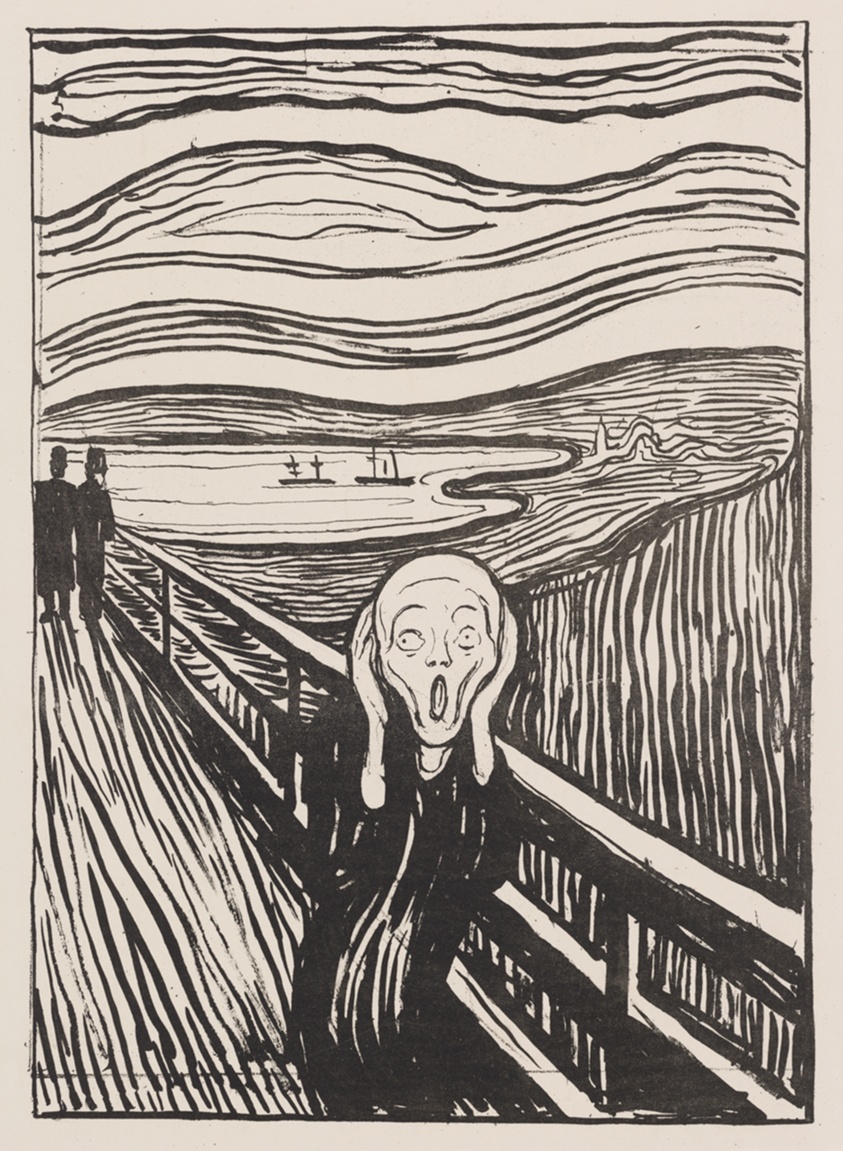
The Scream exists in several versions and media. The black lithograph in this atlas makes its figure, bridge, distant people, and rolling landscape legible through line alone, changing the effect of a subject often remembered in color. The two figures occupy one shore without merging into one mood. Munch’s simplified colored blocks keep their relationship stark and unresolved. The questions raised by Two Women on the Shore may also appear elsewhere in Edvard Munch’s work, but the material object cannot be replaced by that comparison. That combination matters more than a quick description of the artist’s usual style. Its subject, medium, and visible emphasis may seem consistent with other works, or they may reveal a different route. Notice which visual problem seems newly urgent here, and which one the artist has approached before. A career story should follow actual pictures and the changes between them, not a legend of inevitable progress. The choices visible in Two Women on the Shore make one part of Edvard Munch’s career tangible without reducing that career to a single signature look.
The world around Two Women on the Shore
Its fame can shrink his work to a single expression of anxiety. The longer career also includes intimate portraits and repeated images of love, separation, and the natural world. The world of 1898 was the first setting for Two Women on the Shore. Its later life in collections and reproductions has changed how easily, and how often, people see it. The image of Two Women on the Shore and its source record belong together: one offers a close view, the other identifies the object and its material.
Image and object record
Art Institute of Chicago identifies Two Women on the Shore as a work by Edvard Munch from 1898 and records its medium as woodcut printed from one block (sawn into three sections) in dark blue, green, black and red-brown ink with additions in green crayon on cream japanese paper. The collection credits the object to Clarence Buckingham Collection. Follow the linked object record for its catalogue entry and any further notes on its history.