
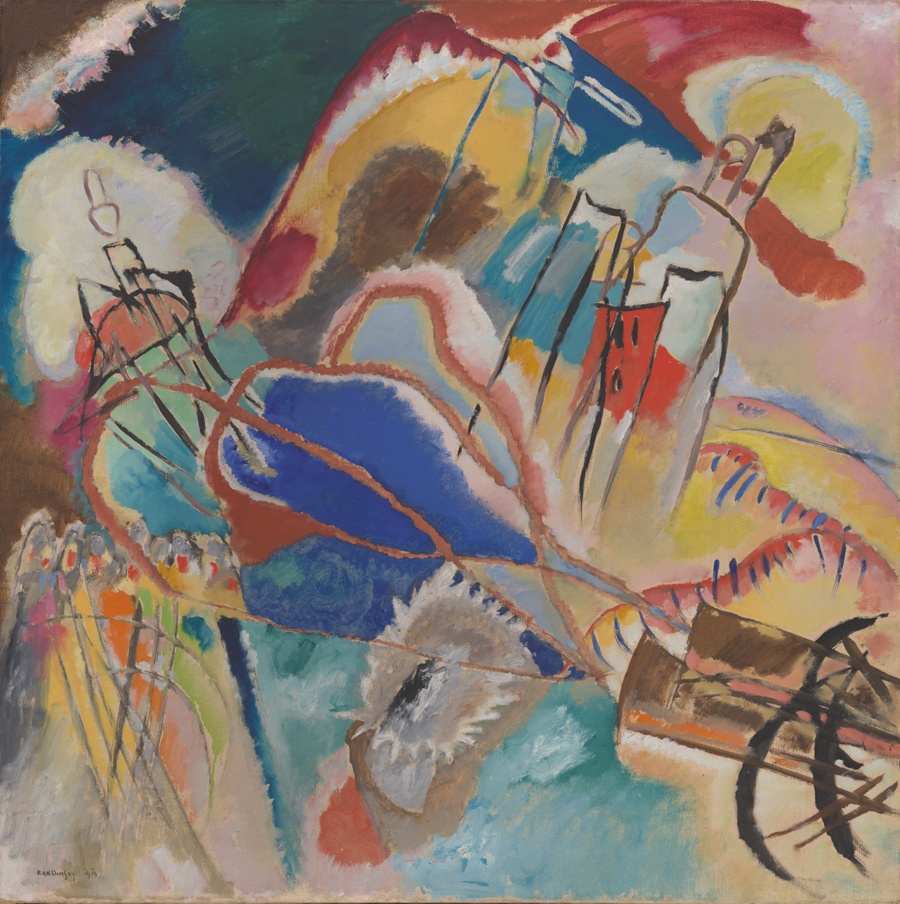
Improvisation No. 30 (Cannons) in its time
Kandinsky sets colored forms in motion while the title hints at cannons beneath the picture's abstract energy. Improvisation No. 30 (Cannons) is dated 1913 and is held by Art Institute of Chicago. The source record names it “Improvisation No. 30 (Cannons).” These details make Improvisation No. 30 (Cannons) traceable to a collection, and they leave room for a closer encounter with the image.
A closer view
Kandinsky scatters energetic lines and color areas across the canvas. The title’s reference to cannons offers one route into the image, but its force comes from the movement of forms across the surface. Recognition and abstraction remain in conversation rather than resolving into one reading. Try reading Improvisation No. 30 (Cannons) from its outer edge inward. The first feature you noticed may no longer dominate. Artists can distribute attention so that a picture unfolds gradually rather than all at once.
How it was made
The collection records Improvisation No. 30 (Cannons) as oil on canvas. The stated materials of Improvisation No. 30 (Cannons) limit what we can reasonably claim about its making. Follow the record for those details, then return to the image to look for their visible effects. The source record for Improvisation No. 30 (Cannons) preserves the medium as well as the subject. Both matter when looking closely at an historical object. The image of Improvisation No. 30 (Cannons) can be enlarged and revisited here. The linked record keeps that view connected to a particular historical object.
Wassily Kandinsky and this work
Kandinsky argued that color and form could communicate without depicting a recognizable subject. His paintings moved from vivid landscapes toward increasingly independent shapes and lines. The title offers a hint of conflict, but the lines and colored shapes do not settle into an illustrated battle. Kandinsky keeps recognition in play while allowing movement across the canvas to carry the experience. In Improvisation No. 30 (Cannons), the viewer meets a work rather than a shorthand for Wassily Kandinsky. That combination matters more than a quick description of the artist’s usual style. Its subject, medium, and visible emphasis may seem consistent with other works, or they may reveal a different route. Ask what this subject allowed the artist to test here and which decisions depend on its particular size or material. A biography becomes more convincing when actual objects are allowed to disagree with a tidy summary. Improvisation No. 30 (Cannons) carries its own subject and process. Following Wassily Kandinsky into another work makes the wider practice easier to see.
The world around Improvisation No. 30 (Cannons)
Kandinsky worked within networks in Munich and later taught at the Bauhaus. His move toward nonrepresentational painting was gradual and involved theory, exhibition, and collaboration. In 1913, Improvisation No. 30 (Cannons) belonged to a world of particular makers, patrons, buyers, or readers. The record can identify the object even where those encounters are harder to recover. The collection facts attached to Improvisation No. 30 (Cannons) are worth following, especially where the image leaves its original setting hard to recover.
Image and object record
Art Institute of Chicago identifies Improvisation No. 30 (Cannons) as a work by Wassily Kandinsky from 1913 and records its medium as oil on canvas. The collection credits the object to Arthur Jerome Eddy Memorial Collection. Follow the linked object record for its catalogue entry and any further notes on its history.

