
Landscape with Two Poplars in its time
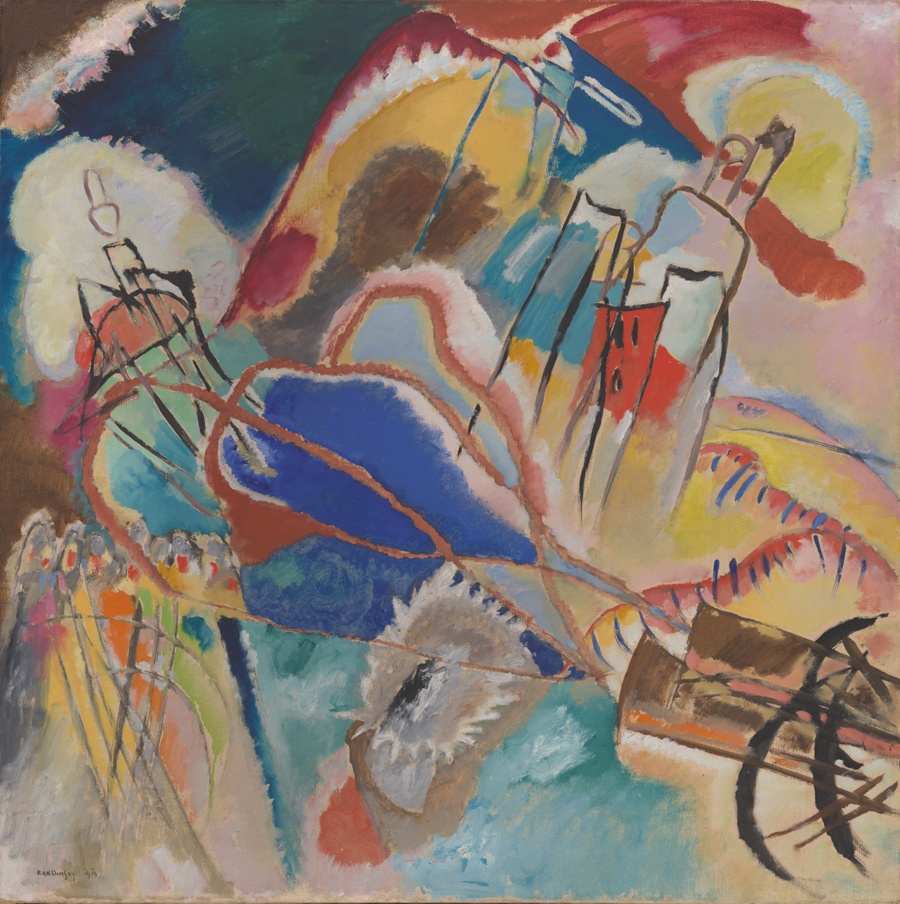
Kandinsky makes two poplars part of a strongly colored landscape, revealing the route from observed scenery toward abstraction. Landscape with Two Poplars is dated 1912 and is held by Art Institute of Chicago. The source record names it “Landscape with Two Poplars.” The source tells us which object this is. Looking at Landscape with Two Poplars reveals decisions that no short catalogue line could contain.
Inside the composition
Two poplars stand among strong bands of color and contour. Kandinsky keeps a visible landscape while pushing it toward a less literal arrangement. A first glance at Landscape with Two Poplars may be drawn to its subject. Look again at the spaces around that subject. Their proportions and pauses give the visible forms a particular pace.
The surface of the work
The collection records Landscape with Two Poplars as oil on canvas. Lines and colors can suggest pressure, direction, or sound without illustrating a named object. His writing proposes analogies with music, though a painting need not be decoded like a score. In Landscape with Two Poplars, process and appearance meet; the materials in the record help explain what kind of surface carried these choices. Compare Landscape with Two Poplars with another work by the artist. Its medium and size can help explain why the two works meet the eye differently.
Wassily Kandinsky and this work
Teaching at the Bauhaus gave his ideas a new setting. Although his theories linked visual art and music, the paintings remain open to viewers who simply follow their shifting weight, motion, and color. The poplars keep a recognizable landscape in view while color pushes the scene toward a less literal order. Kandinsky’s later abstraction has a visible path through pictures like this one. For Wassily Kandinsky, Landscape with Two Poplars brought a subject into contact with a chosen material. The picture may look effortless at first; its organization asks how forms, marks, and empty areas were made to work together. Another image by the same maker may use a related method toward another end, or change the method altogether. Those shifts are easier to recognize when the works are treated as objects with dates and materials. Its differences from nearby works are worth noticing; they restore a little of the uncertainty and invention within the practice. The other works linked from Wassily Kandinsky’s profile give Landscape with Two Poplars a useful company: their differences make this image more specific.
The world around Landscape with Two Poplars
The date 1912 places Landscape with Two Poplars within a particular career and set of viewers. The source link supplies the documented object details; the image still keeps some of that encounter open. The date attached to Landscape with Two Poplars, 1912, is more than a period marker. It places the work among the people and circumstances in which its first audience could encounter it. With Landscape with Two Poplars, the source entry anchors attribution and materials; it does not settle every possible reading of the work.
Image and object record
Art Institute of Chicago identifies Landscape with Two Poplars as a work by Wassily Kandinsky from 1912 and records its medium as oil on canvas. The collection credits the object to Arthur Jerome Eddy Memorial Collection. Follow the linked object record for its catalogue entry and any further notes on its history.