
From landscape toward abstraction
Kandinsky argued that color and form could communicate without depicting a recognizable subject. His paintings moved from vivid landscapes toward increasingly independent shapes and lines. Wassily Kandinsky (1866–1944) worked in Russia and Germany and France. Kandinsky worked within networks in Munich and later taught at the Bauhaus. His move toward nonrepresentational painting was gradual and involved theory, exhibition, and collaboration. The works gathered below bring this setting into view through their subjects and materials. They offer several entrances to Wassily Kandinsky’s career rather than one defining image.
Color as a moving force
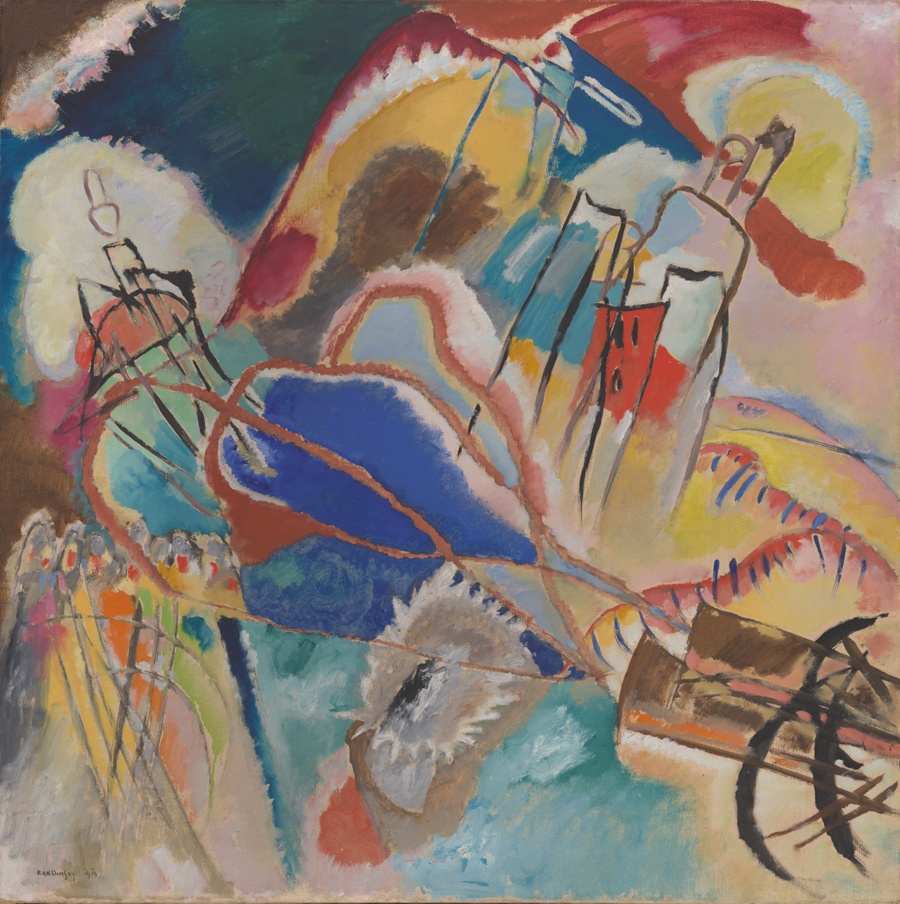
Lines and colors can suggest pressure, direction, or sound without illustrating a named object. His writing proposes analogies with music, though a painting need not be decoded like a score. In Improvisation No. 30 (Cannons), that approach meets a particular subject. A second work can show whether the same visual concern changed when Wassily Kandinsky worked with another material or audience.
Improvisations and experiments
Improvisation and Composition were terms he used for different kinds of work. Later geometric paintings reveal a shift from turbulent movement toward more measured relationships. Those projects give a sense of sustained effort rather than one isolated flash of invention. Improvisation No. 30 (Cannons) offers a smaller, checkable place to study that effort. Notice how its subject has been arranged and what the material allows the artist to emphasize. Then turn to another work on this page. The change in scale, theme, or process may be modest, yet it tells us how Wassily Kandinsky kept testing possibilities across a career.
Abstraction and its limits
Wassily Kandinsky is associated with Abstraction. Abstraction reduces, transforms, or releases recognizable subjects so that line, color, shape, and material can lead. It is a broad field, from Kandinsky’s lyrical compositions to Mondrian’s measured grids and later color field painting. Looking closely reveals how distinct these approaches are. The label helps connect Wassily Kandinsky to other makers and institutions, but it does not decide what any one picture shows. Improvisation No. 30 (Cannons) gives us an object on which to test the history. Place it near a work by another artist from the same period; shared concerns may appear beside real differences of medium and audience. Those differences keep the movement useful as a map while leaving the artist’s own choices visible.
A closer look at Improvisation No. 30 (Cannons)
Kandinsky sets colored forms in motion while the title hints at cannons beneath the picture's abstract energy. Kandinsky scatters energetic lines and color areas across the canvas. The title’s reference to cannons offers one route into the image, but its force comes from the movement of forms across the surface. Recognition and abstraction remain in conversation rather than resolving into one reading. Now set it beside Landscape with Two Poplars. Kandinsky makes two poplars part of a strongly colored landscape, revealing the route from observed scenery toward abstraction. Two poplars stand among strong bands of color and contour. Kandinsky keeps a visible landscape while pushing it toward a less literal arrangement. Both works are linked below this profile, with their own object records and images. They reward comparison because they show Wassily Kandinsky making different decisions, sometimes with a different material, even when a familiar concern carries across the two.
The many paths into abstraction
Teaching at the Bauhaus gave his ideas a new setting. Although his theories linked visual art and music, the paintings remain open to viewers who simply follow their shifting weight, motion, and color. His place in abstraction is significant but not solitary. Other artists also questioned representation, and his theories are one way of approaching rather than closing the pictures. A third work, Painting with Green Center, complicates any account built from a single celebrated picture. Kandinsky lets arcs and color areas circle a green center, making relationships among forms the subject of the painting. Arcs and angled marks move around a green center without settling into an ordinary scene. The work lets the eye register force, pause, and contrast as subjects in themselves. The third work keeps the career from collapsing into one familiar example. Later reputation can simplify an artist; the objects restore its changes and uncertainties.
Landscape with Two Poplars still offers trees to recognize. Painting with Green Center asks the viewer to follow shapes without a familiar scene, and Improvisation No. 30 lets its title hint at cannons within an energetic surface. The movement between these works was not a simple decision to stop observing the world. Kandinsky kept finding new ways for line and color to carry a sense of action.
Explore Abstraction ↗
