Painting with Green Center in its time
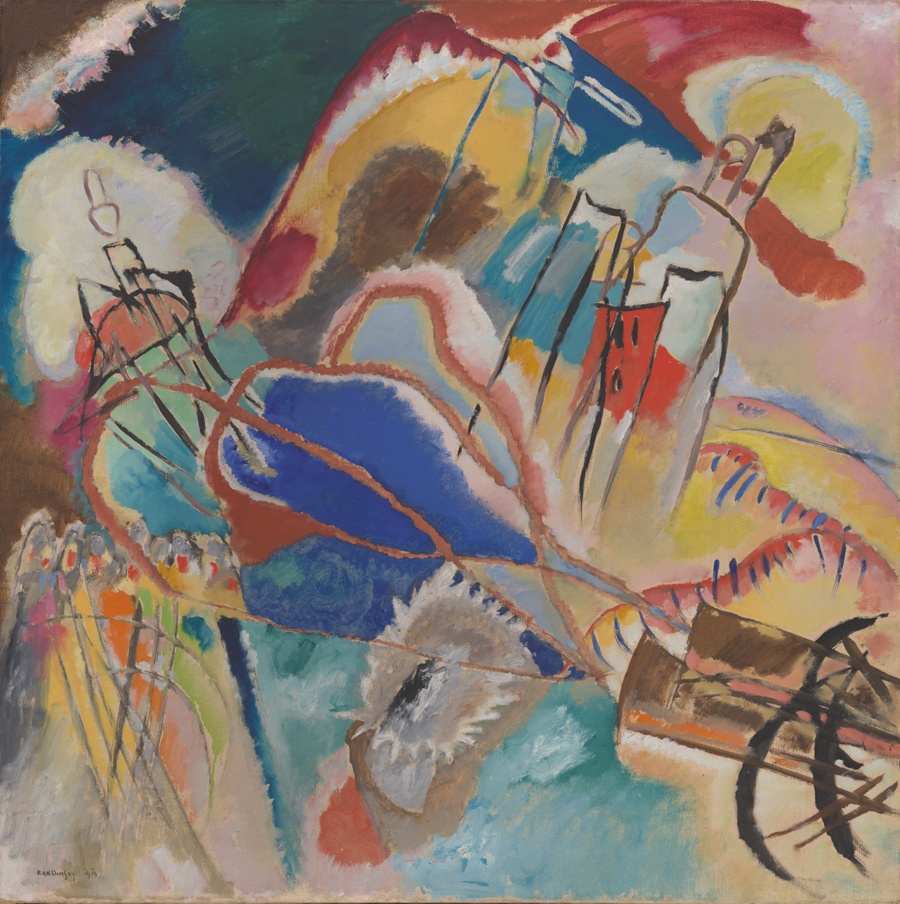
Kandinsky lets arcs and color areas circle a green center, making relationships among forms the subject of the painting. Painting with Green Center is dated 1913 and is held by Art Institute of Chicago. The source record names it “Painting with Green Center.” These details make Painting with Green Center traceable to a collection, and they leave room for a closer encounter with the image.
The choices in the image
Arcs and angled marks move around a green center without settling into an ordinary scene. The work lets the eye register force, pause, and contrast as subjects in themselves. The strength of Painting with Green Center is partly in what it asks us to connect. A gesture, shape, or patch of color can answer another elsewhere in the image. Trace one such connection before deciding what the scene means.
How it was made
The collection records Painting with Green Center as oil on canvas. The medium of Painting with Green Center belongs in the story because a drawing, print, and painting offer different routes from a maker’s hand to a viewer. The linked record names this one precisely. The source record for Painting with Green Center preserves the medium as well as the subject. Both matter when looking closely at an historical object. The image of Painting with Green Center can be enlarged and revisited here. The linked record keeps that view connected to a particular historical object.
Wassily Kandinsky and this work
Improvisation and Composition were terms he used for different kinds of work. Later geometric paintings reveal a shift from turbulent movement toward more measured relationships. The green center is an anchor, but the arcs and angled marks refuse to sit still around it. Kandinsky makes the movement between forms the painting’s event. Looking at Painting with Green Center within Wassily Kandinsky’s larger body of work can be useful, but the relationship runs in both directions. A subject can be revisited without producing the same picture twice: scale, material, and audience all alter the problem. Its subject, medium, and visible emphasis may seem consistent with other works, or they may reveal a different route. The present work has its own conditions of making, documented in the record linked beside it. Each work had its own audience and task, and each can change the story we tell about the career. Painting with Green Center carries its own subject and process. Following Wassily Kandinsky into another work makes the wider practice easier to see.
The world around Painting with Green Center
His place in abstraction is significant but not solitary. Other artists also questioned representation, and his theories are one way of approaching rather than closing the pictures. In 1913, Painting with Green Center belonged to a world of particular makers, patrons, buyers, or readers. The record can identify the object even where those encounters are harder to recover. The collection facts attached to Painting with Green Center are worth following, especially where the image leaves its original setting hard to recover.
Image and object record
Art Institute of Chicago identifies Painting with Green Center as a work by Wassily Kandinsky from 1913 and records its medium as oil on canvas. The collection credits the object to Arthur Jerome Eddy Memorial Collection. Follow the linked object record for its catalogue entry and any further notes on its history.