The many beginnings of the Renaissance
New ways of studying the human body, perspective, and classical antiquity reshaped art in European cities. The period was not a single style: Florence, Venice, Rome, and northern Europe pursued different solutions. Workshops and patrons were crucial to production, and artists increasingly claimed an intellectual status for their work. The usual period given for Renaissance is c. 1400–1600, but dates are guides to overlapping activity rather than firm doors that opened and shut everywhere at once. The term groups artists for the convenience of discussion. It cannot explain a work before we have looked at that work. A useful first move is to ask what problem the name makes visible: a new audience, a disputed subject, a way of organizing space, or a change in what artists thought images could do. Only then can we decide how well a particular painting, print, or design belongs within the account.
The world around the work
The term covers overlapping changes rather than a single rebirth on one date. Italian city-states, northern trading centers, church institutions, and courts offered different kinds of patronage. Ancient texts and objects were studied alongside inherited Christian imagery, so new classical interests rarely replaced older purposes outright. In Florence, a painter could learn by preparing panels, drawing from models, and observing older masters in a busy workshop. The same career might involve devotional images for churches, portraits for households, and designs for patrons who wanted to display learning as well as wealth. Leonardo’s studies and Botticelli’s paintings came out of that environment in different ways. One leaves us visible tests and revisions; the other often gives carefully ordered figures a graceful continuity. Neither can stand for every place or maker grouped under the Renaissance.
Perspective, bodies, and belief
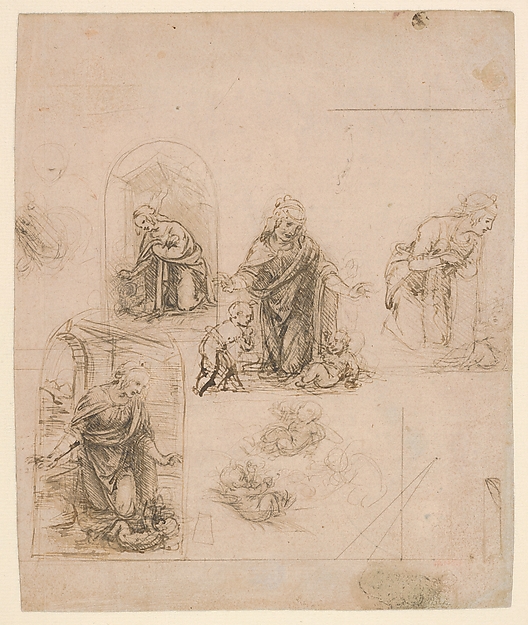
Linear perspective offered one way to organize imagined depth, but it was never the whole of Renaissance art. Painters also tested anatomy, oil painting, atmospheric distance, and the expressive possibilities of line. A convincing body might share a picture with an impossible ideal landscape. Studies for the Virgin Adoring the Christ Child makes these choices visible in a particular object. Its own composition, medium, and subject offer a more useful test of the movement than a checklist of traits. Compare it with another work in this guide and the differences in scale or handling begin to matter as much as the resemblance.
Workshops behind the masterpieces
Leonardo used observation to make figures psychologically present; Botticelli gave line and myth an unusually poetic force. Their differences matter more than a checklist of period features. In northern Europe, attention to surface and domestic detail could answer related questions by different means. Among the names readers may encounter are Leonardo da Vinci, Sandro Botticelli. Such lists help us begin, yet they can imply that artists acted as a single mind. A closer view reveals individual training, friendships, rivalries, access, and ambition. Two works made in the same decade may disagree about what an image owes its viewer. That disagreement is not a problem for the history; it is evidence that the label names a live conversation. Follow one artist into another period and the edges of the category become clearer still.
Artists within Renaissance
Leonardo moved between painting, engineering, anatomy, and theater with an unusual appetite for observation. Trained in Florence, he spent much of his career at the Sforza court in Milan before returning to Florence and later working in France. His surviving paintings are few, yet their delicate transitions of light and expression changed the possibilities of portraiture. Soft transitions between light and shadow let faces seem to change as we look. His drawings of anatomy, flowing water, and machinery show sustained inquiry, though a notebook page should not be mistaken for a completed invention. Studies for the Virgin Adoring the Christ Child gives that practice a concrete form. The sheet brings devotional figures and a perspective exercise into the same working space. It offers an unusually direct view of Leonardo testing positions and relationships before a final composition existed. The marks matter as traces of thought, not merely as preparation for a better-known painting.
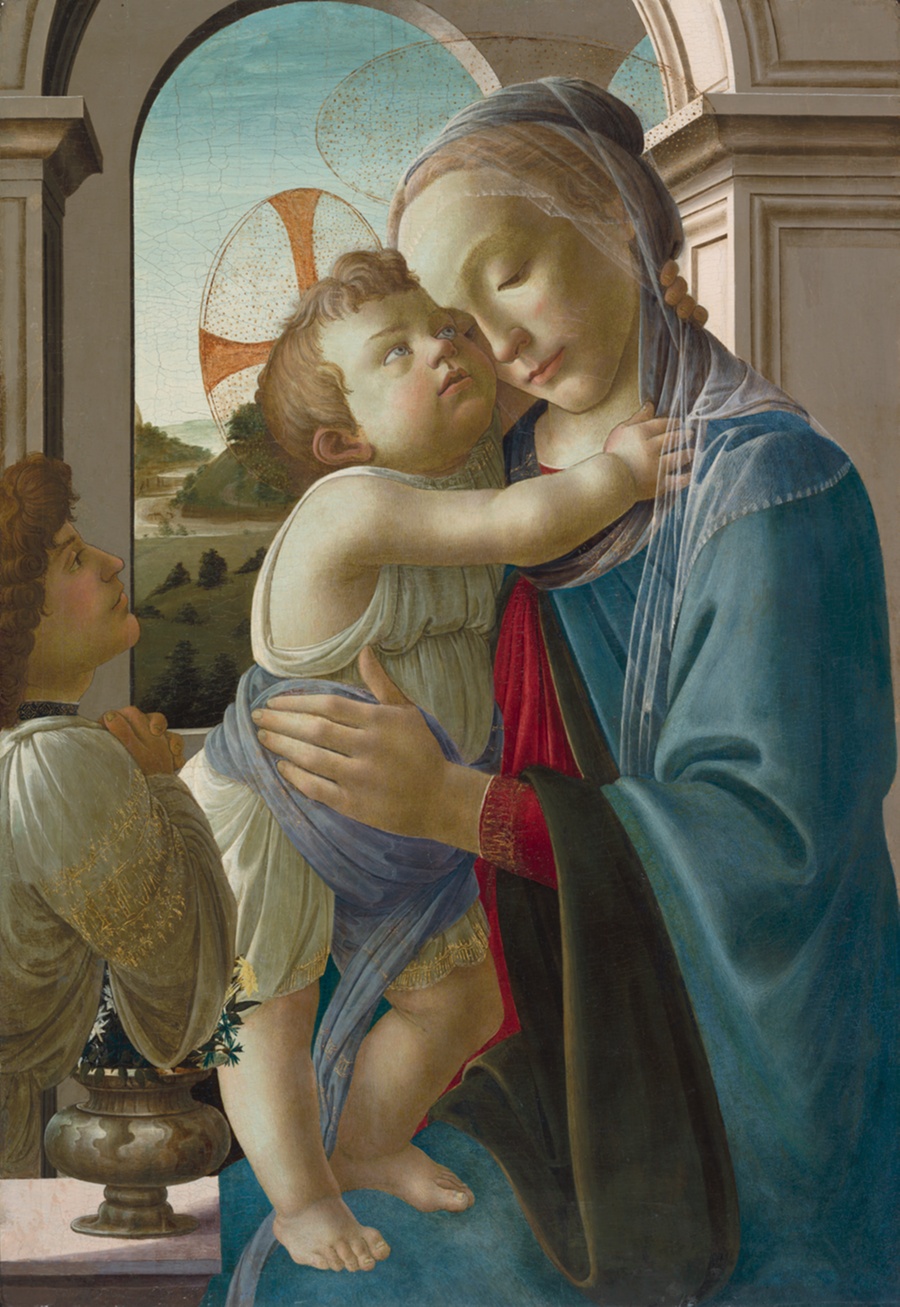
Botticelli gave Renaissance Florence an unmistakable language of graceful contours and poetic figures. Working for patrons connected to the Medici, he painted religious scenes and mythological subjects in which movement travels through hair, drapery, and line. Line does unusually heavy work in his paintings. Hair, hands, drapery, and the borders of figures establish a graceful rhythm even where convincing depth is less important than poetic clarity. Virgin and Child with an Angel gives that practice a concrete form. Botticelli binds the figures through a continuous rhythm of heads, hands, and folded fabric. Their closeness gives the sacred subject a tender human scale, while the deliberate contours keep the group formally poised. The painting invites attention to how feeling is carried by the movement of a line.
Workshop apprentices, patrons, model makers, and material suppliers were part of production. The familiar tale of isolated masters underplays their labor. It also underplays women, who faced restricted training and commissions, and the way wealth and power determined which images survived. The artists shown in this guide offer a starting point, not a complete roll call. The surviving objects and records have their own uneven histories: some were preserved and studied closely, while others disappeared from view. That imbalance is one reason to keep looking beyond a short list of celebrated names.
Renaissance in different materials
A fresco fixed pigment into a wall, a panel invited close viewing, and a print could carry a design well beyond the workshop that made it. Oil and tempera produced different surfaces and opportunities for revision. A silverpoint drawing does not behave like tempera on a panel. Leonardo’s ruled lines and revised figures show a hand working through spatial problems on paper, while Botticelli’s layered color and contour belong to a more settled painted surface. That difference changes what a viewer can infer about process. A workshop might also move a design between drawing, panel, and larger commission, with assistants taking part at several stages. The finished image can hide those passages, so surviving studies are especially valuable evidence of how an idea acquired form.
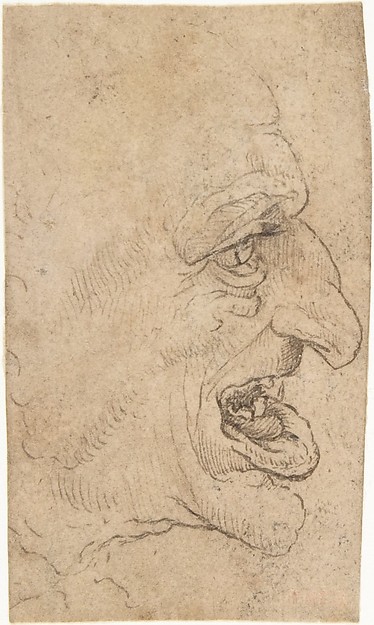
Head of the Virgin is recorded as black chalk, charcoal, and red chalk, with some traces of white chalk (?); some remains of framing lines in pen and brown ink at upper right (not by leonardo). Leonardo layers chalk around the downturned face and loose hair. The drawing's unfinished state makes attention to an expression visible as a process. This particular object makes material decisions easier to see than a list of stylistic traits does. Follow its source record for the stated medium and dimensions, then return to the image to notice where that process leaves its mark. A movement takes on more than one form because people worked with different tools, surfaces, and intended audiences.
How Renaissance reached viewers
A Renaissance image might have been commissioned for a church, a household, or a ruler’s rooms. Workshop assistants could prepare grounds, copy designs, and carry out portions of a larger project. A painting made for an altar belonged to an active religious space before it became a museum object. Drawings traveled differently: they stayed in studios, moved among collectors, or survived as evidence of a problem being worked through. These paths explain why the setting and the maker’s hand are both part of the story.
Questions behind the label
Workshop apprentices, patrons, model makers, and material suppliers were part of production. The familiar tale of isolated masters underplays their labor. It also underplays women, who faced restricted training and commissions, and the way wealth and power determined which images survived. The familiar story of Renaissance innovation often centers a few named men and a sequence of breakthroughs. Such an account can obscure workshop collaborators, craftspeople who prepared materials, and patrons whose demands shaped the work. It can also treat Florence as though it spoke for all of Italy or Europe. Compare the object in front of you with another work from the period before making a claim about a universal Renaissance style. The differences of function, place, and medium may be as revealing as a shared interest in space or anatomy.
Look closely with an actual work
Studies for the Virgin Adoring the Christ Child offers one close-looking example. Leonardo tests a devotional group and a perspective diagram on one sheet, revealing how drawing carried thought between subjects. The sheet brings devotional figures and a perspective exercise into the same working space. It offers an unusually direct view of Leonardo testing positions and relationships before a final composition existed. The marks matter as traces of thought, not merely as preparation for a better-known painting. Place it beside Virgin and Child with an Angel. Botticelli places the Virgin, Child, and angel in a composition where graceful line gives religious feeling a delicate form. Botticelli binds the figures through a continuous rhythm of heads, hands, and folded fabric. Their closeness gives the sacred subject a tender human scale, while the deliberate contours keep the group formally poised. The painting invites attention to how feeling is carried by the movement of a line. Their source records give dates, media, and collections that can be checked. Those facts do not decide what either image means, but they keep the comparison tied to actual objects. Notice one visual decision that the two works share and one that belongs to only one artist. The result may support the movement name, complicate it, or do both at once.
What came after Renaissance
Later artists repeatedly returned to Renaissance perspective and the human figure, sometimes treating them as rules to obey and sometimes as conventions to challenge. The period is therefore a foundation for many later arguments, not a standard against which all art must be measured. Later generations made Leonardo and Botticelli into emblems of the period, but their reputations did not grow in the same way. Botticelli’s nineteenth-century revival gave new importance to pictures that earlier viewers had approached differently. Leonardo’s notebooks attracted modern attention to invention and unfinished thought. These afterlives change which images feel central to the Renaissance today. Returning to a specific sheet or panel keeps the history from shrinking into a story of inevitable progress.