
Virgin and Child with an Angel in its time
Botticelli places the Virgin, Child, and angel in a composition where graceful line gives religious feeling a delicate form. Virgin and Child with an Angel is dated 1475–85 and is held by Art Institute of Chicago. The source record names it “Virgin and Child with an Angel.” The listed facts locate Virgin and Child with an Angel in history, while its visible choices give the viewer something to discover directly.
The choices in the image
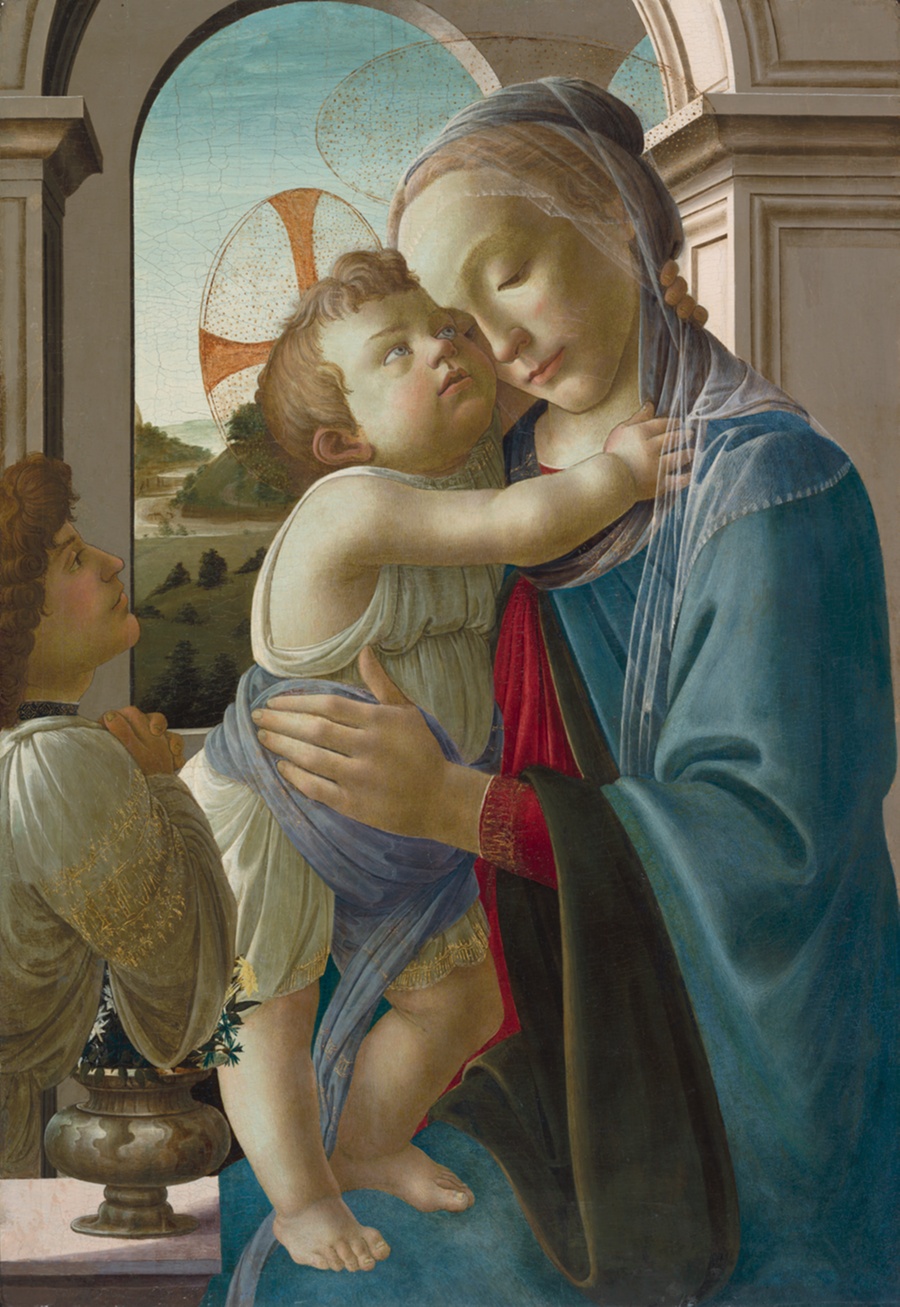
Botticelli binds the figures through a continuous rhythm of heads, hands, and folded fabric. Their closeness gives the sacred subject a tender human scale, while the deliberate contours keep the group formally poised. The painting invites attention to how feeling is carried by the movement of a line. The strength of Virgin and Child with an Angel is partly in what it asks us to connect. A gesture, shape, or patch of color can answer another elsewhere in the image. Trace one such connection before deciding what the scene means.
How it was made
The collection records Virgin and Child with an Angel as tempera on panel. The medium of Virgin and Child with an Angel belongs in the story because a drawing, print, and painting offer different routes from a maker’s hand to a viewer. The linked record names this one precisely. Looking at Virgin and Child with an Angel as an object means asking what the listed materials allow the artist to revise, repeat, or leave visible. Return to the image of Virgin and Child with an Angel for the arrangement of forms, then use the source link to learn what kind of object carries them.
Sandro Botticelli and this work
Botticelli gave Renaissance Florence an unmistakable language of graceful contours and poetic figures. Working for patrons connected to the Medici, he painted religious scenes and mythological subjects in which movement travels through hair, drapery, and line. The hands and tilted heads draw the three figures into a close circuit. Botticelli gives their affection a formal shape through contour, making the spaces between them as important as the sacred identities they carry. Looking at Virgin and Child with an Angel within Sandro Botticelli’s larger body of work can be useful, but the relationship runs in both directions. Virgin and Child with an Angel is valuable precisely because it gives that broad name a specific subject and set of visual choices. Its subject, medium, and visible emphasis may seem consistent with other works, or they may reveal a different route. Then follow another work by the artist and see whether a similar concern survives a change of subject. The pace of Virgin and Child with an Angel deserves attention; another work by Sandro Botticelli may move the eye quite differently. The choices visible in Virgin and Child with an Angel make one part of Sandro Botticelli’s career tangible without reducing that career to a single signature look.
The world around Virgin and Child with an Angel
Florence offered Botticelli a dense world of merchants, religious institutions, humanist reading, and Medici patronage. Those circles shaped the audience for both altarpieces and mythological pictures. The world of 1475–85 was the first setting for Virgin and Child with an Angel. Its later life in collections and reproductions has changed how easily, and how often, people see it. The image of Virgin and Child with an Angel and its source record belong together: one offers a close view, the other identifies the object and its material.
Image and object record
Art Institute of Chicago identifies Virgin and Child with an Angel as a work by Sandro Botticelli from 1475–85 and records its medium as tempera on panel. The collection credits the object to Max and Leola Epstein Collection. Follow the linked object record for its catalogue entry and any further notes on its history.

