
A painter in Medici Florence
Botticelli gave Renaissance Florence an unmistakable language of graceful contours and poetic figures. Working for patrons connected to the Medici, he painted religious scenes and mythological subjects in which movement travels through hair, drapery, and line. Sandro Botticelli (c. 1445–1510) worked in Italy. Florence offered Botticelli a dense world of merchants, religious institutions, humanist reading, and Medici patronage. Those circles shaped the audience for both altarpieces and mythological pictures. Follow the linked works to see how Sandro Botticelli moved among subjects and materials. They keep this life connected to objects someone made, used, preserved, and now studies.
The force of a line
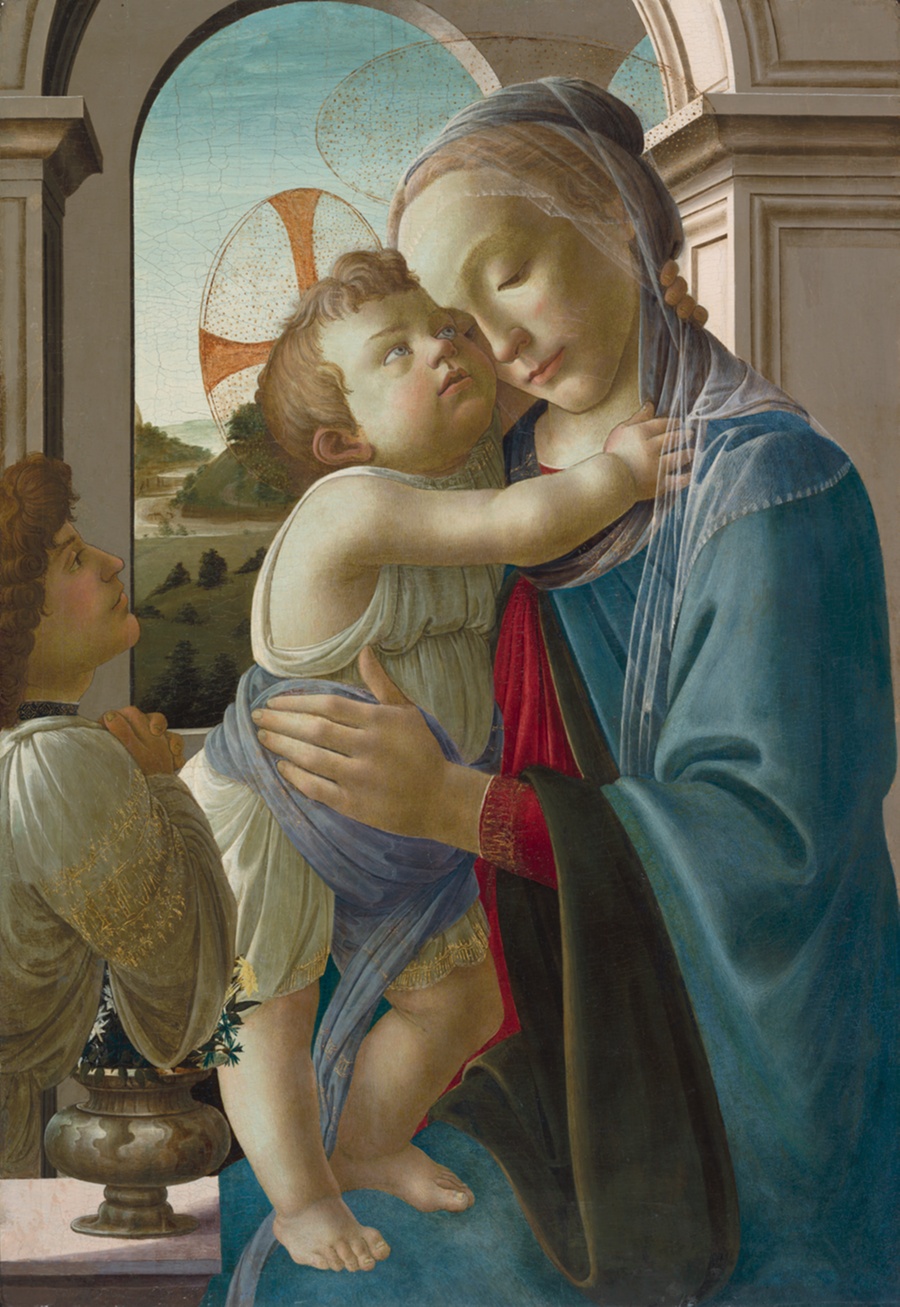
Line does unusually heavy work in his paintings. Hair, hands, drapery, and the borders of figures establish a graceful rhythm even where convincing depth is less important than poetic clarity. What appears fluent in Virgin and Child with an Angel was achieved through decisions about material and form. Other works by Sandro Botticelli let us see the same skill put to different uses.
Sacred and mythological worlds
Primavera and The Birth of Venus turn classical material into images with no simple modern translation. Their figures occupy imaginative settings rather than documentary reconstructions of an ancient world. A well-known project may have a strong place in art history, yet it is still a sequence of choices made by a working artist. Virgin and Child with an Angel lets us attend to one set of those choices. Watch how its subject fits the surface and how the image directs attention. The other linked works change the conversation: they may share a visual habit while pursuing a very different aim. Sandro Botticelli becomes easier to understand through that range.
Renaissance and its limits
Sandro Botticelli is associated with Renaissance. New ways of studying the human body, perspective, and classical antiquity reshaped art in European cities. The period was not a single style: Florence, Venice, Rome, and northern Europe pursued different solutions. Workshops and patrons were crucial to production, and artists increasingly claimed an intellectual status for their work. The category attached to Sandro Botticelli is one way to enter a crowded period. It can gather related questions without turning their answers into a uniform look. Follow Virgin and Child with an Angel from its subject to its materials, then ask what another artist of the time would have chosen differently. The object’s record and image provide a more reliable test than a list of stylistic traits alone.
A closer look at Virgin and Child with an Angel
Botticelli places the Virgin, Child, and angel in a composition where graceful line gives religious feeling a delicate form. Botticelli binds the figures through a continuous rhythm of heads, hands, and folded fabric. Their closeness gives the sacred subject a tender human scale, while the deliberate contours keep the group formally poised. The painting invites attention to how feeling is carried by the movement of a line. Now set it beside Madonna and Child with Two Angels. Botticelli gathers the Madonna, child, and two angels into a compact devotional image shaped by contour and gesture. The Madonna and child are brought close to two angels within a rounded format. Botticelli joins tenderness to a deliberate rhythm of heads and hands. Both works are linked below this profile, with their own object records and images. They reward comparison because they show Sandro Botticelli making different decisions, sometimes with a different material, even when a familiar concern carries across the two.
Botticelli rediscovered
The Birth of Venus and Primavera draw on classical stories, but their power lies in the tension between ideal beauty and earthly feeling. His reputation faded after his death and revived in the nineteenth century, when artists and writers responded to the dreamlike quality of his work. The nineteenth-century revival of his reputation tells us as much about later viewers as about Florence. He is often called ethereal, but the pictures are also precise constructions of movement and surface. A third work, The Coronation of the Virgin, complicates any account built from a single celebrated picture. Botticelli stages the Virgin's coronation across an open composition, joining sacred narrative to carefully ordered figures. Figures gather beneath a broad architectural setting as the Virgin receives her crown. Botticelli orders a crowded sacred subject through scale and gesture. A reputation is assembled after the work is made. This third object offers another angle on Sandro Botticelli, one that may unsettle a story built around a single masterpiece.
The Madonna and Child with Two Angels and The Coronation of the Virgin share a sacred subject but ask for different kinds of attention. A small group is bound by closely arranged hands and faces in one; the other orders a larger event through scale and gesture. Looking between them makes Botticelli’s graceful line feel less like a decorative signature and more like a means of deciding how people in an image belong together.
Explore Renaissance ↗
