From Verrocchio’s workshop
Leonardo moved between painting, engineering, anatomy, and theater with an unusual appetite for observation. Trained in Florence, he spent much of his career at the Sforza court in Milan before returning to Florence and later working in France. His surviving paintings are few, yet their delicate transitions of light and expression changed the possibilities of portraiture. Leonardo da Vinci (1452–1519) worked in Italy. An apprenticeship in the workshop of Andrea del Verrocchio placed Leonardo among painters, sculptors, and engineers before his long Milanese period. Court commissions made artistic invention answer practical as well as ceremonial needs. A life is easier to understand when its objects stay close. The linked works let Leonardo da Vinci’s choices appear in several forms, not only in a familiar story.
Drawing as investigation
Soft transitions between light and shadow let faces seem to change as we look. His drawings of anatomy, flowing water, and machinery show sustained inquiry, though a notebook page should not be mistaken for a completed invention. The method is visible in Studies for the Virgin Adoring the Christ Child, but it is worth looking at the other linked objects before calling it a fixed style. Leonardo da Vinci had room to revise a familiar solution.
Portraits and unfinished questions
The Last Supper makes a moment of speech visible through the different reactions of a group. In the Mona Lisa, the sitter’s expression and distant landscape resist the tidy certainty expected of a portrait. Look at the projects through the material objects that survive. Studies for the Virgin Adoring the Christ Child records one moment of making, not a complete account of Leonardo da Vinci’s intention. Its subject and visible form can be set beside the other works on this page. One may ask for close private attention; another may have been made to address a broader audience. Those conditions make the differences meaningful, even when a shared hand or concern remains easy to recognize.
Renaissance and its limits
Leonardo da Vinci is associated with Renaissance. New ways of studying the human body, perspective, and classical antiquity reshaped art in European cities. The period was not a single style: Florence, Venice, Rome, and northern Europe pursued different solutions. Workshops and patrons were crucial to production, and artists increasingly claimed an intellectual status for their work. Use the movement as a route into Leonardo da Vinci’s world, then allow Studies for the Virgin Adoring the Christ Child to complicate the route. The date and medium attach the work to a real moment of making. Its subject and arrangement may answer a shared question in a way no other artist chose. This is how a broad term can serve close looking without replacing it.
A closer look at Studies for the Virgin Adoring the Christ Child
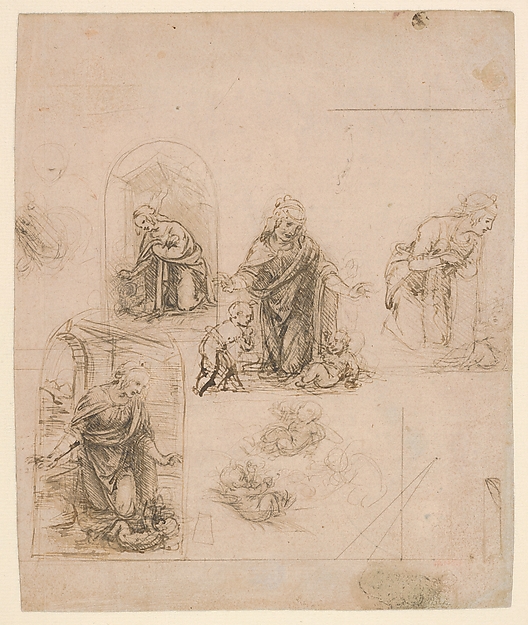
Leonardo tests a devotional group and a perspective diagram on one sheet, revealing how drawing carried thought between subjects. The sheet brings devotional figures and a perspective exercise into the same working space. It offers an unusually direct view of Leonardo testing positions and relationships before a final composition existed. The marks matter as traces of thought, not merely as preparation for a better-known painting. Now set it beside Head of the Virgin. Leonardo studies the Virgin's bowed head through layered chalk, allowing an unfinished drawing to reveal close attention to expression. Leonardo layers chalk around the downturned face and loose hair. The drawing's unfinished state makes attention to an expression visible as a process. Both works are linked below this profile, with their own object records and images. They reward comparison because they show Leonardo da Vinci making different decisions, sometimes with a different material, even when a familiar concern carries across the two.
What Leonardo left behind
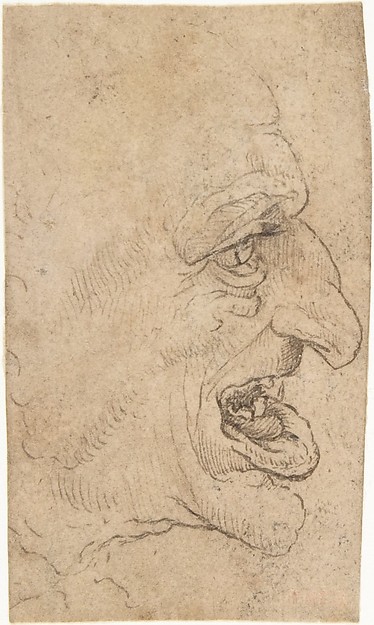
Looking at Leonardo means looking at process as much as finish: notebooks, studies of bodies and water, and years of revision. The Mona Lisa and The Last Supper remain famous because they join close observation to psychological mystery. His career also reminds us that Renaissance art grew in workshops, courts, and networks of patrons. His fame can hide the collaborative labor of workshops and the fact that he completed relatively few paintings. The unfinished and revised works make process part of the story rather than an embarrassment. A third work, Head of a Grotesque Man, complicates any account built from a single celebrated picture. Leonardo sketches an exaggerated profile in pen, showing how observation, character, and invention could meet on a small sheet. An exaggerated nose, open mouth, and sharply outlined profile turn a face into a character study. Leonardo's pen moves quickly, using distortion as a form of observation. Fame draws attention to certain pictures, but this additional object widens the view. Leonardo da Vinci’s work remains open to new comparisons as collections and records are studied.
The drawings of the Virgin’s head and the exaggerated profile make a revealing pair. One seeks a gentle expression through layers of chalk; the other turns a face into a swift character study in ink. La Gioconda asks for another pace again, with the sitter held before an imagined distance. Together they show why Leonardo’s attention to faces cannot be reduced to one famous smile. He changed material, finish, and purpose while keeping observation active.
Explore Renaissance ↗