Head of a Grotesque Man in its time
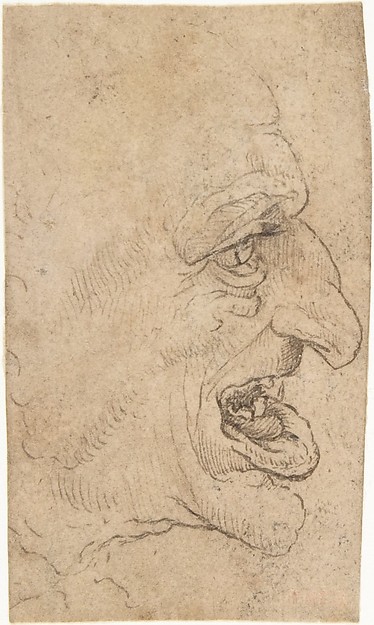
Leonardo sketches an exaggerated profile in pen, showing how observation, character, and invention could meet on a small sheet. Head of a Grotesque Man is dated after 1500 and is held by The Metropolitan Museum of Art. The source record names it “The Head of a Grotesque Man in Profile Facing Right.” These details make Head of a Grotesque Man traceable to a collection, and they leave room for a closer encounter with the image.
A closer view
An exaggerated nose, open mouth, and sharply outlined profile turn a face into a character study. Leonardo's pen moves quickly, using distortion as a form of observation. Try reading Head of a Grotesque Man from its outer edge inward. The first feature you noticed may no longer dominate. Artists can distribute attention so that a picture unfolds gradually rather than all at once.
Paint, paper, and process
The collection records Head of a Grotesque Man as pen and brown ink, on off-white paper (now darkened). The stated materials of Head of a Grotesque Man limit what we can reasonably claim about its making. Follow the record for those details, then return to the image to look for their visible effects. The source record for Head of a Grotesque Man preserves the medium as well as the subject. Both matter when looking closely at an historical object. The image of Head of a Grotesque Man can be enlarged and revisited here. The linked record keeps that view connected to a particular historical object.
Leonardo da Vinci and this work
The Last Supper makes a moment of speech visible through the different reactions of a group. In the Mona Lisa, the sitter’s expression and distant landscape resist the tidy certainty expected of a portrait. The exaggerated profile is both quick observation and invention. Leonardo uses a few forceful features to make the face seem like a character without requiring a larger scene. In Head of a Grotesque Man, the viewer meets a work rather than a shorthand for Leonardo da Vinci. The career gives context to the object; the object can also complicate the familiar account of the career. Its subject, medium, and visible emphasis may seem consistent with other works, or they may reveal a different route. Those shifts are easier to recognize when the works are treated as objects with dates and materials. Treating each object as a fresh decision makes room for change, experiment, and the practical conditions under which an artist worked. Head of a Grotesque Man carries its own subject and process. Following Leonardo da Vinci into another work makes the wider practice easier to see.
The world around Head of a Grotesque Man
His fame can hide the collaborative labor of workshops and the fact that he completed relatively few paintings. The unfinished and revised works make process part of the story rather than an embarrassment. In after 1500, Head of a Grotesque Man belonged to a world of particular makers, patrons, buyers, or readers. The record can identify the object even where those encounters are harder to recover. The collection facts attached to Head of a Grotesque Man are worth following, especially where the image leaves its original setting hard to recover.
Image and object record
The Metropolitan Museum of Art identifies Head of a Grotesque Man as a work by Leonardo da Vinci from after 1500 and records its medium as pen and brown ink, on off-white paper (now darkened). The collection credits the object to Rogers Fund, 1917. Follow the linked object record for its catalogue entry and any further notes on its history.