Studies for the Virgin Adoring the Christ Child in its time
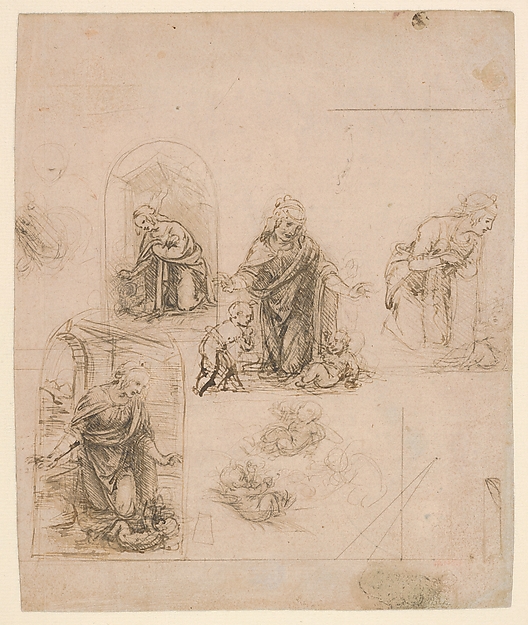
Leonardo tests a devotional group and a perspective diagram on one sheet, revealing how drawing carried thought between subjects. Studies for the Virgin Adoring the Christ Child is dated 1480–85 and is held by The Metropolitan Museum of Art. The source record names it “Compositional Sketches for the Virgin Adoring the Christ Child, with and without the Infant St. John the Baptist; Diagram of a Perspectival Projection (recto); Slight Doodles (verso).” For Studies for the Virgin Adoring the Christ Child, the collection label is a starting point. The work’s arrangement asks for time beyond the facts of its title.
Inside the composition
The sheet brings devotional figures and a perspective exercise into the same working space. It offers an unusually direct view of Leonardo testing positions and relationships before a final composition existed. The marks matter as traces of thought, not merely as preparation for a better-known painting. A first glance at Studies for the Virgin Adoring the Christ Child may be drawn to its subject. Look again at the spaces around that subject. Their proportions and pauses give the visible forms a particular pace.
The surface of the work
The collection records Studies for the Virgin Adoring the Christ Child as silverpoint, partly reworked by the artist with pen and dark brown ink on pink prepared paper; lines ruled with metalpoint (recto); pen and brown ink (verso). In Studies for the Virgin Adoring the Christ Child, materials help determine how marks could be laid down and how the result met its first viewers. The collection entry describes the surface on which those choices were made. The medium named for Studies for the Virgin Adoring the Christ Child tells us about a physical object, including the surface on which its composition first took shape. A closer view of Studies for the Virgin Adoring the Christ Child may reveal decisions missed at first glance. The collection record helps place those decisions on a particular surface and scale.
Leonardo da Vinci and this work
Leonardo moved between painting, engineering, anatomy, and theater with an unusual appetite for observation. Trained in Florence, he spent much of his career at the Sforza court in Milan before returning to Florence and later working in France. His surviving paintings are few, yet their delicate transitions of light and expression changed the possibilities of portraiture. The devotional figures and ruled lines ask to be seen together. Leonardo is testing where bodies might stand inside a measured space, so the sheet preserves decisions in progress instead of presenting one settled image. For Leonardo da Vinci, Studies for the Virgin Adoring the Christ Child brought a subject into contact with a chosen material. Studies for the Virgin Adoring the Christ Child benefits from a slower encounter. Another image by the same maker may use a related method toward another end, or change the method altogether. Another work from the same career may answer those questions differently. A biography becomes more convincing when actual objects are allowed to disagree with a tidy summary. Set Studies for the Virgin Adoring the Christ Child beside another work by Leonardo da Vinci; the comparison can reveal a recurring interest handled through a different image.
The world around Studies for the Virgin Adoring the Christ Child
An apprenticeship in the workshop of Andrea del Verrocchio placed Leonardo among painters, sculptors, and engineers before his long Milanese period. Court commissions made artistic invention answer practical as well as ceremonial needs. For Studies for the Virgin Adoring the Christ Child, the date 1480–85 brings the image back into a specific career. The source record anchors the object while later viewers bring new questions to it. The linked entry for Studies for the Virgin Adoring the Christ Child gives verifiable object facts. Its composition still asks questions that a catalogue cannot answer by itself.
Image and object record
The Metropolitan Museum of Art identifies Studies for the Virgin Adoring the Christ Child as a work by Leonardo da Vinci from 1480–85 and records its medium as silverpoint, partly reworked by the artist with pen and dark brown ink on pink prepared paper; lines ruled with metalpoint (recto); pen and brown ink (verso). The collection credits the object to Rogers Fund, 1917. Follow the linked object record for its catalogue entry and any further notes on its history.