Images for an urban public
Japanese ukiyo-e artists made prints and paintings for a growing urban audience. Publishers, designers, carvers, and printers worked together to turn theater, travel, fashion, and landscape into images that circulated widely. Hokusai used the woodblock series to make Mount Fuji both a landmark and a changing participant in daily life. The usual period given for Ukiyo-e is c. 1600–1900, but dates are guides to overlapping activity rather than firm doors that opened and shut everywhere at once. The term groups artists for the convenience of discussion. It cannot explain a work before we have looked at that work. A useful first move is to ask what problem the name makes visible: a new audience, a disputed subject, a way of organizing space, or a change in what artists thought images could do. Only then can we decide how well a particular painting, print, or design belongs within the account.
The world around the work
Ukiyo-e developed in Edo-period Japan amid expanding cities, commercial publishing, and new audiences for affordable images. The name is often translated as “pictures of the floating world,” but its subjects widened over time from entertainment and fashion to travel, landscape, and natural observation. Ukiyo-e was part of a lively urban print culture with publishers, designers, carvers, printers, and buyers. Hokusai’s changing views of Fuji were made to circulate as a series, rewarding the pleasure of recognition and difference from sheet to sheet. A traveler, a worker, or a sudden shower can change the mountain’s place in the image. Treating the prints only as precursors to European modern art would miss the audience and imaginative range they had within Japan.
The woodblock’s many hands
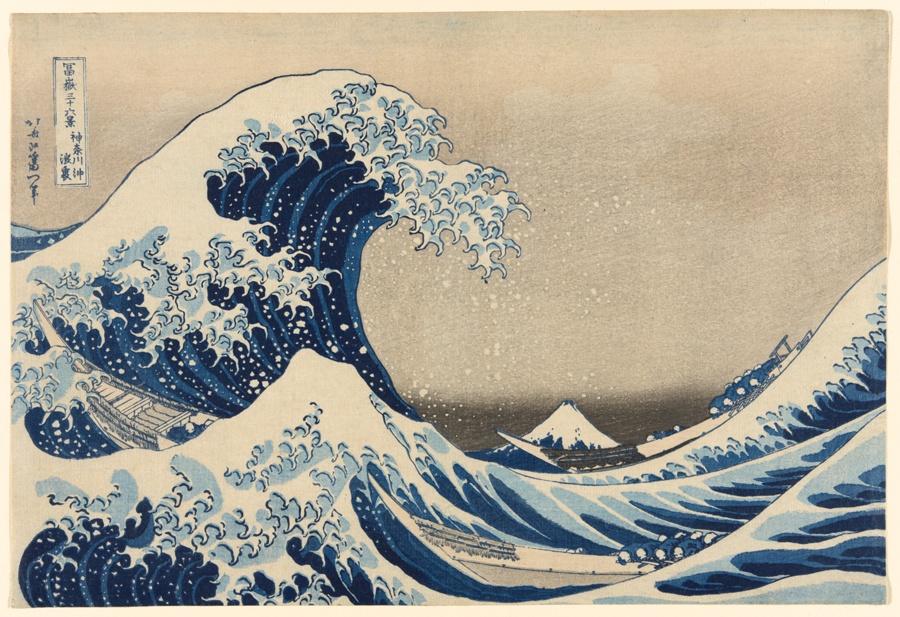
Woodblock printing gives line unusual clarity and lets areas of color meet without the blended transitions of oil painting. A designer could use cropping, diagonal force, and repeated motifs to make a small sheet feel expansive. Printing skill mattered as much as the drawing. The Great Wave off Kanagawa makes these choices visible in a particular object. Its own composition, medium, and subject offer a more useful test of the movement than a checklist of traits. Compare it with another work in this guide and the differences in scale or handling begin to matter as much as the resemblance.
Mount Fuji and a changing world
Hokusai’s long career shows how one artist could work across books, manuals, portraits, and landscape series. The Great Wave belongs to a sequence about Mount Fuji, where the mountain changes role from sheet to sheet rather than occupying a permanent center. Among the names readers may encounter are Katsushika Hokusai. Such lists help us begin, yet they can imply that artists acted as a single mind. A closer view reveals individual training, friendships, rivalries, access, and ambition. Two works made in the same decade may disagree about what an image owes its viewer. That disagreement is not a problem for the history; it is evidence that the label names a live conversation. Follow one artist into another period and the edges of the category become clearer still.
Artists within Ukiyo-e
Hokusai spent a long career reinventing what a printed image could do. Working within the collaborative world of Japanese woodblock publishing, he produced illustrations, manuals, portraits, and landscapes. Decisive contour can hold enormous motion in a small sheet. Repetition across a series lets one landmark or subject change character through weather, scale, and human activity. The Great Wave off Kanagawa gives that practice a concrete form. The wave rises over small boats, while Mount Fuji appears low and distant through its opening. That reversal of apparent scale makes the print more than an image of rough water: it sets human effort, weather, and a familiar landmark in one compressed view. Its strength also depends on the labor of carvers and printers.
The finished print resulted from work by designers, carvers, printers, and publishers. Later accounts that credit only a named artist obscure the people who cut blocks, registered colors, chose paper, and financed an edition. Circulation also meant that surviving impressions could differ. The artists shown in this guide offer a starting point, not a complete roll call. The surviving objects and records have their own uneven histories: some were preserved and studied closely, while others disappeared from view. That imbalance is one reason to keep looking beyond a short list of celebrated names.
Ukiyo-e in different materials
A woodblock print involved blocks cut for lines and colors, careful registration, ink, and paper. A painting by the same designer would make a different kind of object with a different audience and degree of circulation. The woodblock process required one design to pass through several expert hands. Outlines, color blocks, paper, and pressure all affected the finished impression. Two surviving copies of a design may differ in color or condition, so a museum record identifies one object rather than every version of the image. Compare Hokusai’s Great Wave with Shower Below the Summit: similar materials support strikingly different relations among people, weather, and a known mountain.
Cranes on snow-covered pine is recorded as color woodblock print; vertical nagaban. The narrow vertical sheet lets pine branches sweep across a field of snow. Cranes repeat and interrupt their rhythm, inviting the eye to move between living forms and winter pattern. This particular object makes material decisions easier to see than a list of stylistic traits does. Follow its source record for the stated medium and dimensions, then return to the image to notice where that process leaves its mark. A movement takes on more than one form because people worked with different tools, surfaces, and intended audiences.
How Ukiyo-e reached viewers
Ukiyo-e prints were made for circulation. Publishers chose subjects and organized the skilled work of designers, carvers, and printers; buyers encountered the finished sheets in an active urban market. Series encouraged viewers to compare variations in place, weather, and daily life. A museum display changes that encounter by singling out an impression and often framing it behind glass. Remembering the print’s collaborative production and broad first audience gives Hokusai’s designs a fuller setting.
Questions behind the label
The finished print resulted from work by designers, carvers, printers, and publishers. Later accounts that credit only a named artist obscure the people who cut blocks, registered colors, chose paper, and financed an edition. Circulation also meant that surviving impressions could differ. A famous sheet can make the whole field look like landscape design, though ukiyo-e also pictured theater, fashion, and urban pleasure. Another simplification gives all credit to the named designer and forgets the skilled collaboration of carver, printer, and publisher. The object record is a chance to ask about that production history. It also reveals how a work made for circulation later acquired the status of a carefully preserved museum sheet.
Look closely with an actual work
The Great Wave off Kanagawa offers one close-looking example. Hokusai's wave surges above boats while Mount Fuji remains small and distant within the same dramatic frame. The wave rises over small boats, while Mount Fuji appears low and distant through its opening. That reversal of apparent scale makes the print more than an image of rough water: it sets human effort, weather, and a familiar landmark in one compressed view. Its strength also depends on the labor of carvers and printers. Place it beside Shower Below the Summit. Hokusai gives storm clouds, rain, and Mount Fuji a compact, forceful structure through line and color. Hokusai places a sudden fall of rain beneath the steady triangular presence of Mount Fuji. Weather makes the mountain seem changeable without losing its recognizable form. This contrast is one reason the print series rewards comparison from sheet to sheet. Their source records give dates, media, and collections that can be checked. Those facts do not decide what either image means, but they keep the comparison tied to actual objects. Notice one visual decision that the two works share and one that belongs to only one artist. The result may support the movement name, complicate it, or do both at once.
What came after Ukiyo-e
Prints traveled to Europe and North America in the nineteenth century and affected artists there, but that afterlife should not become the whole story. Ukiyo-e deserves to be understood first through its Japanese makers, markets, and audiences. The influence of Japanese prints on artists abroad forms one later chapter, not the entire meaning of ukiyo-e. Reproduction has carried Hokusai’s wave into everyday visual culture, often separated from the series and printing process that gave it form. Looking at another view of Fuji restores some of that variety. The mountain may be small, veiled, or newly prominent, and each design gives the viewer a different path through the scene. Look too at the people working or traveling beneath it. Their place in the composition can change from sheet to sheet, making the series a record of imagined encounters with a shared landmark. The point is not to find one definitive Fuji but to enjoy how many versions a printmaker could make possible.

