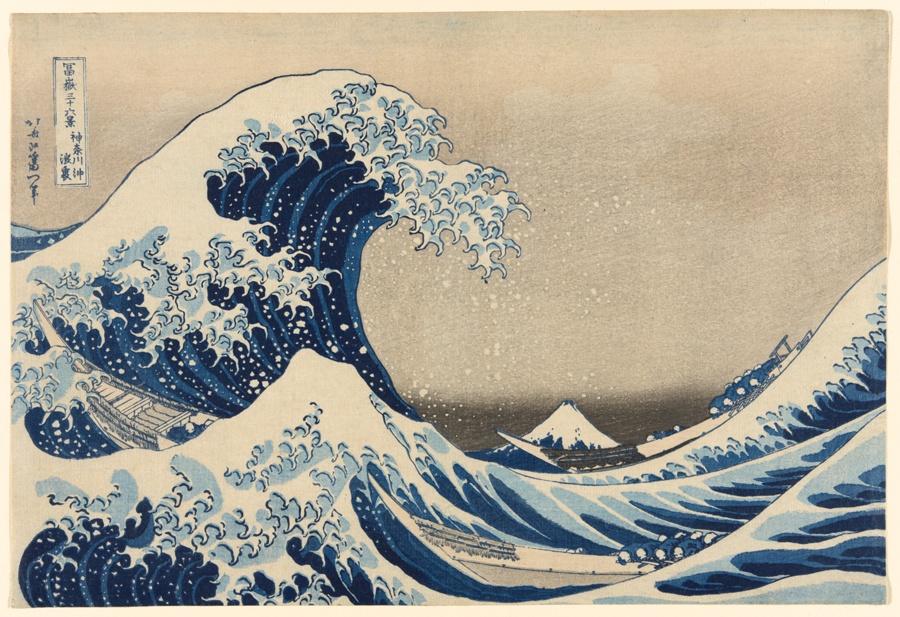
Shower Below the Summit in its time
Hokusai gives storm clouds, rain, and Mount Fuji a compact, forceful structure through line and color. Shower Below the Summit is dated c. 1830/33 and is held by Art Institute of Chicago. The source record names it “Shower Below the Summit (Sanka hakuu), from the series "Thirty-Six Views of Mount Fuji (Fugaku sanjurokkei)".” For Shower Below the Summit, the collection label is a starting point. The work’s arrangement asks for time beyond the facts of its title.
Inside the composition
Hokusai places a sudden fall of rain beneath the steady triangular presence of Mount Fuji. Weather makes the mountain seem changeable without losing its recognizable form. This contrast is one reason the print series rewards comparison from sheet to sheet. A first glance at Shower Below the Summit may be drawn to its subject. Look again at the spaces around that subject. Their proportions and pauses give the visible forms a particular pace.
Paint, paper, and process
The collection records Shower Below the Summit as color woodblock print; oban. Decisive contour can hold enormous motion in a small sheet. Repetition across a series lets one landmark or subject change character through weather, scale, and human activity. The medium named for Shower Below the Summit tells us about a physical object, including the surface on which its composition first took shape. A closer view of Shower Below the Summit may reveal decisions missed at first glance. The collection record helps place those decisions on a particular surface and scale.
Katsushika Hokusai and this work
His Thirty-six Views of Mount Fuji made the mountain a constant presence amid changing human activity and weather. The Great Wave became globally famous, but it is one image in a much broader practice defined by restless experimentation and an eye for motion. Fuji remains a steady form while the falling rain crosses it in a different rhythm. Hokusai lets weather change the viewer’s encounter with a landmark without removing the mountain from sight. For Katsushika Hokusai, Shower Below the Summit brought a subject into contact with a chosen material. The subject may belong to a familiar part of the artist’s reputation, but the manner of showing it remains particular. Another image by the same maker may use a related method toward another end, or change the method altogether. Those shifts are easier to recognize when the works are treated as objects with dates and materials. An artist’s story gains detail from works like Shower Below the Summit rather than supplying a ready explanation for them. Set Shower Below the Summit beside another work by Katsushika Hokusai; the comparison can reveal a recurring interest handled through a different image.
The world around Shower Below the Summit
The date c. 1830/33 places Shower Below the Summit within a particular career and set of viewers. The source link supplies the documented object details; the image still keeps some of that encounter open. For Shower Below the Summit, the date c. 1830/33 brings the image back into a specific career. The source record anchors the object while later viewers bring new questions to it. The linked entry for Shower Below the Summit gives verifiable object facts. Its composition still asks questions that a catalogue cannot answer by itself.
Image and object record
Art Institute of Chicago identifies Shower Below the Summit as a work by Katsushika Hokusai from c. 1830/33 and records its medium as color woodblock print; oban. The collection credits the object to Clarence Buckingham Collection. Follow the linked object record for its catalogue entry and any further notes on its history.