A life in Japanese print culture
Hokusai spent a long career reinventing what a printed image could do. Working within the collaborative world of Japanese woodblock publishing, he produced illustrations, manuals, portraits, and landscapes. Katsushika Hokusai (1760–1849) worked in Japan. Woodblock publishing was a collective trade: a designer, carver, printer, and publisher all contributed to a finished print. Hokusai worked within that system while repeatedly changing subjects and names. Follow the linked works to see how Katsushika Hokusai moved among subjects and materials. They keep this life connected to objects someone made, used, preserved, and now studies.
Lines that hold motion
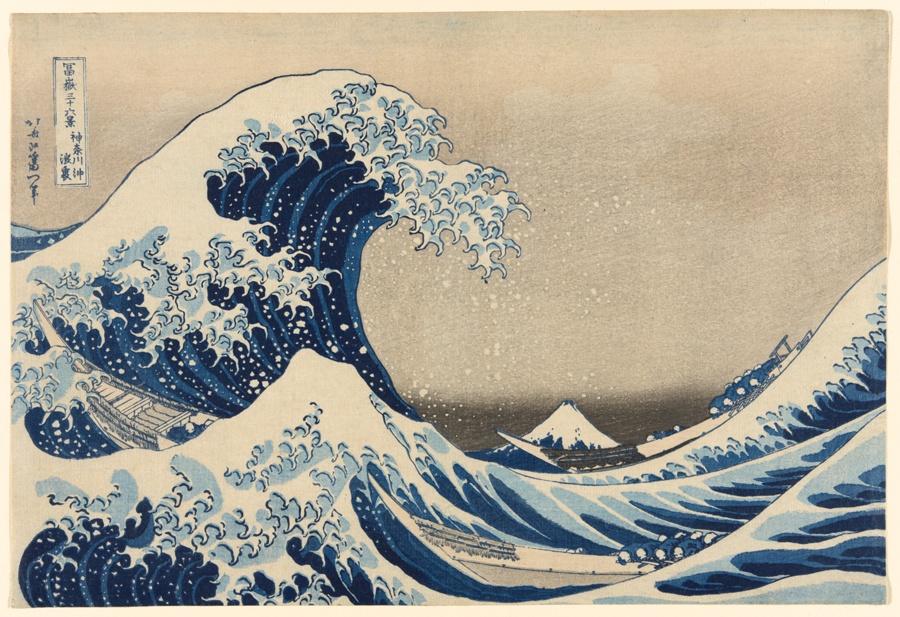
Decisive contour can hold enormous motion in a small sheet. Repetition across a series lets one landmark or subject change character through weather, scale, and human activity. What appears fluent in The Great Wave off Kanagawa was achieved through decisions about material and form. Other works by Katsushika Hokusai let us see the same skill put to different uses.
Mount Fuji, seen again and again
Thirty-six Views of Mount Fuji includes The Great Wave off Kanagawa, but the sequence ranges across ordinary labor, travel, and atmospheric conditions. Fuji becomes a recurring measure of distance. A well-known project may have a strong place in art history, yet it is still a sequence of choices made by a working artist. The Great Wave off Kanagawa lets us attend to one set of those choices. Watch how its subject fits the surface and how the image directs attention. The other linked works change the conversation: they may share a visual habit while pursuing a very different aim. Katsushika Hokusai becomes easier to understand through that range.
Ukiyo-e and its limits
Katsushika Hokusai is associated with Ukiyo-e. Japanese ukiyo-e artists made prints and paintings for a growing urban audience. Publishers, designers, carvers, and printers worked together to turn theater, travel, fashion, and landscape into images that circulated widely. Hokusai used the woodblock series to make Mount Fuji both a landmark and a changing participant in daily life. The category attached to Katsushika Hokusai is one way to enter a crowded period. It can gather related questions without turning their answers into a uniform look. Follow The Great Wave off Kanagawa from its subject to its materials, then ask what another artist of the time would have chosen differently. The object’s record and image provide a more reliable test than a list of stylistic traits alone.
A closer look at The Great Wave off Kanagawa
Hokusai's wave surges above boats while Mount Fuji remains small and distant within the same dramatic frame. The wave rises over small boats, while Mount Fuji appears low and distant through its opening. That reversal of apparent scale makes the print more than an image of rough water: it sets human effort, weather, and a familiar landmark in one compressed view. Its strength also depends on the labor of carvers and printers. Now set it beside Shower Below the Summit. Hokusai gives storm clouds, rain, and Mount Fuji a compact, forceful structure through line and color. Hokusai places a sudden fall of rain beneath the steady triangular presence of Mount Fuji. Weather makes the mountain seem changeable without losing its recognizable form. This contrast is one reason the print series rewards comparison from sheet to sheet. Both works are linked below this profile, with their own object records and images. They reward comparison because they show Katsushika Hokusai making different decisions, sometimes with a different material, even when a familiar concern carries across the two.
A design that traveled
His Thirty-six Views of Mount Fuji made the mountain a constant presence amid changing human activity and weather. The Great Wave became globally famous, but it is one image in a much broader practice defined by restless experimentation and an eye for motion. The global fame of one wave can obscure a career of books, drawing manuals, and experiment. His example also raises questions about how prints moved through markets and across cultures. A third work, Cranes on snow-covered pine, complicates any account built from a single celebrated picture. Hokusai arranges cranes against snow-covered pine branches, turning a winter nature study into a lively play of patterned shapes. The narrow vertical sheet lets pine branches sweep across a field of snow. Cranes repeat and interrupt their rhythm, inviting the eye to move between living forms and winter pattern. A reputation is assembled after the work is made. This third object offers another angle on Katsushika Hokusai, one that may unsettle a story built around a single masterpiece.
The Great Wave makes Fuji small beneath violent water; Shower Below the Summit lets weather cross the mountain’s familiar shape. Cranes on Snow-Covered Pine moves to a different natural subject and a narrow vertical format. These prints make series and variation central to Hokusai’s practice. Their lively designs can be enjoyed separately, but placing them together shows how much can change when scale, weather, and the direction of the viewer’s eye change.
Explore Ukiyo-e ↗
