
Cranes on snow-covered pine in its time
Hokusai arranges cranes against snow-covered pine branches, turning a winter nature study into a lively play of patterned shapes. Cranes on snow-covered pine is dated c. 1834 and is held by Art Institute of Chicago. The source record names it “Cranes on snow-covered pine.” For Cranes on snow-covered pine, the collection label is a starting point. The work’s arrangement asks for time beyond the facts of its title.
How the picture holds together
The narrow vertical sheet lets pine branches sweep across a field of snow. Cranes repeat and interrupt their rhythm, inviting the eye to move between living forms and winter pattern. The subject named in Cranes on snow-covered pine is only one part of the encounter. Edges, intervals, and changes of emphasis control how much time the viewer spends in each area of the work.
The surface of the work
The collection records Cranes on snow-covered pine as color woodblock print; vertical nagaban. With Cranes on snow-covered pine, the source’s medium label points to a process as well as a finished image. Surface, scale, and handling can change what close looking reveals. The medium named for Cranes on snow-covered pine tells us about a physical object, including the surface on which its composition first took shape. A closer view of Cranes on snow-covered pine may reveal decisions missed at first glance. The collection record helps place those decisions on a particular surface and scale.
Katsushika Hokusai and this work
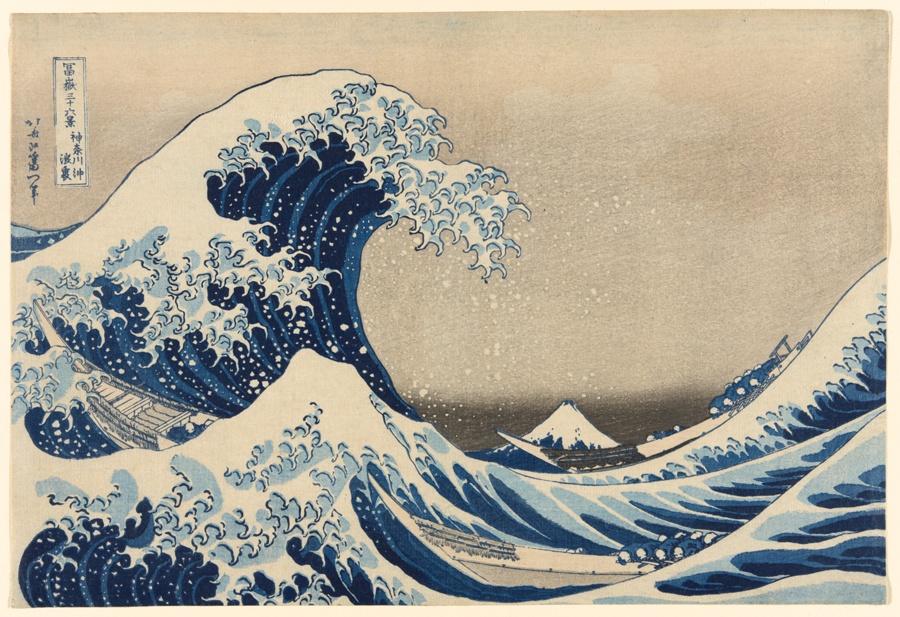
Thirty-six Views of Mount Fuji includes The Great Wave off Kanagawa, but the sequence ranges across ordinary labor, travel, and atmospheric conditions. Fuji becomes a recurring measure of distance. Cranes and pine branches repeat across a narrow vertical space. Hokusai gives the eye several routes through the winter scene, using the interruptions of snow as part of its pattern. Cranes on snow-covered pine sits among other attempts, commissions, or studies made during Katsushika Hokusai’s working life. For Katsushika Hokusai, a visual effect was never an abstract signature floating free of materials and purpose. Another image by the same maker may use a related method toward another end, or change the method altogether. Follow the linked works rather than relying on one celebrated image. Each work had its own audience and task, and each can change the story we tell about the career. Set Cranes on snow-covered pine beside another work by Katsushika Hokusai; the comparison can reveal a recurring interest handled through a different image.
The world around Cranes on snow-covered pine
The global fame of one wave can obscure a career of books, drawing manuals, and experiment. His example also raises questions about how prints moved through markets and across cultures. For Cranes on snow-covered pine, the date c. 1834 brings the image back into a specific career. The source record anchors the object while later viewers bring new questions to it. The linked entry for Cranes on snow-covered pine gives verifiable object facts. Its composition still asks questions that a catalogue cannot answer by itself.
Image and object record
Art Institute of Chicago identifies Cranes on snow-covered pine as a work by Katsushika Hokusai from c. 1834 and records its medium as color woodblock print; vertical nagaban. The collection credits the object to Clarence Buckingham Collection. Follow the linked object record for its catalogue entry and any further notes on its history.