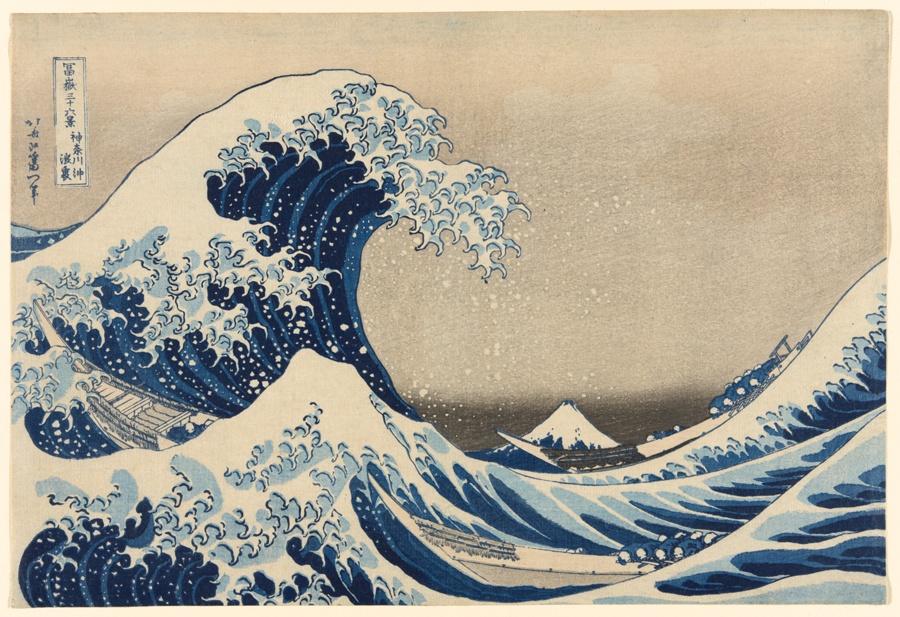
The Great Wave off Kanagawa in its time
Hokusai's wave surges above boats while Mount Fuji remains small and distant within the same dramatic frame. The Great Wave off Kanagawa is dated 1830/33 and is held by Art Institute of Chicago. The source record names it “Under the Wave off Kanagawa (Kanagawa oki nami ura), also known as The Great Wave, from the series "Thirty-Six Views of Mount Fuji (Fugaku sanjūrokkei)".” The source tells us which object this is. Looking at The Great Wave off Kanagawa reveals decisions that no short catalogue line could contain.
How the picture holds together
The wave rises over small boats, while Mount Fuji appears low and distant through its opening. That reversal of apparent scale makes the print more than an image of rough water: it sets human effort, weather, and a familiar landmark in one compressed view. Its strength also depends on the labor of carvers and printers. The subject named in The Great Wave off Kanagawa is only one part of the encounter. Edges, intervals, and changes of emphasis control how much time the viewer spends in each area of the work.
Paint, paper, and process
The collection records The Great Wave off Kanagawa as color woodblock print; oban. With The Great Wave off Kanagawa, the source’s medium label points to a process as well as a finished image. Surface, scale, and handling can change what close looking reveals. In The Great Wave off Kanagawa, process and appearance meet; the materials in the record help explain what kind of surface carried these choices. Compare The Great Wave off Kanagawa with another work by the artist. Its medium and size can help explain why the two works meet the eye differently.
Katsushika Hokusai and this work
Hokusai spent a long career reinventing what a printed image could do. Working within the collaborative world of Japanese woodblock publishing, he produced illustrations, manuals, portraits, and landscapes. The boats are easy to overlook beneath the curling water, yet their small forms give the wave its frightening scale. Fuji is still present in the distance, making a stable landmark share the image with immediate danger. The Great Wave off Kanagawa sits among other attempts, commissions, or studies made during Katsushika Hokusai’s working life. Even when two objects share a subject, they need not share the same emphasis. Another image by the same maker may use a related method toward another end, or change the method altogether. Follow the linked works rather than relying on one celebrated image. Its differences from nearby works are worth noticing; they restore a little of the uncertainty and invention within the practice. The other works linked from Katsushika Hokusai’s profile give The Great Wave off Kanagawa a useful company: their differences make this image more specific.
The world around The Great Wave off Kanagawa
Woodblock publishing was a collective trade: a designer, carver, printer, and publisher all contributed to a finished print. Hokusai worked within that system while repeatedly changing subjects and names. The date attached to The Great Wave off Kanagawa, 1830/33, is more than a period marker. It places the work among the people and circumstances in which its first audience could encounter it. With The Great Wave off Kanagawa, the source entry anchors attribution and materials; it does not settle every possible reading of the work.
Image and object record
Art Institute of Chicago identifies The Great Wave off Kanagawa as a work by Katsushika Hokusai from 1830/33 and records its medium as color woodblock print; oban. The collection credits the object to Clarence Buckingham Collection. Follow the linked object record for its catalogue entry and any further notes on its history.

