After the Impressionist exhibitions
Artists after Impressionism pushed its experiments in different directions. Cézanne built structure through color, Seurat systematized marks, and Van Gogh intensified line and hue. The label was coined later, so it describes a set of connected departures rather than a single organized group. The usual period given for Post-Impressionism is late 1800s–early 1900s, but dates are guides to overlapping activity rather than firm doors that opened and shut everywhere at once. The term groups artists for the convenience of discussion. It cannot explain a work before we have looked at that work. A useful first move is to ask what problem the name makes visible: a new audience, a disputed subject, a way of organizing space, or a change in what artists thought images could do. Only then can we decide how well a particular painting, print, or design belongs within the account.
The world around the work
Post-Impressionism is a later label for artists who worked after or alongside the Impressionist experiments without forming one unified school. It gathers several answers to the question of what could be done with open color and a newly flexible surface. Cézanne, Seurat, and Van Gogh worked after the first Impressionist breakthroughs, yet their concerns did not converge into one group program. A still life could become an inquiry into form, a riverside crowd into a planned system of marks, and a bedroom into a charged arrangement of color. The label was applied retrospectively, so it is especially important to follow the separate career behind each work. Shared chronology is a starting point rather than an explanation.
Color in different directions
Cézanne used passages of color to give objects weight while keeping space unsettled. Van Gogh intensified line and hue to charge familiar subjects with movement. Seurat organized small touches of color through a more systematic method. The Basket of Apples makes these choices visible in a particular object. Its own composition, medium, and subject offer a more useful test of the movement than a checklist of traits. Compare it with another work in this guide and the differences in scale or handling begin to matter as much as the resemblance.
A label invented later
A mountain, a vase of flowers, and a Parisian riverside do not look like parts of a single program. That is precisely why the label must be handled carefully. The artists shared a historical conversation, not an agreed visual recipe. Among the names readers may encounter are Paul Cézanne, Vincent van Gogh, Georges Seurat. Such lists help us begin, yet they can imply that artists acted as a single mind. A closer view reveals individual training, friendships, rivalries, access, and ambition. Two works made in the same decade may disagree about what an image owes its viewer. That disagreement is not a problem for the history; it is evidence that the label names a live conversation. Follow one artist into another period and the edges of the category become clearer still.
Artists within Post-Impressionism
Cézanne studied landscapes, still lifes, and bathers through repeated sessions of looking. He used small, shifting passages of color to build form, allowing a mountain or an apple to feel both stable and alive. Short patches of color build volume without hiding the surface of the canvas. An apple can seem stable and slightly unstable at once because its edges are negotiated in paint. The Basket of Apples gives that practice a concrete form. Cézanne lets fruit, cloth, and table edges pull against ordinary perspective. The apparent instability is productive: looking moves from one object to another without being locked into a single optical position. A familiar still life becomes a way to test how form can be built on a flat surface.
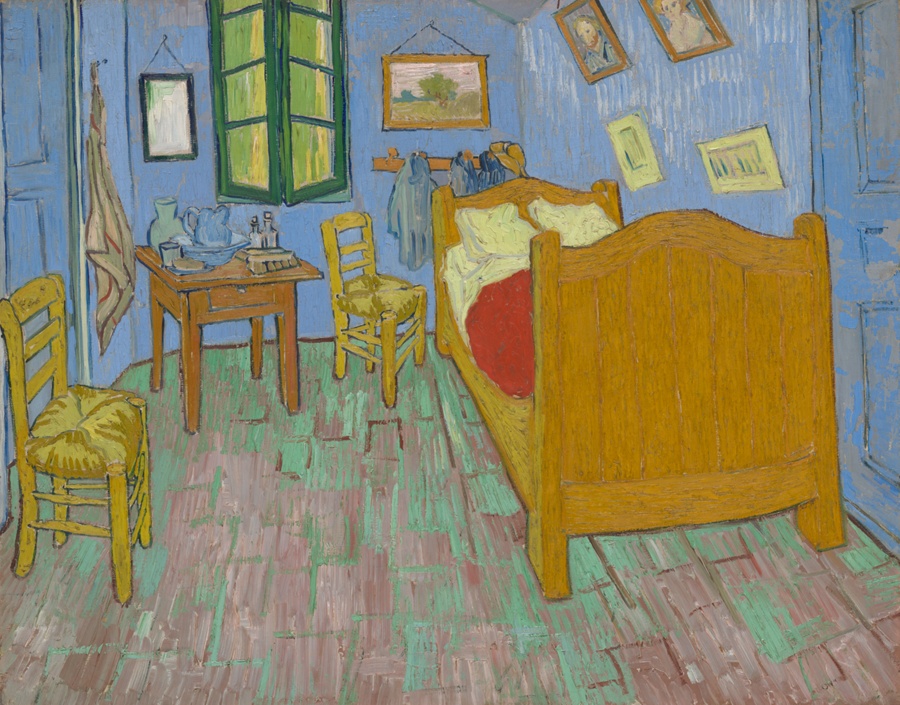
Van Gogh began painting seriously in his late twenties. Supported emotionally and financially by his brother Theo, he moved from the dark earth tones of Dutch rural scenes toward the intense color he encountered in Paris and southern France. Brush direction, thick paint, and sharpened color make familiar forms feel active. His letters show how carefully he planned motifs and combinations rather than painting only by impulse. The Bedroom gives that practice a concrete form. Van Gogh simplifies the bedroom into strong color and tilted planes. Bed, chairs, and pictures are ordinary possessions, yet their arrangement gives the room an expressive rhythm. The image offers an idea of rest while its painted structure remains animated and deliberately unsettled.
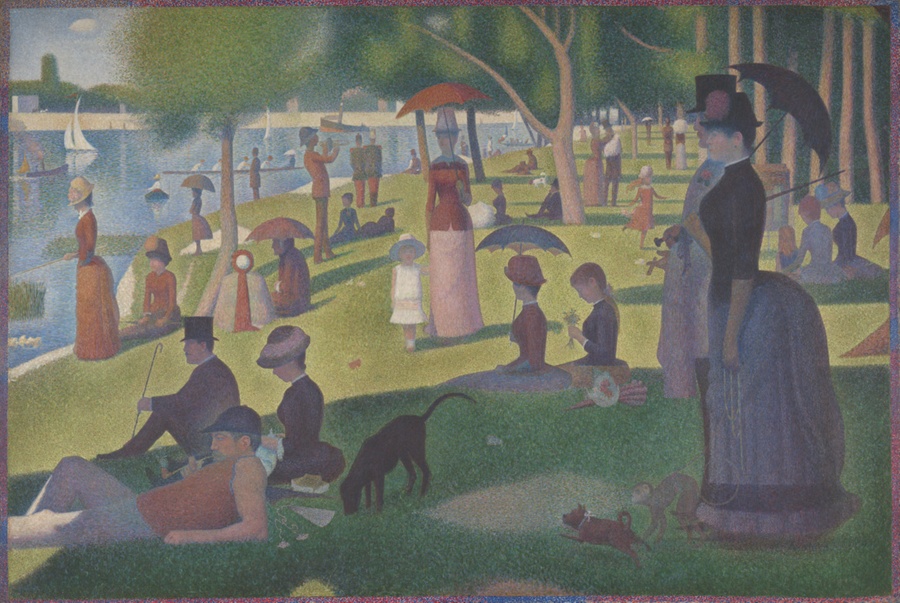
Seurat approached painting as an investigation into color, perception, and modern leisure. By setting tiny marks of contrasting pigment beside one another, he invited the eye to assemble a luminous scene. Separate touches of color are part of a planned structure. The image is not merely a demonstration of theory; silhouettes, intervals, and still poses determine its peculiar mood. A Sunday on La Grande Jatte gives that practice a concrete form. Seurat sets many separate figures in a shared riverside space. Small touches of color build a carefully planned whole, while the people seem curiously apart even when near each other. The painting holds leisure, social distinction, and a rigorous experiment in visual perception together.
Post-Impressionism in different materials
Oil paint could be laid in short constructive patches, thick expressive strokes, or measured touches of contrasting color. Works on paper reveal how each painter tested an idea before or beyond a finished canvas. Seurat’s oil studies expose steps toward a much larger composition; Cézanne’s fruit and table edges register decisions about how space can hold together. Van Gogh’s paint can make direction and pressure conspicuous. All three used oil, but no single description of brushwork tells us what they were seeking. Look for the material trace in each object: a provisional patch, a layered color plane, or a stroke kept visible. Their differences make the broad label useful only if it sends us back to the surface.
A Sunday on La Grande Jatte is recorded as oil on canvas. Seurat sets many separate figures in a shared riverside space. Small touches of color build a carefully planned whole, while the people seem curiously apart even when near each other. The painting holds leisure, social distinction, and a rigorous experiment in visual perception together. This particular object makes material decisions easier to see than a list of stylistic traits does. Follow its source record for the stated medium and dimensions, then return to the image to notice where that process leaves its mark. A movement takes on more than one form because people worked with different tools, surfaces, and intended audiences.
How Post-Impressionism reached viewers
Post-Impressionism was named after many of the pictures had already been made. Cézanne, Seurat, and Van Gogh did not assemble under a single banner with one public program. Their works entered view through different exhibitions, friendships, dealers, and later retrospectives. The name helped later viewers describe departures from Impressionism, but it also made separate careers look like a planned sequence. Reading the first audiences of each artist keeps that neat retrospective story from taking over.
Questions behind the label
Later accounts can turn every experiment into a stepping stone toward Cubism or abstraction. That story diminishes the works on their own terms. They were also responses to place, friendship, commerce, science, and individual habits of looking. A story of inevitable progress from Impressionism into abstraction makes these works sound like stops on one road. Their makers did not know the neat sequence later surveys would draw. Questions of friendship, trade, health, and exhibition opportunity shaped each career differently. A painting also had an audience and purpose before it became evidence for a movement name. Compare the works as experiments with particular subjects, then decide what the later category helps you see and what it hides.
Look closely with an actual work
The Basket of Apples offers one close-looking example. Cézanne lets apples, basket, and cloth test how a still life can feel solid while its space remains unsettled. Cézanne lets fruit, cloth, and table edges pull against ordinary perspective. The apparent instability is productive: looking moves from one object to another without being locked into a single optical position. A familiar still life becomes a way to test how form can be built on a flat surface. Place it beside The Bedroom. Van Gogh paints his Arles room with direct color and tilted space, making an ordinary interior intensely personal. Van Gogh simplifies the bedroom into strong color and tilted planes. Bed, chairs, and pictures are ordinary possessions, yet their arrangement gives the room an expressive rhythm. The image offers an idea of rest while its painted structure remains animated and deliberately unsettled. Their source records give dates, media, and collections that can be checked. Those facts do not decide what either image means, but they keep the comparison tied to actual objects. Notice one visual decision that the two works share and one that belongs to only one artist. The result may support the movement name, complicate it, or do both at once.
What came after Post-Impressionism
Their varied surfaces helped later painters treat form and color as active decisions rather than neutral containers for a subject. The most useful legacy is the freedom to ask what a painting can organize beyond resemblance. Later artists and critics made Cézanne, Seurat, and Van Gogh central to histories of modern art, but that stature came unevenly and often after death. The afterlife of a work can make its original uncertainties hard to see. A study might look like a deliberate step toward a famous masterpiece only because we know what followed. Respecting the study as an object in its own right keeps this history open rather than prewritten.