An exacting Parisian painter
Seurat approached painting as an investigation into color, perception, and modern leisure. By setting tiny marks of contrasting pigment beside one another, he invited the eye to assemble a luminous scene. Georges Seurat (1859–1891) worked in France. Seurat worked in a Parisian culture interested in optics, urban recreation, and new public spaces. He gave considerable time to drawing and preparation before a large canvas was finished. Each documented work on this page occupies one point in a longer career. Together they make a more varied account of Georges Seurat than a single celebrated image can give.
Color in separate marks
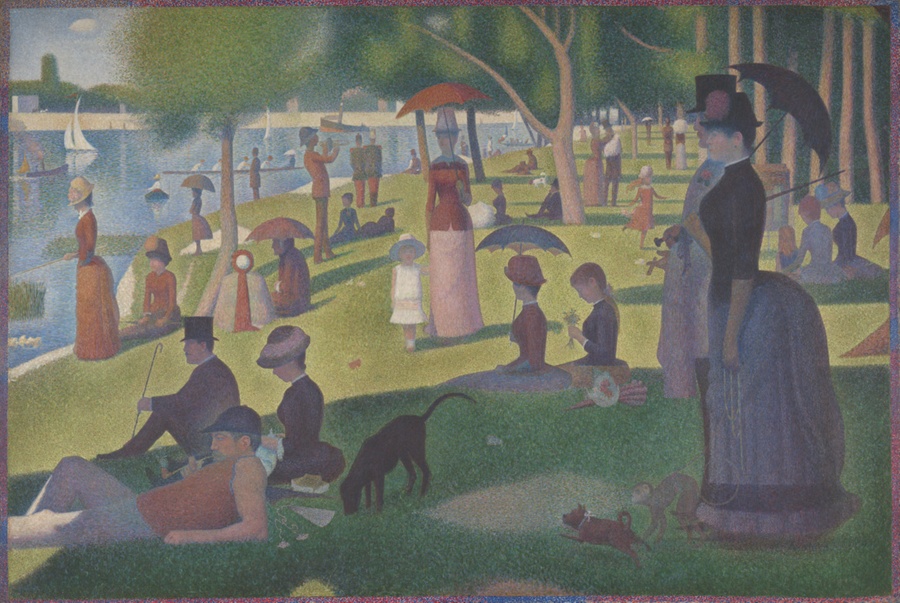
Separate touches of color are part of a planned structure. The image is not merely a demonstration of theory; silhouettes, intervals, and still poses determine its peculiar mood. No single technique explains every part of Georges Seurat’s career. A Sunday on La Grande Jatte is a starting point for noticing both continuity and experiment in the other works.
Studies for a public scene
A Sunday Afternoon on the Island of La Grande Jatte gathers many people into one scene while making their social distance palpable. Its famous surface rewards both close inspection and a step back. The projects in this life were made for viewers, patrons, or buyers with their own expectations. A Sunday on La Grande Jatte reached them through a particular material and format. Its arrangement can be studied without treating it as a perfect illustration of what Georges Seurat always did. A second work may keep an interest but reverse the balance of color, line, or subject. That difference is evidence of an artist working through new demands rather than repeating a formula.
Neo-Impressionism and its limits
Georges Seurat is associated with Neo-Impressionism. The label Neo-Impressionism locates one strand of this career, but no short movement name can contain every decision in a lifetime of work. A movement name can tell us about exhibitions, markets, or a later historian’s way of grouping works. For Georges Seurat, its value depends on what it explains in a specific object. Return to A Sunday on La Grande Jatte and describe the subject before reaching for the label. Which visual problem does it share with nearby artists, and where does it take another path? A good comparison can sharpen the historical category without making it rigid.
A closer look at A Sunday on La Grande Jatte
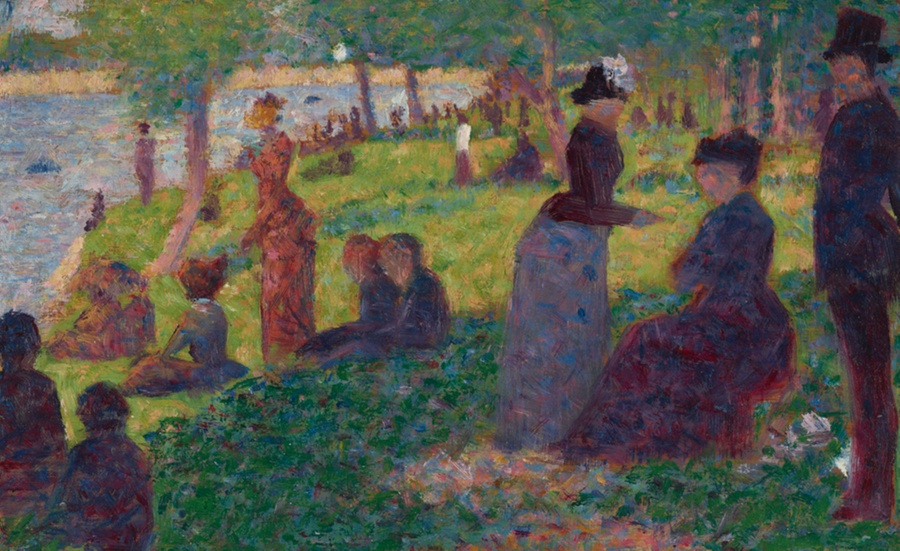
Seurat arranges figures beside the river in a monumental, carefully built image of modern leisure. Seurat sets many separate figures in a shared riverside space. Small touches of color build a carefully planned whole, while the people seem curiously apart even when near each other. The painting holds leisure, social distinction, and a rigorous experiment in visual perception together. Now set it beside Oil Sketch for A Sunday on La Grande Jatte. Seurat's painted study shows the planning behind his larger riverside composition and the value of a provisional image. This sketch lets viewers see Seurat working toward the larger composition. Groups and light are already being tested, but the surface keeps the immediacy of a study. Comparing it with the finished painting shows that preparation can have its own visual life. Both works are linked below this profile, with their own object records and images. They reward comparison because they show Georges Seurat making different decisions, sometimes with a different material, even when a familiar concern carries across the two.
Seurat’s unfinished experiments
A Sunday Afternoon on the Island of La Grande Jatte took years of planning and studies. Its stillness and structure offered an alternative to the quick-looking image often associated with Impressionism. His short career still changed ideas about method and color. The later label Neo-Impressionism recognizes a disciplined alternative to the quick impression often associated with the earlier group. A third work, Study for Bathers at Asnières, complicates any account built from a single celebrated picture. Seurat prepares his riverside scene through a small oil study, where figures and color relationships remain actively in formation. People at the river remain provisional within a small oil study. Seurat is testing how bodies, water, and distant banks might be organized before a larger painting fixes their relationships. The difference among these objects is part of Georges Seurat’s legacy. It asks later viewers to remember a working artist rather than a fixed style.
A Sunday on La Grande Jatte presents an apparently settled afternoon built from a great deal of planning. Its oil sketch keeps some decisions provisional, and Study for Bathers at Asnières shows that the riverbank was a recurring field of experiment. The studies are valuable works in themselves. They let us see Seurat testing figures, light, and space before a larger composition turned those choices into an image many people now recognize.