A Sunday on La Grande Jatte in its time
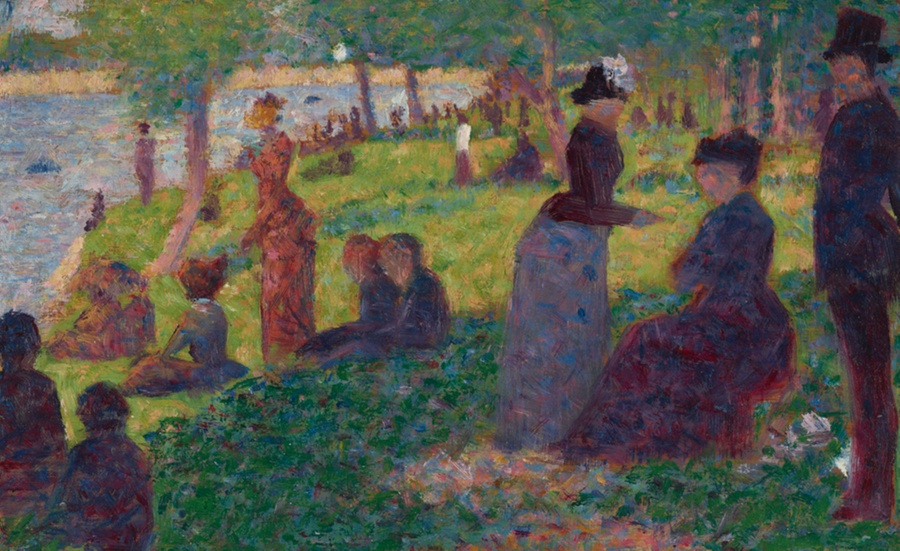
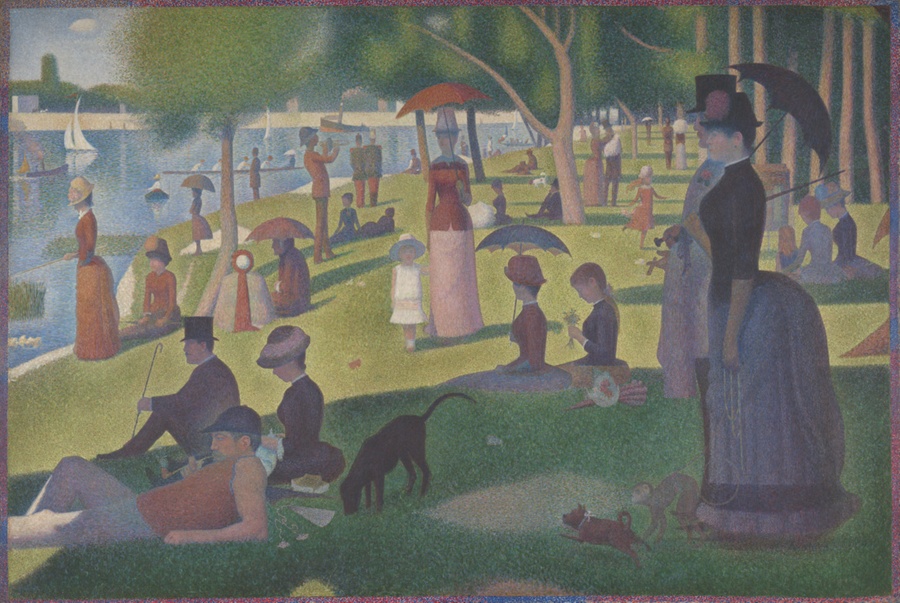
Seurat arranges figures beside the river in a monumental, carefully built image of modern leisure. A Sunday on La Grande Jatte is dated 1884–86, border added 1888–89 and is held by Art Institute of Chicago. The source record names it “A Sunday on La Grande Jatte — 1884.” The listed facts locate A Sunday on La Grande Jatte in history, while its visible choices give the viewer something to discover directly.
Where the eye settles
Seurat sets many separate figures in a shared riverside space. Small touches of color build a carefully planned whole, while the people seem curiously apart even when near each other. The painting holds leisure, social distinction, and a rigorous experiment in visual perception together. In A Sunday on La Grande Jatte, compare the most firmly defined passage with one left open. The contrast can be a way to direct attention, or a trace of the artist testing how much description the image needs.
The material object
The collection records A Sunday on La Grande Jatte as oil on canvas. The medium recorded for A Sunday on La Grande Jatte gives this image a physical scale and process. A screen can show its design, while the source record preserves what is known of the object itself. Looking at A Sunday on La Grande Jatte as an object means asking what the listed materials allow the artist to revise, repeat, or leave visible. Return to the image of A Sunday on La Grande Jatte for the arrangement of forms, then use the source link to learn what kind of object carries them.
Georges Seurat and this work
Seurat approached painting as an investigation into color, perception, and modern leisure. By setting tiny marks of contrasting pigment beside one another, he invited the eye to assemble a luminous scene. The riverside crowd shares one afternoon while many figures remain turned away from one another. Seurat’s patient organization of color makes that social distance look carefully composed rather than casually observed. The questions raised by A Sunday on La Grande Jatte may also appear elsewhere in Georges Seurat’s work, but the material object cannot be replaced by that comparison. A subject can be revisited without producing the same picture twice: scale, material, and audience all alter the problem. Its subject, medium, and visible emphasis may seem consistent with other works, or they may reveal a different route. The choices in this image have a pace of their own. An artist’s story gains detail from works like A Sunday on La Grande Jatte rather than supplying a ready explanation for them. The choices visible in A Sunday on La Grande Jatte make one part of Georges Seurat’s career tangible without reducing that career to a single signature look.
The world around A Sunday on La Grande Jatte
Seurat worked in a Parisian culture interested in optics, urban recreation, and new public spaces. He gave considerable time to drawing and preparation before a large canvas was finished. The world of 1884–86, border added 1888–89 was the first setting for A Sunday on La Grande Jatte. Its later life in collections and reproductions has changed how easily, and how often, people see it. The image of A Sunday on La Grande Jatte and its source record belong together: one offers a close view, the other identifies the object and its material.
Image and object record
Art Institute of Chicago identifies A Sunday on La Grande Jatte as a work by Georges Seurat from 1884–86, border added 1888–89 and records its medium as oil on canvas. The collection credits the object to Helen Birch Bartlett Memorial Collection. Follow the linked object record for its catalogue entry and any further notes on its history.