Art for a changing Dutch market
Seventeenth-century Dutch artists developed a rich market for portraits, landscapes, still lifes, and scenes of domestic life. Religious and commercial conditions differed from those in many neighboring courts. Vermeer made the quiet interior a place of concentrated light, social detail, and unresolved human attention. The usual period given for Dutch Golden Age is c. 1600–1700, but dates are guides to overlapping activity rather than firm doors that opened and shut everywhere at once. The term groups artists for the convenience of discussion. It cannot explain a work before we have looked at that work. A useful first move is to ask what problem the name makes visible: a new audience, a disputed subject, a way of organizing space, or a change in what artists thought images could do. Only then can we decide how well a particular painting, print, or design belongs within the account.
The world around the work
The Dutch Republic supported a varied art market in the seventeenth century. Merchants, civic groups, and households bought images for purposes different from those of a royal court or a Catholic altarpiece. Maritime trade brought wealth while connecting the period to colonial violence and slavery. Vermeer’s carefully measured interiors belonged to a Dutch market that also supported landscapes, portraits, and still lifes. Buyers might live with such pictures in private rooms rather than encounter them in a public church. Household objects, maps, and window light could carry questions about trade, knowledge, and social behavior. A quiet image was not an empty one. Its details rewarded an audience accustomed to reading the familiar things of daily life.
The interior as a world
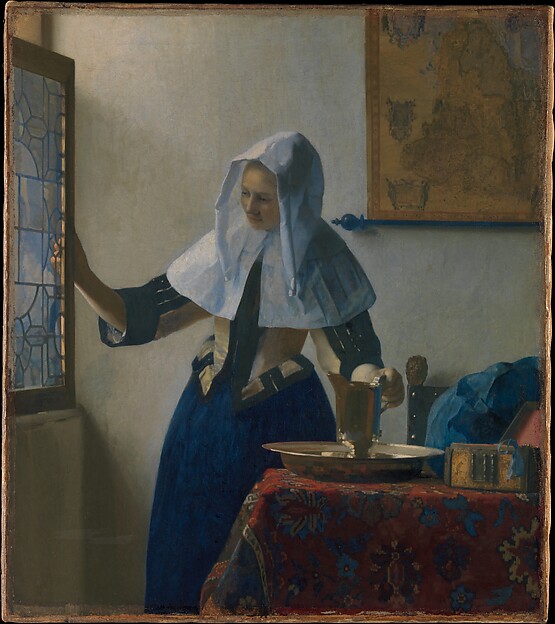
Painters made still lifes, portraits, landscapes, and domestic interiors with different kinds of attention. In Vermeer, a window and a carefully placed object can organize a room as strongly as a figure. Detail is not simply a claim to photographic accuracy; it is a way to pace looking. Young Woman with a Water Pitcher makes these choices visible in a particular object. Its own composition, medium, and subject offer a more useful test of the movement than a checklist of traits. Compare it with another work in this guide and the differences in scale or handling begin to matter as much as the resemblance.
Households, trade, and looking
Vermeer’s small surviving group of paintings is only one route through this history. His quiet rooms sit within a culture of maps, music, commerce, and household display, and they should not stand in for every Dutch artist or every social experience of the period. Among the names readers may encounter are Johannes Vermeer. Such lists help us begin, yet they can imply that artists acted as a single mind. A closer view reveals individual training, friendships, rivalries, access, and ambition. Two works made in the same decade may disagree about what an image owes its viewer. That disagreement is not a problem for the history; it is evidence that the label names a live conversation. Follow one artist into another period and the edges of the category become clearer still.
Artists within Dutch Golden Age
Vermeer made quiet rooms feel vast. In a relatively small body of surviving paintings, he used windows, maps, tiled floors, and concentrated color to turn daily routines into moments of attention. Window light, carefully placed objects, and restrained geometry let apparently quiet scenes unfold slowly. A wall, a table, or a map can be as active in the composition as a person. Young Woman with a Water Pitcher gives that practice a concrete form. Vermeer turns an ordinary action into an arrangement of light, fabric, metal, and space. The figure stands between the window and the objects of the room, so that opening the day becomes a quiet event. The map behind her enlarges the world beyond this carefully measured interior.
A scene of everyday life can appear modest while carrying clues to wealth, labor, gender, and global trade. Asking who could afford a painting or whose work made a comfortable interior possible complicates the notion of an innocent domestic world. The artists shown in this guide offer a starting point, not a complete roll call. The surviving objects and records have their own uneven histories: some were preserved and studied closely, while others disappeared from view. That imbalance is one reason to keep looking beyond a short list of celebrated names.
Dutch Golden Age in different materials
Oil on canvas or panel could support small interiors as well as larger portraits. Prints spread designs more widely, while paintings in private homes invited a repeated, close encounter. Oil paint allowed Vermeer to make light gather on fabric, metal, and a wall with different degrees of clarity. A room’s geometry can direct attention just as firmly as a figure’s gesture. Compare Young Woman with a Water Pitcher with Allegory of the Catholic Faith: one keeps its story open, the other places named symbols inside a related kind of interior. Their surfaces and scales ask us to look past the generic idea of a “Dutch room” toward distinct pictorial purposes.
Allegory of the Catholic Faith is recorded as oil on canvas. Symbolic objects crowd the room around a central figure. Vermeer uses the careful structure of an interior to make an allegory visible without giving it a single simple reading. This particular object makes material decisions easier to see than a list of stylistic traits does. Follow its source record for the stated medium and dimensions, then return to the image to notice where that process leaves its mark. A movement takes on more than one form because people worked with different tools, surfaces, and intended audiences.
How Dutch Golden Age reached viewers
Seventeenth-century Dutch pictures could be made for individual patrons or offered in a lively market for domestic display. A Vermeer interior was not necessarily planned for the kind of hushed museum room in which it is now seen. Its scale and carefully placed objects rewarded a close private look. Other painters supplied landscapes, still lifes, and portraits for different buyers. The variety of that market helps explain why the period cannot be reduced to one style or subject.
Questions behind the label
A scene of everyday life can appear modest while carrying clues to wealth, labor, gender, and global trade. Asking who could afford a painting or whose work made a comfortable interior possible complicates the notion of an innocent domestic world. The term Dutch Golden Age can suggest prosperity shared evenly across society. The period’s trade and wealth rested on unequal structures, including colonial commerce, while paintings often show only selected parts of a household or market. A picture need not illustrate every part of that history to belong within it. The question is how its subject and audience relate to the world beyond the room and what its beautiful quietness may leave unspoken.
Look closely with an actual work
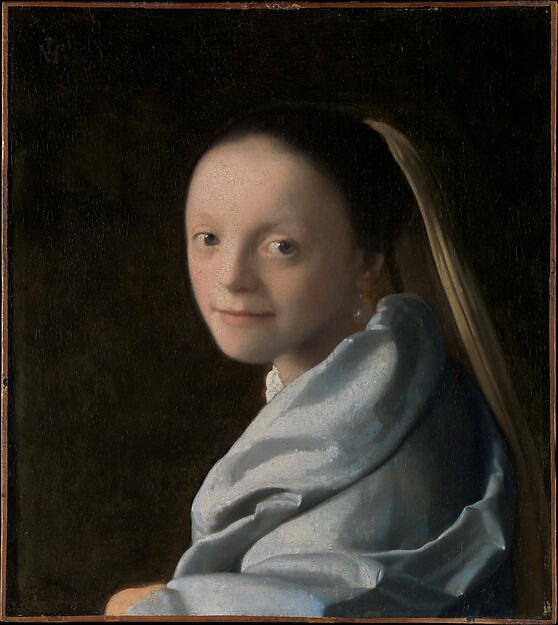
Young Woman with a Water Pitcher offers one close-looking example. Vermeer turns a woman's action near a window into a measured encounter with light, domestic space, and attention. Vermeer turns an ordinary action into an arrangement of light, fabric, metal, and space. The figure stands between the window and the objects of the room, so that opening the day becomes a quiet event. The map behind her enlarges the world beyond this carefully measured interior. Place it beside Study of a Young Woman. Vermeer makes a young woman's face the center of a study in light, expression, and quiet attention. The young woman's face is caught in soft light against a dark setting. Vermeer withholds a full narrative and lets expression and illumination lead the encounter. Their source records give dates, media, and collections that can be checked. Those facts do not decide what either image means, but they keep the comparison tied to actual objects. Notice one visual decision that the two works share and one that belongs to only one artist. The result may support the movement name, complicate it, or do both at once.
What came after Dutch Golden Age
Later collectors and museums helped turn certain Dutch pictures into timeless icons. Returning to the original material, scale, and first audience restores some of the questions that familiarity can hide. Vermeer’s modern fame was built through rediscovery, collecting, and the enormous circulation of a small surviving body of work. That history can make each interior seem like the inevitable work of an isolated genius. Returning to the object’s likely first setting and the wider Dutch market restores some of the social world in which it was made. Light remains central, but it becomes part of a picture with owners, materials, and a changing public life. The map behind a figure, the shape of a window, or the gleam of a vessel can suggest connections to trade and knowledge without turning an interior into a literal account of them. Those small things reward return visits because they keep the picture open to more than one scale of reading. A private room can hold a large world.