Delft and its households
Vermeer made quiet rooms feel vast. In a relatively small body of surviving paintings, he used windows, maps, tiled floors, and concentrated color to turn daily routines into moments of attention. Johannes Vermeer (1632–1675) worked in Netherlands. Vermeer lived and worked in Delft, where domestic interiors could carry questions about wealth, knowledge, music, and social conduct. His surviving output is small enough that every canvas attracts close attention. A life is easier to understand when its objects stay close. The linked works let Johannes Vermeer’s choices appear in several forms, not only in a familiar story.
The work of quiet light
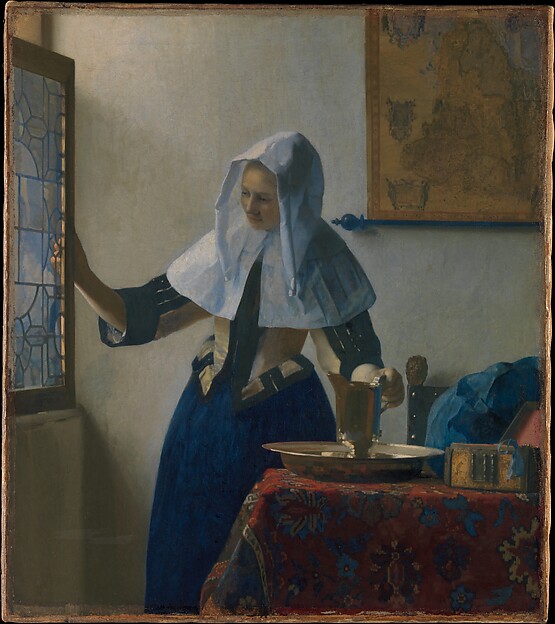
Window light, carefully placed objects, and restrained geometry let apparently quiet scenes unfold slowly. A wall, a table, or a map can be as active in the composition as a person. The method is visible in Young Woman with a Water Pitcher, but it is worth looking at the other linked objects before calling it a fixed style. Johannes Vermeer had room to revise a familiar solution.
Rooms full of questions
The Milkmaid and Girl with a Pearl Earring invite different forms of attention: one concentrates on work and material, the other on a turning face whose identity is uncertain. Look at the projects through the material objects that survive. Young Woman with a Water Pitcher records one moment of making, not a complete account of Johannes Vermeer’s intention. Its subject and visible form can be set beside the other works on this page. One may ask for close private attention; another may have been made to address a broader audience. Those conditions make the differences meaningful, even when a shared hand or concern remains easy to recognize.
Dutch Golden Age and its limits
Johannes Vermeer is associated with Dutch Golden Age. Seventeenth-century Dutch artists developed a rich market for portraits, landscapes, still lifes, and scenes of domestic life. Religious and commercial conditions differed from those in many neighboring courts. Vermeer made the quiet interior a place of concentrated light, social detail, and unresolved human attention. Use the movement as a route into Johannes Vermeer’s world, then allow Young Woman with a Water Pitcher to complicate the route. The date and medium attach the work to a real moment of making. Its subject and arrangement may answer a shared question in a way no other artist chose. This is how a broad term can serve close looking without replacing it.
A closer look at Young Woman with a Water Pitcher
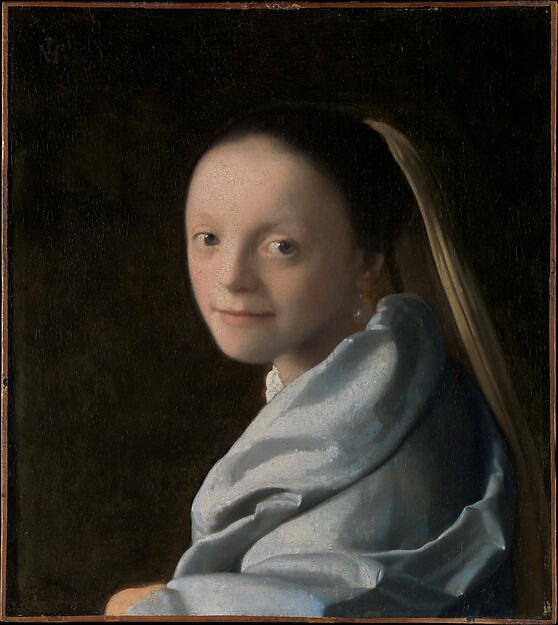
Vermeer turns a woman's action near a window into a measured encounter with light, domestic space, and attention. Vermeer turns an ordinary action into an arrangement of light, fabric, metal, and space. The figure stands between the window and the objects of the room, so that opening the day becomes a quiet event. The map behind her enlarges the world beyond this carefully measured interior. Now set it beside Study of a Young Woman. Vermeer makes a young woman's face the center of a study in light, expression, and quiet attention. The young woman's face is caught in soft light against a dark setting. Vermeer withholds a full narrative and lets expression and illumination lead the encounter. Both works are linked below this profile, with their own object records and images. They reward comparison because they show Johannes Vermeer making different decisions, sometimes with a different material, even when a familiar concern carries across the two.
Vermeer after his lifetime
He worked in Delft and was respected during his life, though his name later slipped from prominence. Rediscovered in the nineteenth century, he is now admired for the balance of structure and intimacy in works such as Girl with a Pearl Earring and The Milkmaid. Rediscovery altered his status long after his death. The modern image of a solitary genius should be balanced against the household, marketplace, and visual culture of seventeenth-century Delft. A third work, Allegory of the Catholic Faith, complicates any account built from a single celebrated picture. Vermeer fills an interior with symbolic objects and a central figure, turning religious allegory into a precisely arranged room. Symbolic objects crowd the room around a central figure. Vermeer uses the careful structure of an interior to make an allegory visible without giving it a single simple reading. Fame draws attention to certain pictures, but this additional object widens the view. Johannes Vermeer’s work remains open to new comparisons as collections and records are studied.
Young Woman with a Water Pitcher leaves the action near a window open to interpretation. Study of a Young Woman concentrates that uncertainty in a turning face, while Allegory of the Catholic Faith fills an interior with named symbols. These works share Vermeer’s care with light, yet each gives its viewer a different task. A quiet room can hold private attention, a face can resist a story, and an allegory can ask to be read object by object.
Explore Dutch Golden Age ↗