Young Woman with a Water Pitcher in its time
Vermeer turns a woman's action near a window into a measured encounter with light, domestic space, and attention. Young Woman with a Water Pitcher is dated ca. 1662 and is held by The Metropolitan Museum of Art. The source record names it “Young Woman with a Water Pitcher.” Knowing where Young Woman with a Water Pitcher belongs helps; it also leaves open the question of how the maker organized what we see.
A closer view
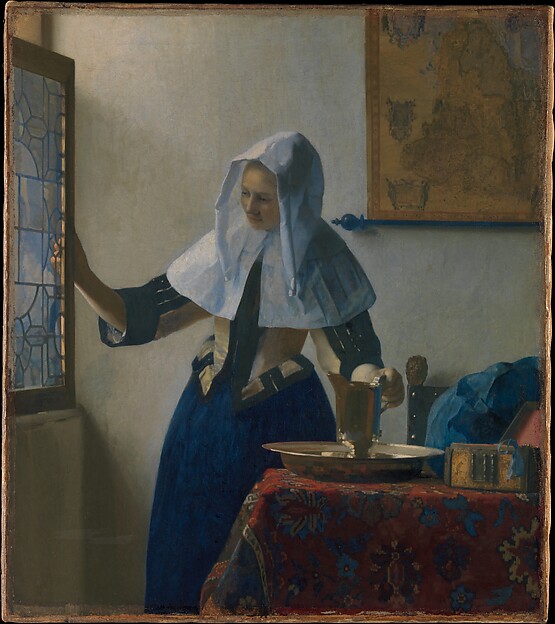
Vermeer turns an ordinary action into an arrangement of light, fabric, metal, and space. The figure stands between the window and the objects of the room, so that opening the day becomes a quiet event. The map behind her enlarges the world beyond this carefully measured interior. Look at how Young Woman with a Water Pitcher handles distance. Its nearest forms and farthest spaces may be described with very different degrees of clarity. That difference affects where you feel invited to stand.
What the medium can tell us
The collection records Young Woman with a Water Pitcher as oil on canvas. The stated materials of Young Woman with a Water Pitcher limit what we can reasonably claim about its making. Follow the record for those details, then return to the image to look for their visible effects. The material description for Young Woman with a Water Pitcher matters because an image seen at screen size can conceal how it was first made and handled. The image of Young Woman with a Water Pitcher invites another look at its arrangement; its collection entry gives the material description and further details about the work.
Johannes Vermeer and this work
Vermeer made quiet rooms feel vast. In a relatively small body of surviving paintings, he used windows, maps, tiled floors, and concentrated color to turn daily routines into moments of attention. The hand at the window and the pitcher on the table connect a near action to the wider room. Vermeer lets the map remain legible behind the figure, suggesting another scale of life beyond this domestic instant. An artist’s name can make a work feel familiar before we have really looked at it. The career gives context to the object; the object can also complicate the familiar account of the career. Its subject, medium, and visible emphasis may seem consistent with other works, or they may reveal a different route. Ask what this subject allowed the artist to test here and which decisions depend on its particular size or material. An artist’s story gains detail from works like Young Woman with a Water Pitcher rather than supplying a ready explanation for them. For Johannes Vermeer, Young Woman with a Water Pitcher was one particular solution among many. A second work can show which decisions were revisited and which were left behind.
The world around Young Woman with a Water Pitcher
Vermeer lived and worked in Delft, where domestic interiors could carry questions about wealth, knowledge, music, and social conduct. His surviving output is small enough that every canvas attracts close attention. A viewer first meeting Young Woman with a Water Pitcher in ca. 1662 may have known its subject and setting differently. That distance is one reason to keep both the image and its documented record in view. A record helps place Young Woman with a Water Pitcher in a collection. The details you notice in the image can then lead to more precise questions.
Image and object record
The Metropolitan Museum of Art identifies Young Woman with a Water Pitcher as a work by Johannes Vermeer from ca. 1662 and records its medium as oil on canvas. The collection credits the object to Marquand Collection, Gift of Henry G. Marquand, 1889. Follow the linked object record for its catalogue entry and any further notes on its history.