
From Dutch landscape to grids
Mondrian simplified trees, dunes, and seascapes before arriving at compositions of black lines and colored rectangles. His mature paintings seek dynamic balance through the fewest possible elements. Piet Mondrian (1872–1944) worked in Netherlands and France and United States. Mondrian’s abstract grids emerged through years of looking at trees, dunes, and seascapes. Moves between the Netherlands, Paris, London, and New York placed the work in changing artistic circles. The place and dates locate Piet Mondrian, while the objects below show what such a life could produce. Their differences deserve as much attention as their resemblance.
The balance of unequal parts
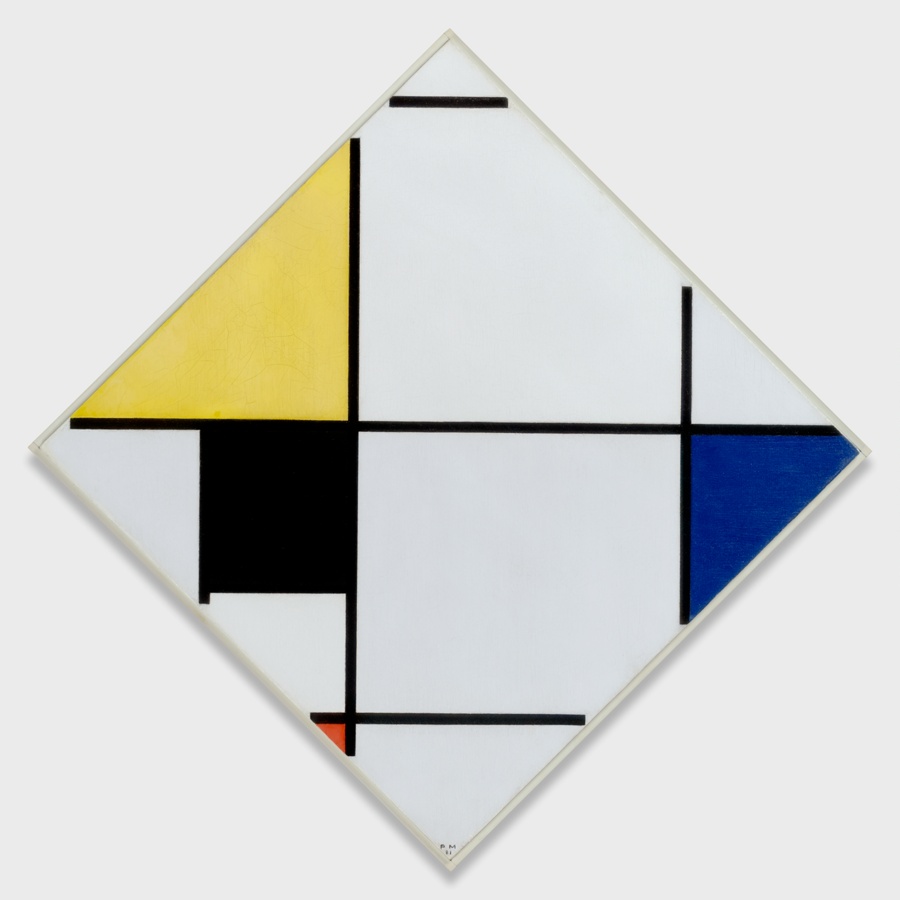
Black lines and colored rectangles are never simply filled-in geometry. Their unequal widths and intervals make balance feel negotiated rather than mechanically solved. Look at Lozenge Composition with Yellow, Black, Blue, Red, and Gray and then at a different work below. The comparison makes clear which choices Piet Mondrian returned to and which belonged only to one image.
A painting built from intervals
Broadway Boogie Woogie translated the pulse of a city into small units of color and movement. Earlier tree studies help show how far his reduction developed. What survives from a career is uneven: famous objects, studies, commissions, and works valued differently by later audiences. Lozenge Composition with Yellow, Black, Blue, Red, and Gray deserves attention as one of those objects, with a date and medium that can be checked. A close look may reveal a decision missing from the standard story of Piet Mondrian. Moving from this work to another on the page helps restore an experimental life behind the short account of a style.
Abstraction and its limits
Piet Mondrian is associated with Abstraction. Abstraction reduces, transforms, or releases recognizable subjects so that line, color, shape, and material can lead. It is a broad field, from Kandinsky’s lyrical compositions to Mondrian’s measured grids and later color field painting. Looking closely reveals how distinct these approaches are. Movements are conversations held through exhibitions, training, images, and later writing. Piet Mondrian participated in one such history, and Lozenge Composition with Yellow, Black, Blue, Red, and Gray gives that story a specific surface. A comparison with a peer can show where the artists met and where they parted. The label works best when it leads us back to that particularity instead of taking it away.
A closer look at Lozenge Composition with Yellow, Black, Blue, Red, and Gray
Mondrian balances a tilted square, colored blocks, and black lines with exact but lively asymmetry. Mondrian turns the square on a point, making the canvas edge part of the picture’s rhythm. Black lines and unequal color areas resist a simple centered balance. The result is measured yet active: each interval changes the weight of the spaces around it. Now set it beside Farm near Duivendrecht. Mondrian paints a farm and its reflection through repeated trees and architecture, linking his later abstractions to landscape observation. Farm buildings and bare trees meet their reflections in still water. Mondrian's landscape makes repeated vertical and horizontal forms visible before his later grid paintings. Both works are linked below this profile, with their own object records and images. They reward comparison because they show Piet Mondrian making different decisions, sometimes with a different material, even when a familiar concern carries across the two.
Mondrian beyond the square
The apparent strictness is deceptive. Small shifts in proportion and placement give each work its own rhythm. His ideas traveled far beyond painting into design, architecture, and visual culture. Designers have borrowed his style so freely that the paintings can seem familiar before they are seen. Their precise irregularities reward a slow encounter with the actual surface. A third work, Composition (No. 1) Gray-Red, complicates any account built from a single celebrated picture. Mondrian gives lines and a restrained red accent a measured tension within an abstract composition. A few lines divide pale fields, and the red accent changes their apparent weight. Mondrian builds a quiet but active balance from unequal parts. Read beside the earlier works, this object makes the arc of Piet Mondrian’s career less predictable. Its survival lets us notice decisions a short label might hide.
Farm near Duivendrecht makes vertical trees, buildings, and reflections conspicuous in a recognizable landscape. Composition (No. 1) Gray-Red and the Lozenge Composition give far fewer elements the work of holding a picture together. Seen in sequence, they show Mondrian changing the role of line and interval. The early landscape should still be allowed to stand on its own, not only as a forecast of later grids.
Explore Abstraction ↗
