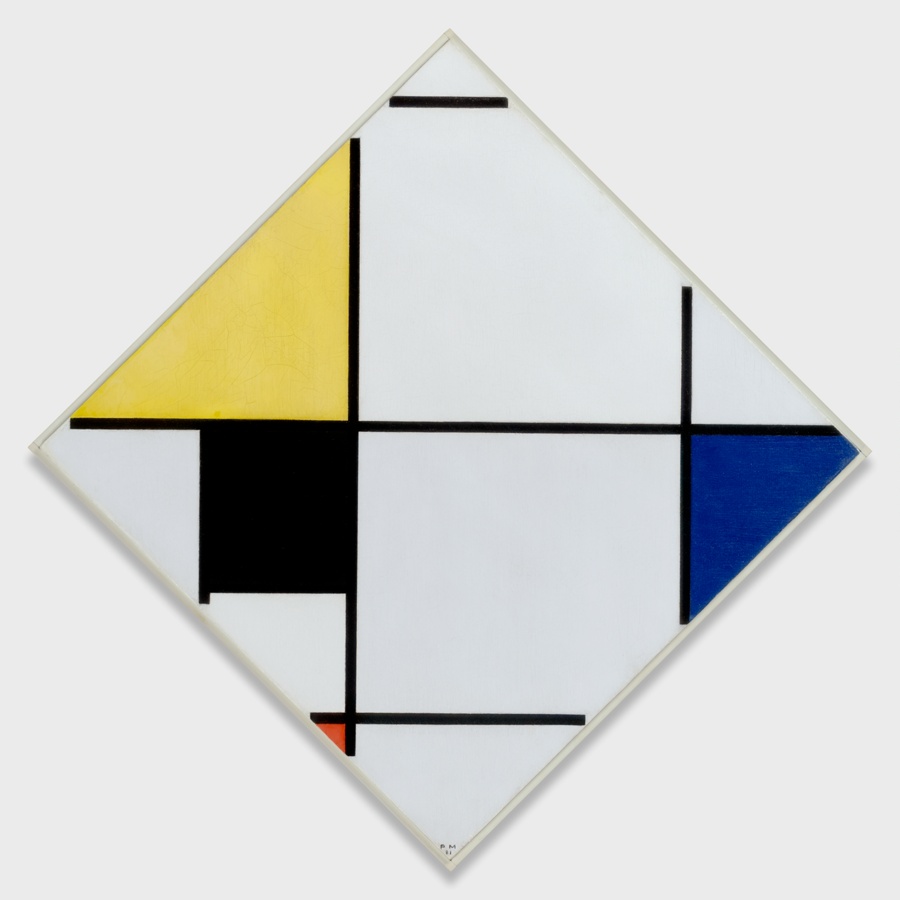

Farm near Duivendrecht in its time
Mondrian paints a farm and its reflection through repeated trees and architecture, linking his later abstractions to landscape observation. Farm near Duivendrecht is dated c. 1916 and is held by Art Institute of Chicago. The source record names it “Farm near Duivendrecht.” With Farm near Duivendrecht, the catalogue provides the facts of the object; the visual relationships carry the experience further.
What appears at first glance
Farm buildings and bare trees meet their reflections in still water. Mondrian's landscape makes repeated vertical and horizontal forms visible before his later grid paintings. In Farm near Duivendrecht, a minor detail can change the balance of the larger view. Let your eye move from its busiest place toward a quieter passage, then return. The route is part of the work’s design.
The material object
The collection records Farm near Duivendrecht as oil on canvas. Black lines and colored rectangles are never simply filled-in geometry. Their unequal widths and intervals make balance feel negotiated rather than mechanically solved. The listed materials give Farm near Duivendrecht a physical history beyond its familiar digital image, including a support, surface, and scale. Look between the image of Farm near Duivendrecht and its object record. Each answers different questions about appearance, material, and scale.
Piet Mondrian and this work
The apparent strictness is deceptive. Small shifts in proportion and placement give each work its own rhythm. His ideas traveled far beyond painting into design, architecture, and visual culture. Bare trees, farm buildings, and reflections repeat vertical and horizontal directions. Mondrian’s later grid can be approached through this observed landscape without treating it as a simple preview. The source identifies Farm near Duivendrecht as one work in a changing practice. For Piet Mondrian, a visual effect was never an abstract signature floating free of materials and purpose. Another image by the same maker may use a related method toward another end, or change the method altogether. The choices in this image have a pace of their own. Treating each object as a fresh decision makes room for change, experiment, and the practical conditions under which an artist worked. No single image can contain Piet Mondrian’s career. Farm near Duivendrecht is a vivid place to begin, with other works nearby to complicate the view.
The world around Farm near Duivendrecht
For Farm near Duivendrecht, c. 1916 is an anchor rather than a full explanation. The linked institution identifies the object, but its first setting and audience require further historical questions. Farm near Duivendrecht carries a date, c. 1916, but it has also had a later life. Each collection, display, or reproduction offers another meeting with the same historical object. The linked source keeps Farm near Duivendrecht tied to a particular object while you continue exploring what its image makes visible.
Image and object record
Art Institute of Chicago identifies Farm near Duivendrecht as a work by Piet Mondrian from c. 1916 and records its medium as oil on canvas. The collection credits the object to Gift of Dolly J. van der Hoop Schoenberg. Follow the linked object record for its catalogue entry and any further notes on its history.