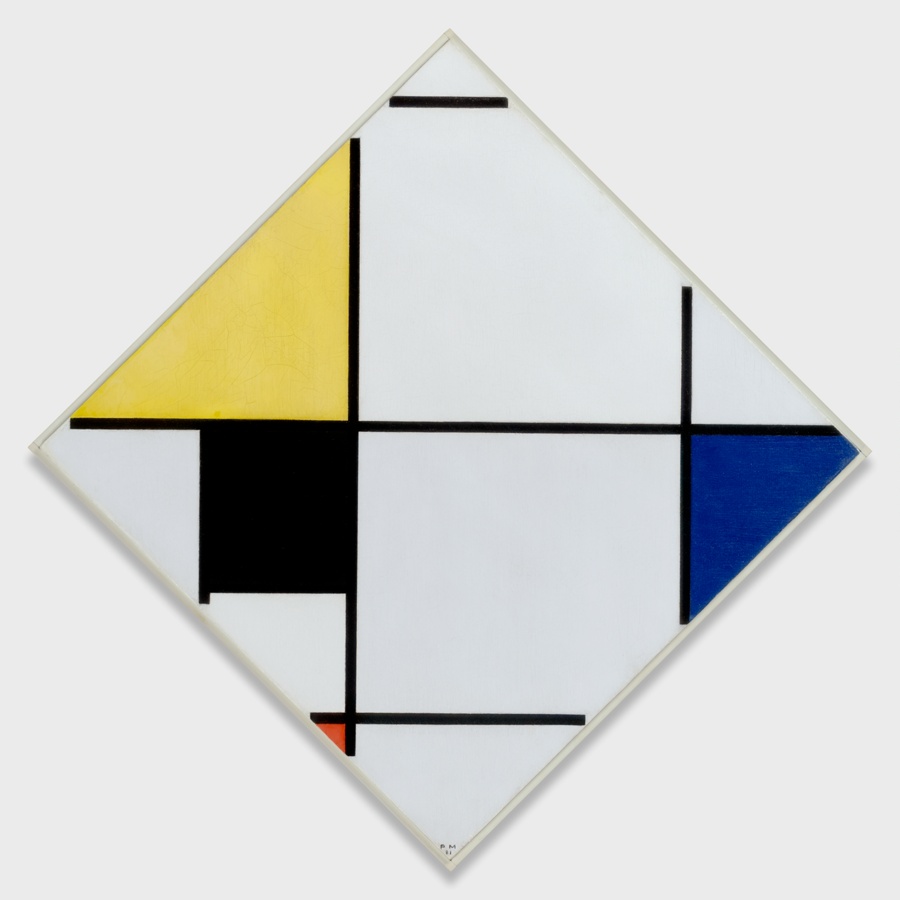
Composition (No. 1) Gray-Red in its time
Mondrian gives lines and a restrained red accent a measured tension within an abstract composition. Composition (No. 1) Gray-Red is dated 1935 and is held by Art Institute of Chicago. The source record names it “Composition (No. 1) Gray-Red.” The record identifies Composition (No. 1) Gray-Red; the image itself invites a slower look at how its parts meet.
A closer view
A few lines divide pale fields, and the red accent changes their apparent weight. Mondrian builds a quiet but active balance from unequal parts. Look at how Composition (No. 1) Gray-Red handles distance. Its nearest forms and farthest spaces may be described with very different degrees of clarity. That difference affects where you feel invited to stand.
What the medium can tell us
The collection records Composition (No. 1) Gray-Red as oil on canvas. The stated materials of Composition (No. 1) Gray-Red limit what we can reasonably claim about its making. Follow the record for those details, then return to the image to look for their visible effects. In Composition (No. 1) Gray-Red, the recorded material is part of the encounter: it affects the scale, marks, and finish that the original object can hold. Look again at the strongest visual accent in Composition (No. 1) Gray-Red. The linked record supplies dimensions and materials that help place that detail within the whole work.
Piet Mondrian and this work
Broadway Boogie Woogie translated the pulse of a city into small units of color and movement. Earlier tree studies help show how far his reduction developed. The red accent changes the weight of pale fields divided by lines. Mondrian’s restraint leaves every interval responsible for the balance of the whole. An artist’s name can make a work feel familiar before we have really looked at it. Its surface and arrangement hold decisions made for this image alone. Its subject, medium, and visible emphasis may seem consistent with other works, or they may reveal a different route. Another work from the same career may answer those questions differently. A biography becomes more convincing when actual objects are allowed to disagree with a tidy summary. Composition (No. 1) Gray-Red belongs to Piet Mondrian’s longer practice, and the other works in this collection let you test what changed from one subject to another.
The world around Composition (No. 1) Gray-Red
Designers have borrowed his style so freely that the paintings can seem familiar before they are seen. Their precise irregularities reward a slow encounter with the actual surface. Composition (No. 1) Gray-Red has been seen under different conditions since 1935. Its first setting shaped its audience; the linked record documents the object as it is known today. Read the documented title and medium for Composition (No. 1) Gray-Red beside the image; the record can settle object details while leaving interpretation open.
Image and object record
Art Institute of Chicago identifies Composition (No. 1) Gray-Red as a work by Piet Mondrian from 1935 and records its medium as oil on canvas. The collection credits the object to Gift of Mrs. Gilbert W. Chapman. Follow the linked object record for its catalogue entry and any further notes on its history.