
Lozenge Composition with Yellow, Black, Blue, Red, and Gray in its time
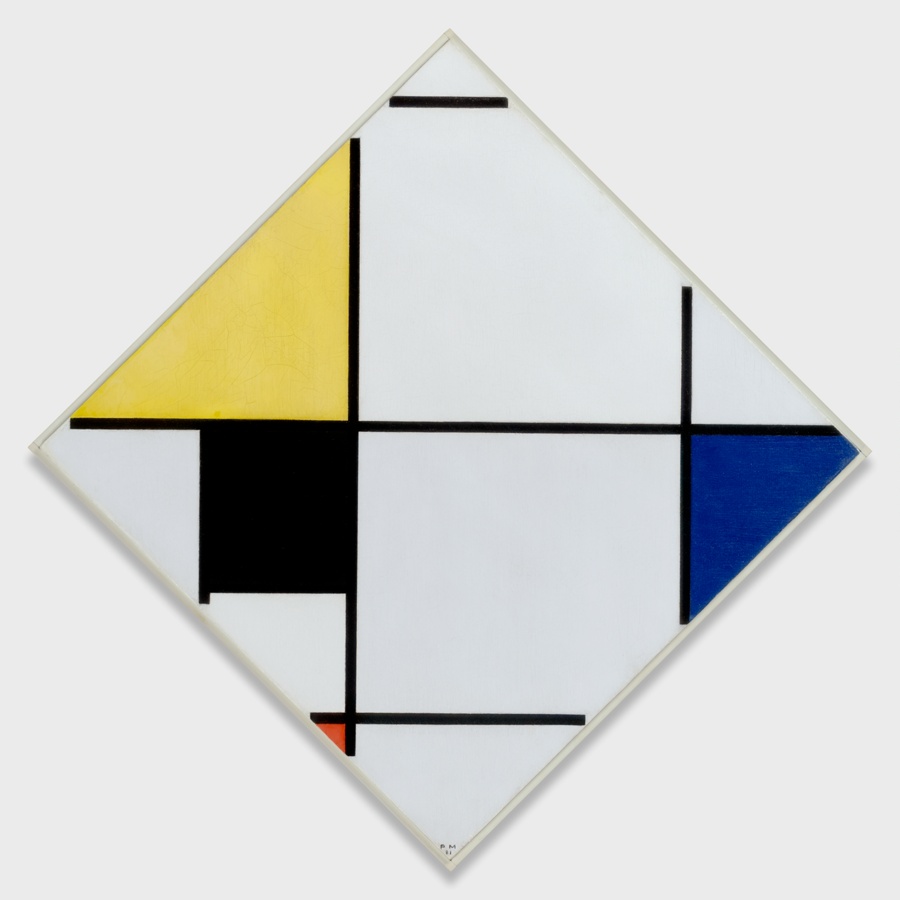
Mondrian balances a tilted square, colored blocks, and black lines with exact but lively asymmetry. Lozenge Composition with Yellow, Black, Blue, Red, and Gray is dated 1921 and is held by Art Institute of Chicago. The source record names it “Lozenge Composition with Yellow, Black, Blue, Red, and Gray.” With Lozenge Composition with Yellow, Black, Blue, Red, and Gray, the catalogue provides the facts of the object; the visual relationships carry the experience further.
How the picture holds together
Mondrian turns the square on a point, making the canvas edge part of the picture’s rhythm. Black lines and unequal color areas resist a simple centered balance. The result is measured yet active: each interval changes the weight of the spaces around it. The arrangement in Lozenge Composition with Yellow, Black, Blue, Red, and Gray is purposeful even where it feels informal. Compare where the strongest marks gather with the quieter ground around them. That relationship gives the subject its visual weight.
The material object
The collection records Lozenge Composition with Yellow, Black, Blue, Red, and Gray as oil on canvas. With Lozenge Composition with Yellow, Black, Blue, Red, and Gray, the source’s medium label points to a process as well as a finished image. Surface, scale, and handling can change what close looking reveals. The listed materials give Lozenge Composition with Yellow, Black, Blue, Red, and Gray a physical history beyond its familiar digital image, including a support, surface, and scale. Look between the image of Lozenge Composition with Yellow, Black, Blue, Red, and Gray and its object record. Each answers different questions about appearance, material, and scale.
Piet Mondrian and this work
Mondrian simplified trees, dunes, and seascapes before arriving at compositions of black lines and colored rectangles. His mature paintings seek dynamic balance through the fewest possible elements. The rotated support changes how Mondrian’s black lines meet the edge. Small differences in width and color prevent the picture from feeling mechanically balanced, even though its elements are spare. For Piet Mondrian, making Lozenge Composition with Yellow, Black, Blue, Red, and Gray meant choosing among possible viewpoints, marks, and degrees of finish. Lozenge Composition with Yellow, Black, Blue, Red, and Gray benefits from a slower encounter. Another image by the same maker may use a related method toward another end, or change the method altogether. Follow the linked works rather than relying on one celebrated image. The pace of Lozenge Composition with Yellow, Black, Blue, Red, and Gray deserves attention; another work by Piet Mondrian may move the eye quite differently. No single image can contain Piet Mondrian’s career. Lozenge Composition with Yellow, Black, Blue, Red, and Gray is a vivid place to begin, with other works nearby to complicate the view.
The world around Lozenge Composition with Yellow, Black, Blue, Red, and Gray
Mondrian’s abstract grids emerged through years of looking at trees, dunes, and seascapes. Moves between the Netherlands, Paris, London, and New York placed the work in changing artistic circles. Lozenge Composition with Yellow, Black, Blue, Red, and Gray carries a date, 1921, but it has also had a later life. Each collection, display, or reproduction offers another meeting with the same historical object. The linked source keeps Lozenge Composition with Yellow, Black, Blue, Red, and Gray tied to a particular object while you continue exploring what its image makes visible.
Image and object record
Art Institute of Chicago identifies Lozenge Composition with Yellow, Black, Blue, Red, and Gray as a work by Piet Mondrian from 1921 and records its medium as oil on canvas. The collection credits the object to Gift of Edgar Kaufmann, Jr.. Follow the linked object record for its catalogue entry and any further notes on its history.

