John Constable painted landscapes that many people now think they have always known: a river crossing, a boy in a shaded lane, a cathedral beneath moving weather. Their familiarity can hide what made them difficult. He took ordinary places seriously on a large scale, built outdoor observation into carefully planned exhibition pictures, and kept asking how paint could carry the unstable life of a sky.
A childhood beside the Stour
Constable was born in East Bergholt, Suffolk, in 1776. His father operated mills and a shipping business on the River Stour, so water, boats, banks, and the work around them were not distant curiosities. The places he later painted had practical uses and familiar names. He knew how a river could support a household and how weather could change the work planned for a day. That knowledge gave his landscape painting a particular ground beneath its beauty.
He did not arrive at painting through one sudden revelation in a field. He learned, studied earlier artists, and developed his skill while family expectations pulled him toward the business. London eventually offered formal artistic training, but he continued to return to Suffolk subjects. The movement between city studio and remembered countryside became a lasting part of his method, rather than a problem he solved once and left behind.
Learning to trust a local place
British landscape painting could reward a grand, historically resonant view. Constable made an argument for the places closest to him: a millpond, a track between villages, the ordinary tree line across a meadow. He did not have to pretend those scenes were untouched by people. Their houses, wagons, animals, and field workers were part of what made them worth studying. A landscape could be local and still carry the ambition of a major painting.
That ambition did not make him indifferent to small observations. He drew and painted sketches outdoors, recording cloud forms, light, and the way a familiar bank changed from one day to another. Those studies were not miniature versions of every later canvas. They were a store of looking, material he could use when a large composition needed convincing air and place. His celebrated skies grew from patient attention as well as freedom with the brush.
The six-foot pictures
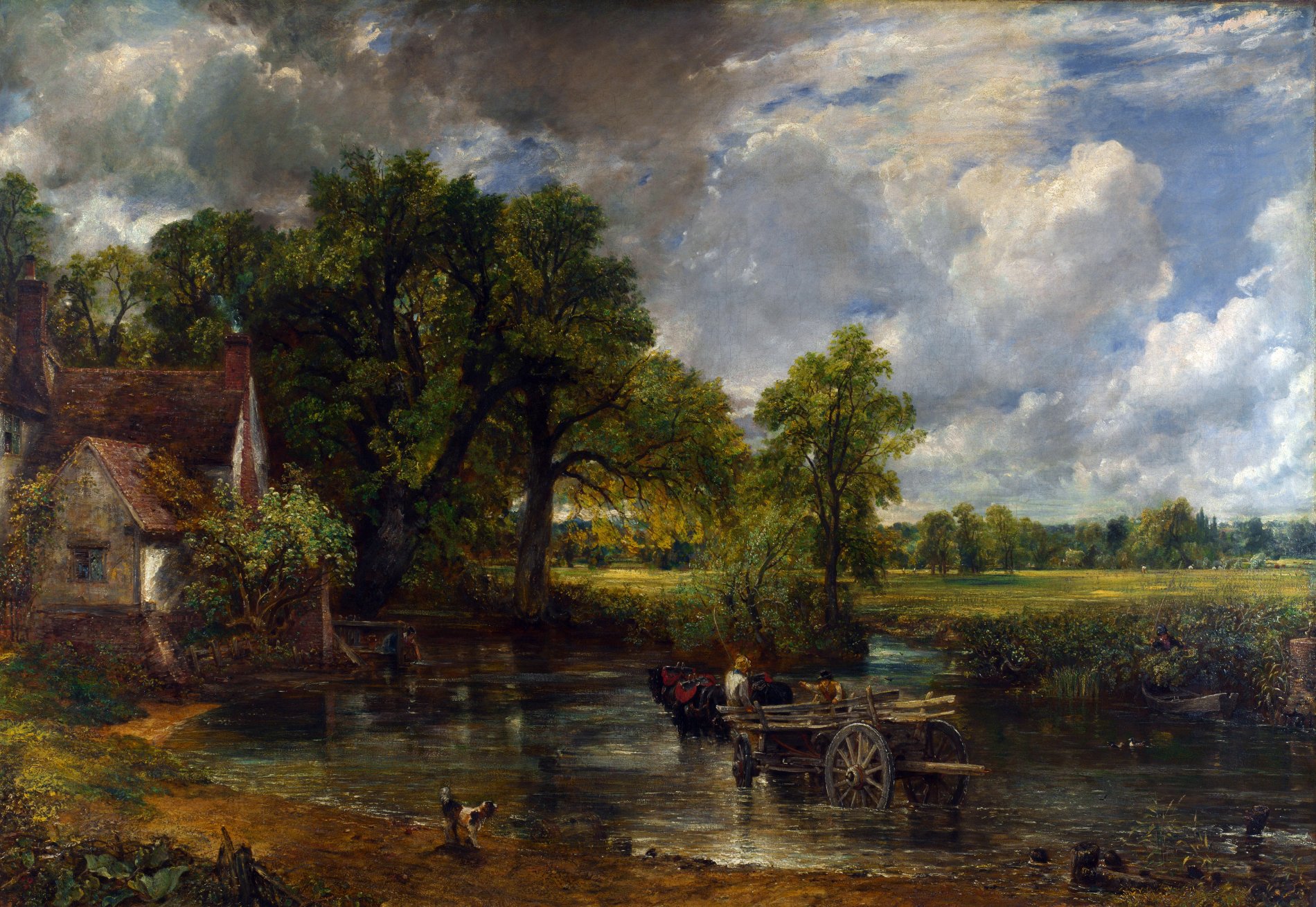
Constable began making large exhibition landscapes sometimes called his six-footers. Their size changed the status of the scenes he chose. The Hay Wain, completed in 1821, gives the crossing at Flatford the visual room usually granted to more elevated subjects. The wagon is a practical object, and the mill belongs to a family economy, yet both sit under a sky capable of commanding the whole canvas. That balance between human use and moving weather became one of his great strengths.
A scene so closely tied to Suffolk was completed in a London studio. Constable worked from drawings, oil sketches, and memory, adjusting figures and the route of the eye. The apparent immediacy is a crafted achievement. The Hay Wain found important recognition in France after its appearance at the Paris Salon in 1824. Its later iconic status should not make us imagine that English buyers immediately understood what he was trying to do.
Summer made during winter
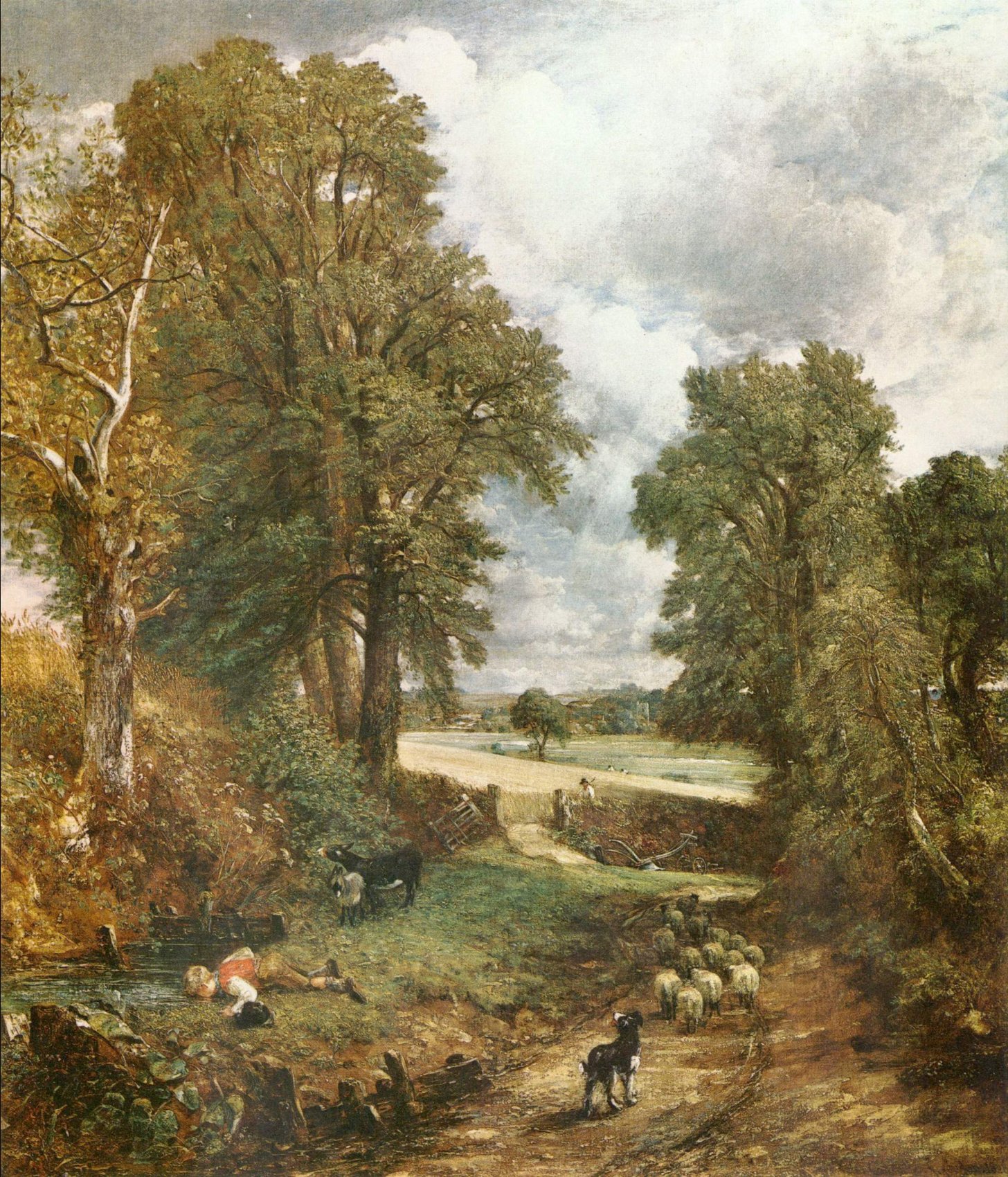
The Cornfield followed in 1826. Constable painted its hot Suffolk lane in London between January and March. A boy drinking from a pool and sheep moving ahead give the scene a small narrative, while the shady trees and bright field make temperature almost visible. Much of the distant country was invented around a path he knew. This is a useful example of how close observation and imaginative construction worked together in his art.
The picture was praised but remained unsold through several exhibitions. Constable's career was not a straight march from success to success. He faced the practical uncertainty of a market for large landscapes and the personal strain of maintaining a family while pursuing his work. That context makes the boy's pause and the inviting lane feel less like easy nostalgia. They came from a painter for whom the making and selling of pictures were sustained labor.
Weather after loss
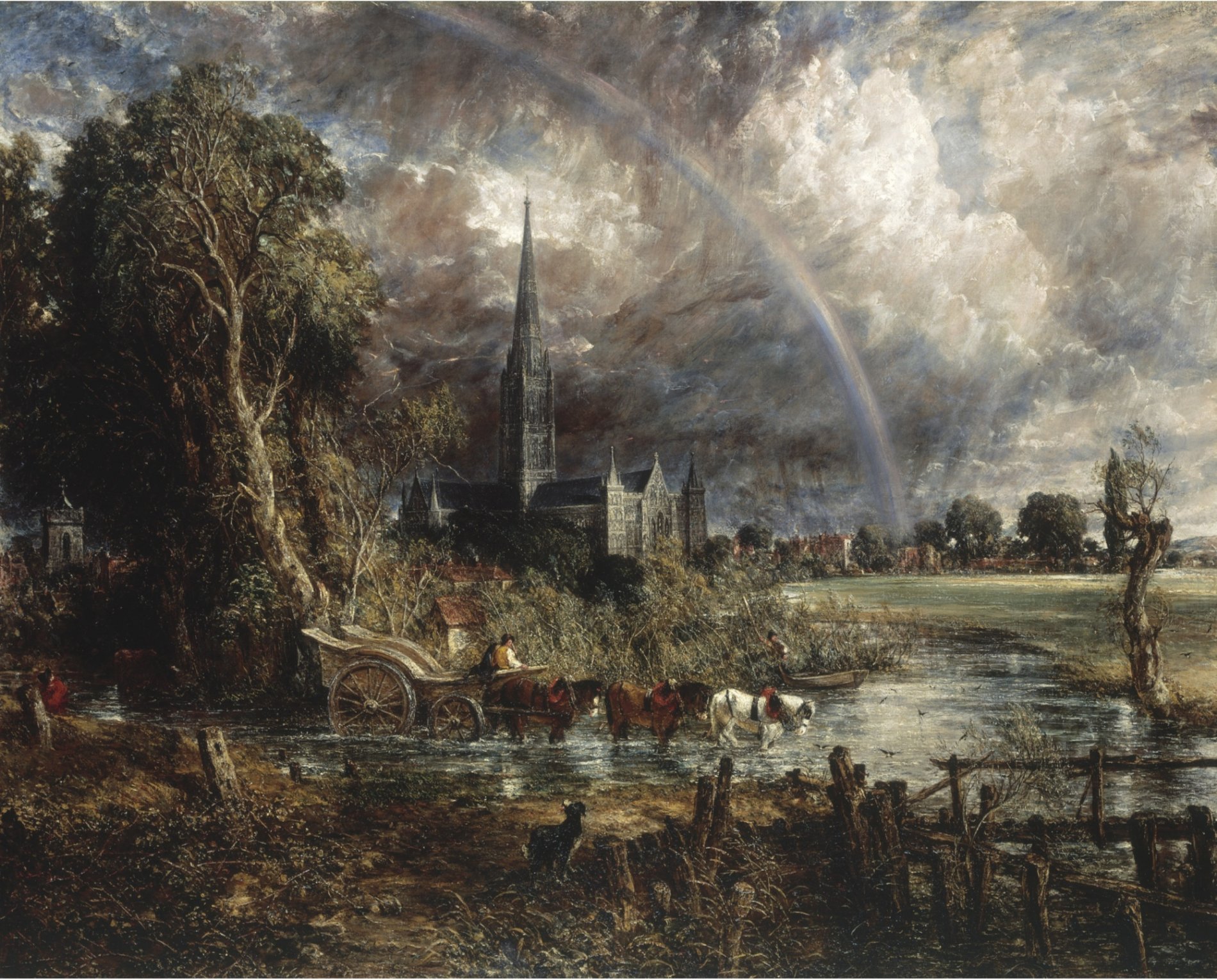
Constable's wife Maria died in 1828. He continued to paint, and Salisbury Cathedral from the Meadows, exhibited in 1831, has often been read through that grief. Its dark cloud and rainbow can invite such a reading. It is wiser to keep personal history beside, rather than on top of, the image. He had long studied weather and had painted Salisbury from different angles. The cathedral scene joins those artistic interests to a period of real loss without becoming a coded diary entry.
He was elected to the Royal Academy in 1829, relatively late in his career. By the time he died in 1837, he had made a body of work that changed what a familiar English place could mean on canvas. He also left studies and unfinished inquiries that keep the work from hardening into a single style. The ambition of the large paintings and the quickness of the sketches belong to the same searching artist.
How to meet Constable now
Begin with the wagon in The Hay Wain, then move to the thirsty boy in The Cornfield and the storm over Salisbury. Each picture gives a different role to human activity, memory, and weather. None is simply a transparent view through a window. Constable chose where to stand, what to bring together, and how a mark of paint might make a cloud or river feel alive.
His paintings are sometimes used as shorthand for a peaceful countryside. Their best moments resist that flattening. The land is worked, a child is tired, and weather can be uncertain even when a rainbow appears. Constable cared for these places enough to show their changes. The reward for a viewer is not a permanent escape into rural calm, but a more attentive way of meeting the world just outside a door.
Explore Romanticism ↗