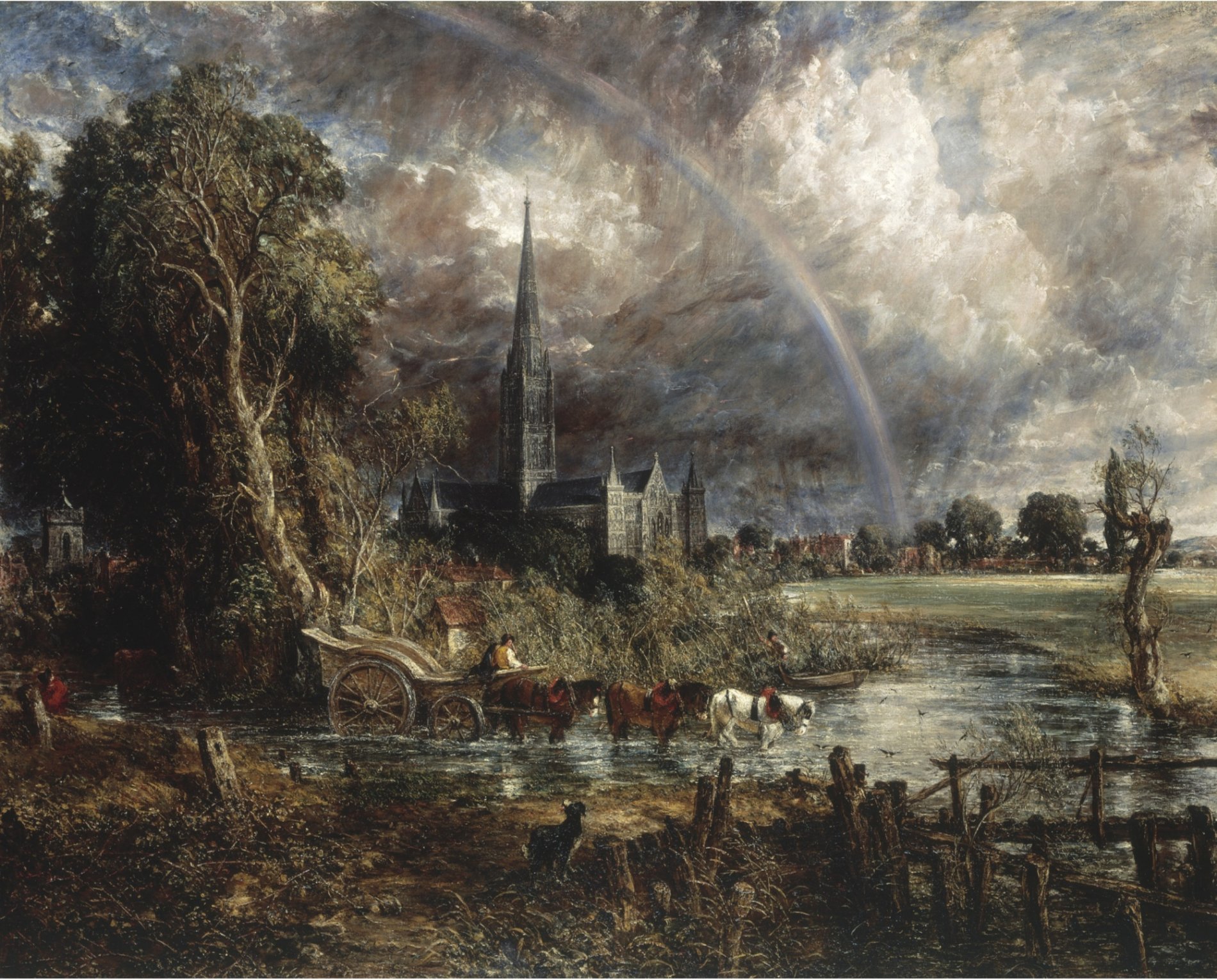
A cathedral rises in the distance, but it has to compete with the sky. Rain-dark cloud sweeps across Salisbury Cathedral from the Meadows, while a rainbow arches over the scene and light reaches the grazing land below. Constable has built a landscape that refuses to choose between threat and reassurance. It can look hopeful, and it can look troubled, in the same glance.
A landmark almost lost to weather
Salisbury Cathedral's spire gives the painting a clear point of recognition. Yet Constable makes us travel across water, cattle, trees, and field before we reach it. The building is not a solitary architectural portrait. It belongs to a lived landscape under changing conditions, and the threatening cloud can make the familiar spire seem briefly fragile.
The rainbow is especially easy to overread. It has a traditional language of promise, but it is also a particular effect of rain and sun sharing the sky. Constable may have valued both possibilities. The arc connects parts of the composition without explaining exactly what the viewer should feel. Its beauty does not sweep the dark weather away.
The scene has a difficult date
Constable exhibited the painting in 1831. His wife Maria had died in 1828, and later viewers often find private grief in the storm. That context can enrich a reading, but a canvas is not a diary entry in code. Constable also cared deeply about the pictorial drama of weather and the public force of a large landscape. The picture can carry loss without every cloud standing for a named emotion.
Salisbury was a place of artistic and personal importance to him. He made other cathedral views at different times and from different vantage points. Here he chooses a broad meadow setting rather than a close view of the stonework. We see the building at a distance, almost as something approached through uncertainty.
Painted weather, not just pictured weather
The dark cloud is not a smooth lid laid over the scene. Its edges break and move, while lighter areas pull the eye toward the rainbow. Below, the river catches fragments of that changing light. Constable used strong contrasts to make the entire surface feel unsettled. A reproduction can convey the design, but the full canvas asks the eye to pass between small ground details and a sky that seems much larger than the human world.
A rainbow is hard to paint without making it look pasted on. Constable lets it belong to the same moist atmosphere as the cloud and river. Its curve carries us above the spire and back toward the foreground. That movement makes the promise of clearer weather feel possible rather than guaranteed.
What the cathedral can and cannot anchor
The spire holds steady while the light changes around it. That stability has encouraged readings about faith and endurance, and the painting leaves room for them. It also asks us to notice people, cattle, and water at ground level. An institution may endure in stone; a morning is experienced in wind, wet grass, and the next change of sky.
Look first at the building, then let it disappear behind your attention to the cloud. Look again and it returns as a point of orientation. This rhythm is part of the work's emotional intelligence. Salisbury Cathedral from the Meadows does not turn storm into an easy moral. It lets a familiar landmark stand inside a world that refuses to stay still.