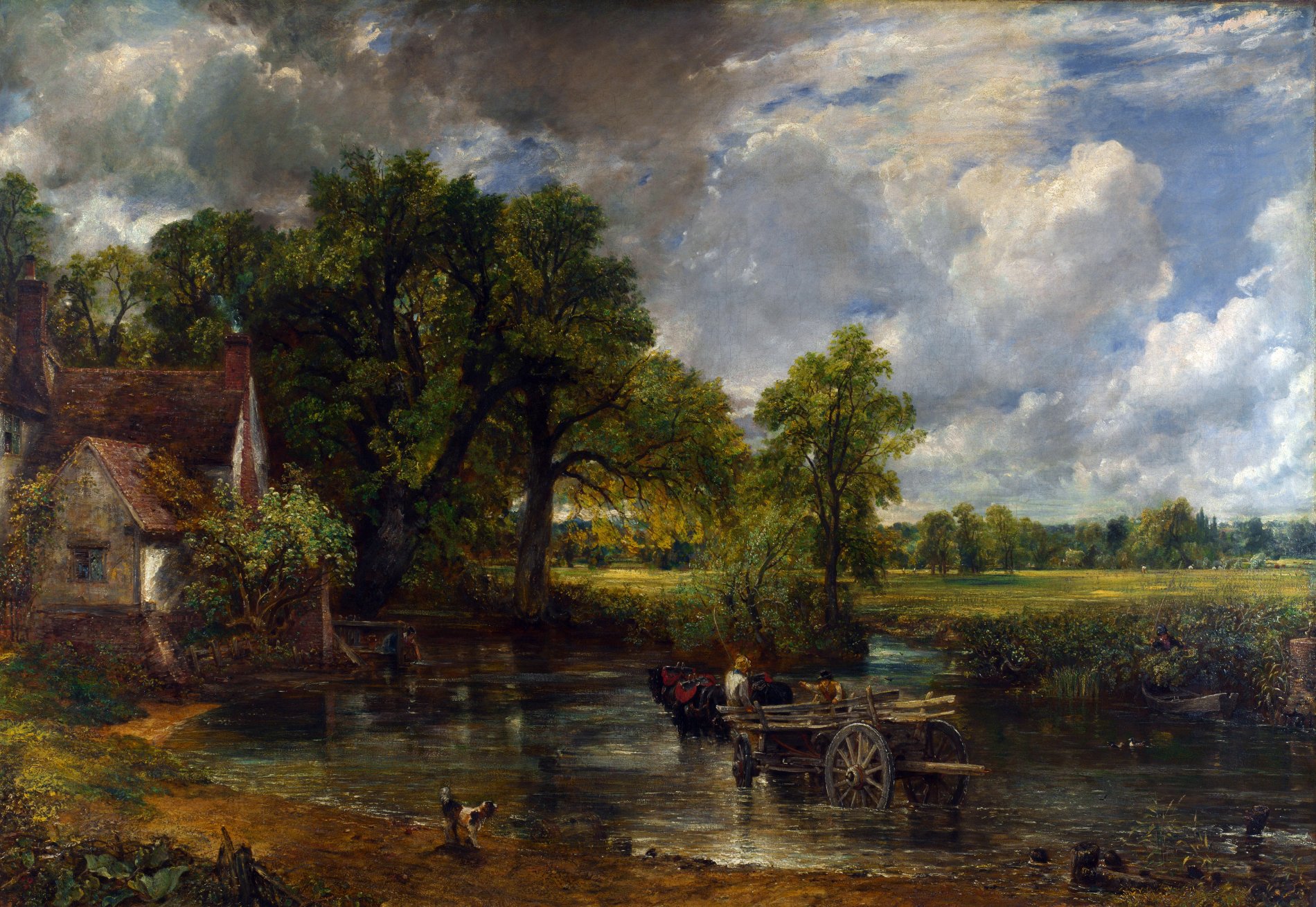
A wagon waits in shallow water, and a river does what rivers do: it interrupts the day's work. The Hay Wain is so familiar that it can look like a ready-made picture of peaceful England. Constable knew this stretch of the Stour as a working place, however. Spend a few minutes with its mud, people, moving cloud, and busy distances, and the calm begins to feel earned rather than supplied.
A crossing, not a postcard
The wooden wagon, or wain, is heading toward the haymakers in the meadow beyond the river. It has to cross the ford first. On the left stands Willy Lott's house, next to a millpond connected to the Constable family's milling business at Flatford. The house and water were part of an everyday landscape the artist had known since childhood. Their appearance here is affectionate, but it is also precise about how people used the place.
Look beyond the wagon and the far meadow seems full of small tasks. The figures do not turn toward us to explain themselves. A dog watches near the foreground, and a woman works by the house. Constable gives the river a social life without making any one worker the hero of the scene. The picture is large enough to invite a wandering eye, as a real riverbank might.
Weather has a speaking part
The sky takes nearly half the canvas. Clouds gather, break, and drift over the fields, changing the brightness of everything below. Constable watched weather closely, making studies that helped him understand how a cloud mass can lift or weigh down an entire view. In The Hay Wain, light is not a single spotlight. It passes unevenly over water, foliage, and hay ground.
That restless sky keeps the scene from settling into a perfect rural emblem. There may be enough time to cross the ford and finish the day's work; there may also be rain. Constable does not need to decide for us. The paint makes the atmosphere feel temporary, as though the same place would look quite different an hour later.
Made in London from a remembered Suffolk
The painting was completed in 1821 in Constable's London studio. He drew on earlier sketches of the house and river, rather than setting up a huge canvas beside the ford. That process matters. The view is rooted in close knowledge, yet its apparent ease is an arrangement worked out over time. Constable enlarged local details into a composition that could stand before a Royal Academy audience.
It is tempting to call the scene natural because the objects are familiar: a cottage, trees, water, a wagon. But follow how the bank guides the eye toward the crossing and how patches of light pull us from the near water to the distant field. The painter has made a route through a complicated place. We experience that route as discovery.
What the idyll leaves visible
A view of farm work can easily become an escape for viewers who do not have to perform it. The Hay Wain certainly offers pleasure: cool water, warm light, and the deep shade of old trees. It also shows that the land is managed, inhabited, and economically useful. The mill, the hayfield, and the wagon are all part of the same system, even when no one in the picture looks hurried.
Return to the wagon after looking around the whole canvas. It has moved nowhere. The delay lets us take in the sky, the bank, and the workers who will be waiting on the other side. Constable makes a pause in labor hold an entire landscape. That is more interesting, and more human, than a countryside emptied for our enjoyment.