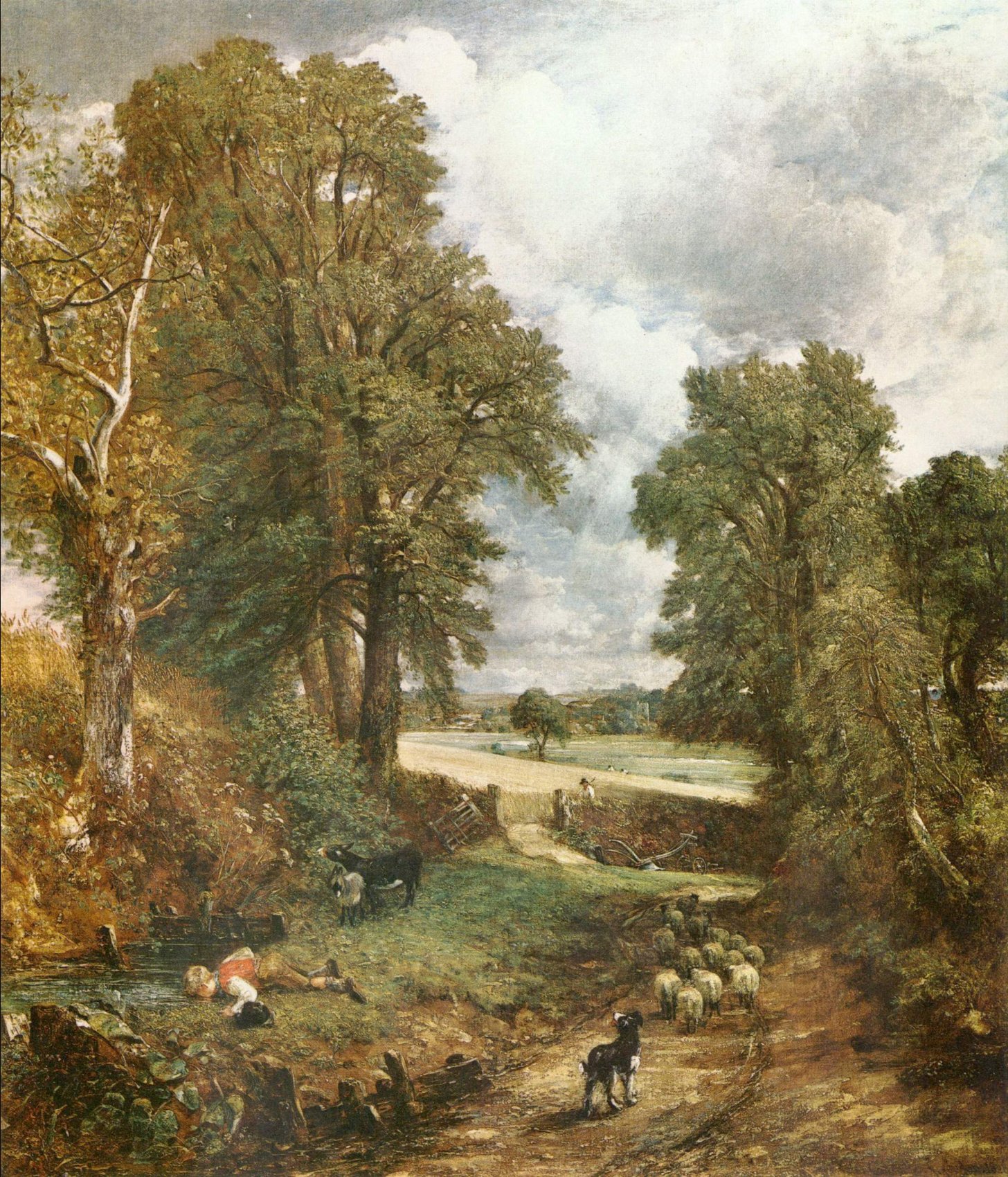
The boy is meant to be moving sheep, but he has stopped to drink. His face is almost in the pool; the animals continue ahead without him. Constable's The Cornfield gives a tiny act of thirst the scale of a grand landscape. The scene feels like a summer memory, though its painter made it in a London studio during the first months of 1826.
The lane and its interruption
The path is based on Fen Lane in Suffolk, a route Constable knew from walks between East Bergholt and Dedham. Trees bend over it so densely that the road seems to be making a tunnel. The boy has left the line of travel to kneel at the water. His sheep drift toward the brightness ahead, turning a pastoral scene into a small question: how long can he rest before he has to catch them?
Constable did not simply copy the whole view. The National Gallery notes that the lane itself existed, while much of the country beyond was invented. That combination of remembered path and arranged distance makes the painting feel unusually personal. A real place supplies the walk; painting supplies the way its light opens at the far end.
Shade makes the heat believable
The foreground is full of cool greens and dark trunks. Farther along the path, sun lands on the cornfield and the sheep. Rather than paint summer as a uniform golden wash, Constable lets us feel the difference between shade and exposed ground. The boy's drink is not a decorative gesture. In this heat, the pool looks useful.
A patch of sky peeks through the upper branches. Bright marks in the leaves and grass keep the shaded area alive, so our eyes do not hurry straight to the field. Constable's energetic surface can seem casual from a distance. Come close and it is doing careful work, separating foliage, light, water, and path while letting them share one breezy atmosphere.
A winter's work on a summer subject
Constable painted the canvas between January and March 1826. Its warm air was made indoors, with studies and recollections at hand. The contradiction is worth holding on to. Landscape painting was not always the record of a single outdoor sitting; for large exhibition pictures, the studio could be where years of observation were gathered into one image.
He sent The Cornfield to the Royal Academy that year. It won praise but found no buyer, even after appearing at further exhibitions. Its later familiarity can hide that awkward beginning. A picture that looks entirely at home in a national collection first had to wait for an audience willing to take it home.
A path through more than scenery
The boy's pause gives the painting a human clock. We can imagine the sound of the sheep, the feel of water, and the minute before he stands up. Yet Constable leaves us outside the boy's thoughts. We cannot know whether this is relief, distraction, or a task delayed by necessity. The landscape is generous enough to allow several readings.
Follow the lane from the shaded pool to the bright field, then reverse your gaze. On the way out, the scene feels like a promise of open space. On the way back, it becomes about a person kneeling in the foreground, needing something simple before the journey continues. That small change of direction is where The Cornfield earns its staying power.