Making a career against barriers
Evelyn De Morgan worked in painting and drawing at a time when women faced barriers to training and public recognition. Her allegorical figures address love, captivity, death, and spiritual change. Close to the later Pre-Raphaelite world, she developed a distinct symbolic language rather than simply repeating its conventions. Evelyn De Morgan (1855–1919) worked in Britain. De Morgan trained at institutions that only gradually admitted women to serious artistic study. She built a professional career around allegorical subjects and developed interests in spiritualism, social reform, and the expressive possibilities of the figure. This history takes on a different shape when it is followed through actual objects. The works on this page show Evelyn De Morgan meeting different subjects at different moments.
Symbol and luminous color
A symbolic image need not conceal a single code. She used bodies, gestures, and carefully chosen materials to make an encounter feel emotionally precise while leaving its larger meaning open. The Angel of Death offers one test of that way of working. Its surface, scale, and subject can be compared with another object by Evelyn De Morgan without assuming every decision was repeated.
Allegory with human feeling
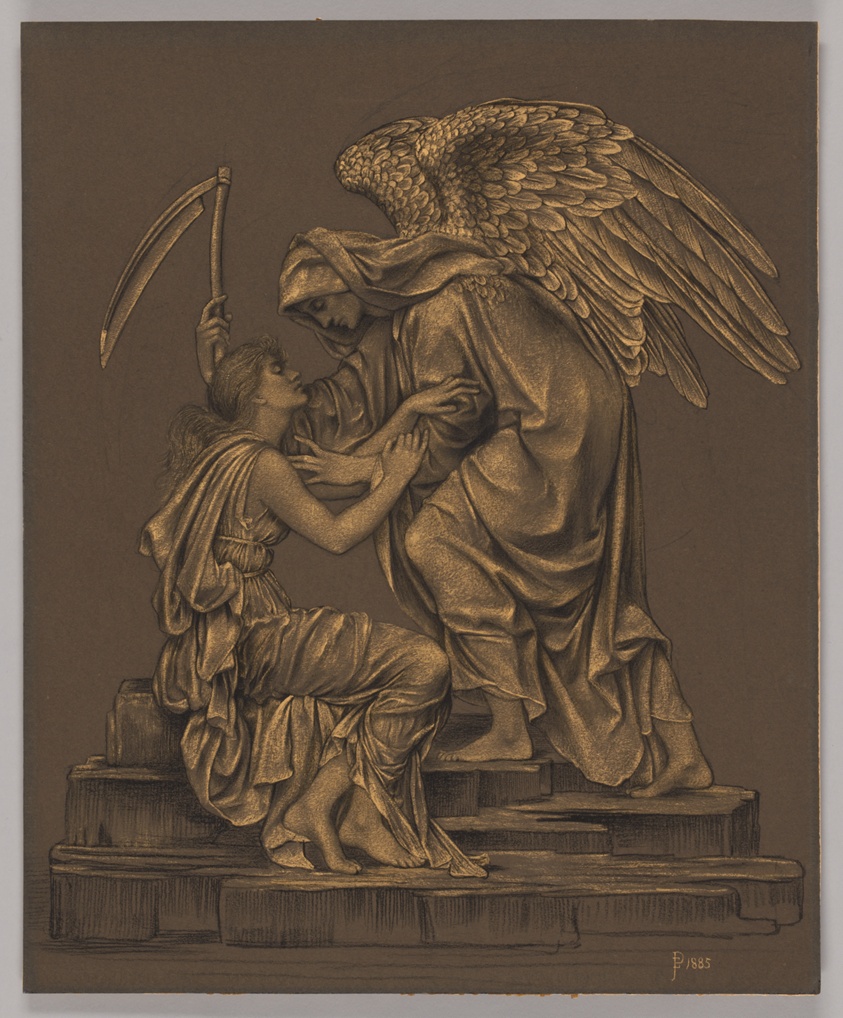
The Angel of Death is a drawing with gold paint rather than a finished oil painting. Its seated woman, winged figure, and scythe make a meeting with mortality visible through touch and posture. The familiar titles in a career can hide the choices that made each picture distinct. Start with The Angel of Death: its source record identifies an object, and its image makes visible a particular arrangement. Ask where the eye is held and what has been given less description. The next linked work may answer that question differently. Seen together, these objects give Evelyn De Morgan a history of decisions rather than a single emblem of talent.
Symbolism and its limits
Evelyn De Morgan is associated with Symbolism. Symbolist artists often asked an image to suggest more than it plainly described. Dreams, myth, memory, and psychological states could enter a portrait or landscape through color and pattern. Klimt’s work in Vienna joined intimate figures to ornament and made the surface itself part of the meaning. The word Symbolism can organize a gallery or a book chapter, but the visible evidence is in objects. With The Angel of Death, ask how Evelyn De Morgan directs attention and what the source record says about material and date. Compare that encounter with another artist’s work from the period. The resulting differences may make the label less neat, but more useful.
A closer look at The Angel of Death
De Morgan draws a winged, scythe-bearing figure leaning toward a seated woman, using gold against black pastel to make mortality both imposing and intimate. A seated woman reaches toward the draped angel, whose wing and scythe fill the upper space. Gold paint catches against the dark paper and black pastel, giving the meeting both physical weight and an otherworldly quality. The closeness of the two figures resists a single reading of death as either comfort or threat. Now set it beside Night and Sleep. De Morgan lets winged figures carry night and sleep across the sky, making an allegory feel like a moving landscape. Flying figures and trailing fabric move across a bright sky. De Morgan gives Night and Sleep human form while keeping the allegory open to feeling as well as interpretation. Both works are linked below this profile, with their own object records and images. They reward comparison because they show Evelyn De Morgan making different decisions, sometimes with a different material, even when a familiar concern carries across the two.
A wider history of British art
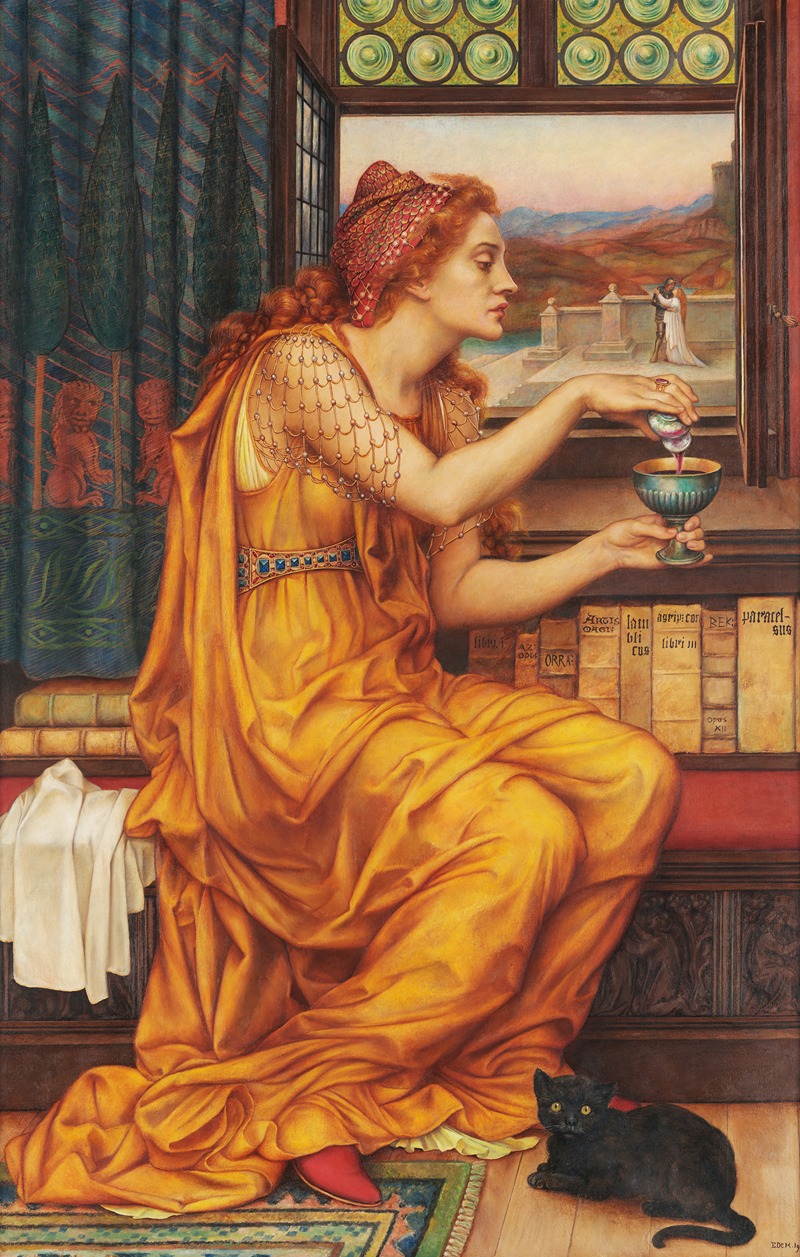
The Angel of Death uses black pastel and gold to stage an encounter between a winged figure and a human one. De Morgan gives mortality a visual form that can be read as warning, comfort, or passage. Her career broadens the story of British art beyond a familiar list of male painters. Her work is now receiving fuller attention within histories that once treated the later Pre-Raphaelite world mainly through male artists. The recovery changes the questions asked of the period. A third work, The Love Potion, complicates any account built from a single celebrated picture. De Morgan places a woman with a potion among rich color and symbolic objects, turning an interior into a scene of desire and uncertainty. The seated figure works with a vessel as color and objects fill the room around her. De Morgan makes the potion part of a larger question about desire, agency, and transformation. The third image makes room for a less familiar part of the career. Evelyn De Morgan’s legacy is richer when these separate works remain visible beside one another.
The Angel of Death brings a dark, gold-touched figure close to a seated woman. Night and Sleep sends allegorical figures across open sky, while The Love Potion gathers color and symbolic things into a room. Their settings and scales differ, yet each work lets a visible encounter hold several possible meanings. De Morgan’s allegories gain strength from that openness and from the physical materials through which she made it visible.
Explore Symbolism ↗