The Angel of Death in its time
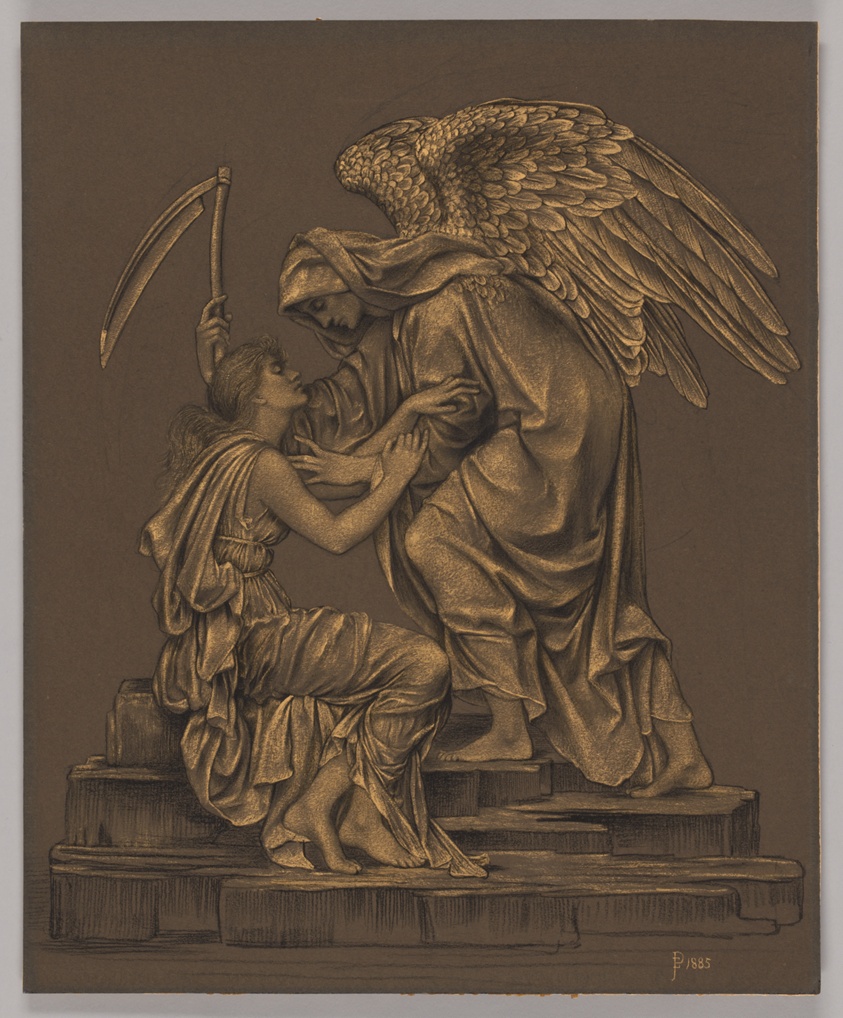
De Morgan draws a winged, scythe-bearing figure leaning toward a seated woman, using gold against black pastel to make mortality both imposing and intimate. The Angel of Death is dated 1885 and is held by Art Institute of Chicago. The source record names it “The Angel of Death.” The record identifies The Angel of Death; the image itself invites a slower look at how its parts meet.
A closer view
A seated woman reaches toward the draped angel, whose wing and scythe fill the upper space. Gold paint catches against the dark paper and black pastel, giving the meeting both physical weight and an otherworldly quality. The closeness of the two figures resists a single reading of death as either comfort or threat. Look at how The Angel of Death handles distance. Its nearest forms and farthest spaces may be described with very different degrees of clarity. That difference affects where you feel invited to stand.
Paint, paper, and process
The collection records The Angel of Death as black pastel and opaque gold paint, over traces of black chalk, on brown wove paper. The stated materials of The Angel of Death limit what we can reasonably claim about its making. Follow the record for those details, then return to the image to look for their visible effects. In The Angel of Death, the recorded material is part of the encounter: it affects the scale, marks, and finish that the original object can hold. Look again at the strongest visual accent in The Angel of Death. The linked record supplies dimensions and materials that help place that detail within the whole work.
Evelyn De Morgan and this work
Evelyn De Morgan worked in painting and drawing at a time when women faced barriers to training and public recognition. Her allegorical figures address love, captivity, death, and spiritual change. Close to the later Pre-Raphaelite world, she developed a distinct symbolic language rather than simply repeating its conventions. The angel’s wing and scythe could make the subject remote, but the reaching woman brings the encounter close. De Morgan’s gold against dark paper lets the allegory feel both material and uncertain. An artist’s name can make a work feel familiar before we have really looked at it. A subject can be revisited without producing the same picture twice: scale, material, and audience all alter the problem. Its subject, medium, and visible emphasis may seem consistent with other works, or they may reveal a different route. Ask what this subject allowed the artist to test here and which decisions depend on its particular size or material. Its differences from nearby works are worth noticing; they restore a little of the uncertainty and invention within the practice. The Angel of Death belongs to Evelyn De Morgan’s longer practice, and the other works in this collection let you test what changed from one subject to another.
The world around The Angel of Death
De Morgan trained at institutions that only gradually admitted women to serious artistic study. She built a professional career around allegorical subjects and developed interests in spiritualism, social reform, and the expressive possibilities of the figure. The Angel of Death has been seen under different conditions since 1885. Its first setting shaped its audience; the linked record documents the object as it is known today. Read the documented title and medium for The Angel of Death beside the image; the record can settle object details while leaving interpretation open.
Image and object record
Art Institute of Chicago identifies The Angel of Death as a work by Evelyn De Morgan from 1885 and records its medium as black pastel and opaque gold paint, over traces of black chalk, on brown wove paper. The collection credits the object to Regenstein Endowment and Meg and Mark Hausberg funds. Follow the linked object record for its catalogue entry and any further notes on its history.