Night and Sleep in its time
De Morgan lets winged figures carry night and sleep across the sky, making an allegory feel like a moving landscape. Night and Sleep is dated 1878 and is held by De Morgan Collection. The source record names it “Night and Sleep.” A title and date can orient us to Night and Sleep, but neither replaces the experience of following its forms across the image.
How the picture holds together
Flying figures and trailing fabric move across a bright sky. De Morgan gives Night and Sleep human form while keeping the allegory open to feeling as well as interpretation. The arrangement in Night and Sleep is purposeful even where it feels informal. Compare where the strongest marks gather with the quieter ground around them. That relationship gives the subject its visual weight.
The material object
The collection records Night and Sleep as oil on canvas. A symbolic image need not conceal a single code. She used bodies, gestures, and carefully chosen materials to make an encounter feel emotionally precise while leaving its larger meaning open. For Night and Sleep, the collection’s medium label is a clue to the work of the hand and to the surface that first carried the image. On a screen, Night and Sleep has a convenient size. Its actual dimensions and support belong to the source record linked beside the work.
Evelyn De Morgan and this work
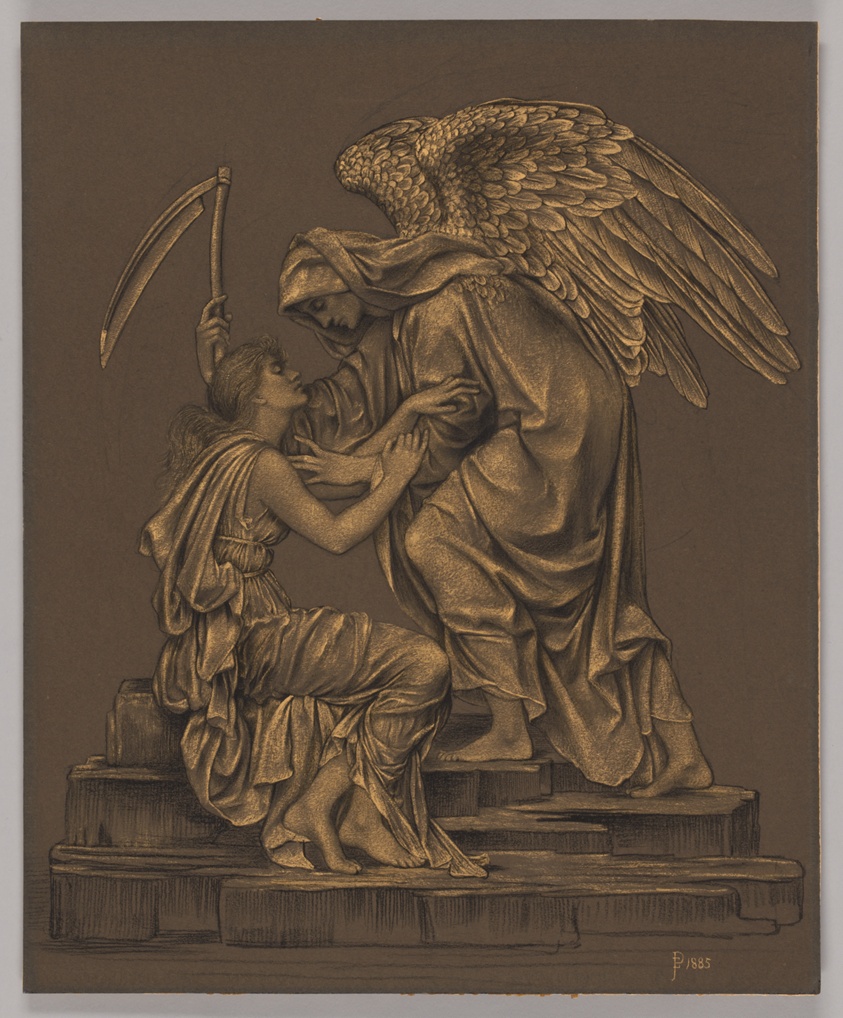
The Angel of Death uses black pastel and gold to stage an encounter between a winged figure and a human one. De Morgan gives mortality a visual form that can be read as warning, comfort, or passage. Her career broadens the story of British art beyond a familiar list of male painters. The floating figures carry an allegorical idea across an open sky. De Morgan gives Night and Sleep bodies and movement while leaving their meaning spacious enough for more than one reading. For Evelyn De Morgan, making Night and Sleep meant choosing among possible viewpoints, marks, and degrees of finish. The picture may look effortless at first; its organization asks how forms, marks, and empty areas were made to work together. Another image by the same maker may use a related method toward another end, or change the method altogether. Then follow another work by the artist and see whether a similar concern survives a change of subject. Each work had its own audience and task, and each can change the story we tell about the career. Seen with Evelyn De Morgan’s other works, Night and Sleep shows how one maker could return to a concern while changing material or scale.
The world around Night and Sleep
The source places Night and Sleep in 1878. Compare that historical point with the way the work is presented now; its meaning can shift as settings and viewers change. Night and Sleep began as an object in 1878, made for viewers with their own habits and expectations. Today its collection record offers a route back to that material history. For Night and Sleep, use the collection link to check date and medium before returning to the visual choices made on the surface.
Image and object record
De Morgan Collection identifies Night and Sleep as a work by Evelyn De Morgan from 1878 and records its medium as oil on canvas. The collection credits the object to De Morgan Foundation, P_EDM_0001. Follow the linked object record for its catalogue entry and any further notes on its history.