The world of Romantic painting
Delacroix used color and movement to make history painting feel urgent. He drew subjects from literature, politics, and travel, building scenes that pulse with contrasting hues and expressive brushwork. Eugène Delacroix (1798–1863) worked in France. Delacroix worked within the institutions of French history painting while seeking subjects in literature, politics, religion, and travel. His diaries reveal a painter deeply attentive to other arts. The place and dates locate Eugène Delacroix, while the objects below show what such a life could produce. Their differences deserve as much attention as their resemblance.
Color in motion
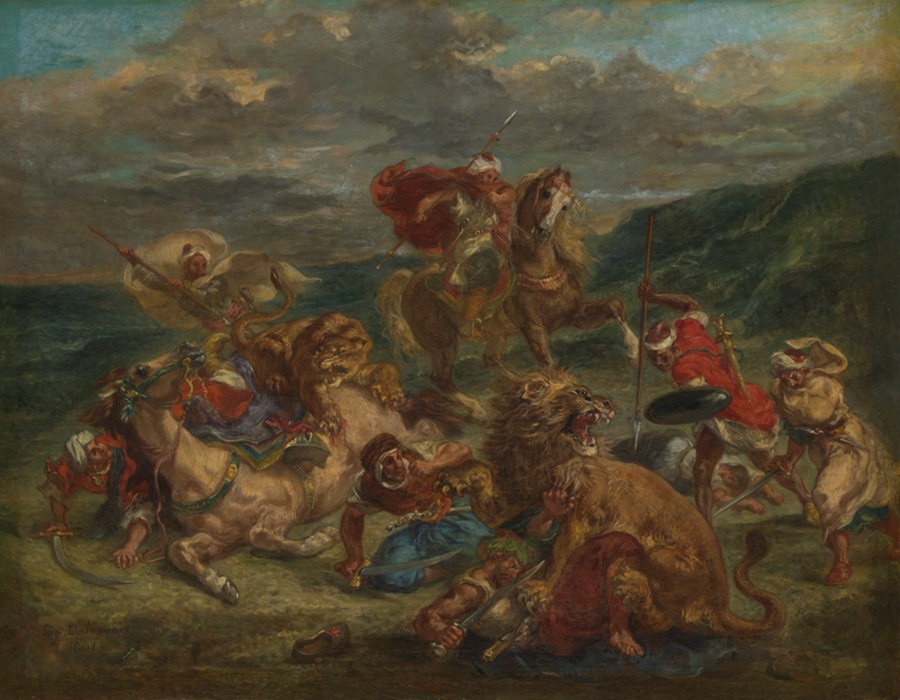
Contrasts of warm and cool color create much of the motion in his pictures. A crowded composition can feel coherent because the eye follows color and gesture through it. Look at Lion Hunt and then at a different work below. The comparison makes clear which choices Eugène Delacroix returned to and which belonged only to one image.
Literature, history, and conflict
Liberty Leading the People ties a political moment to a symbolic figure without becoming a simple report. Paintings shaped by his North African journey demand attention to colonial power as well as visual discovery. What survives from a career is uneven: famous objects, studies, commissions, and works valued differently by later audiences. Lion Hunt deserves attention as one of those objects, with a date and medium that can be checked. A close look may reveal a decision missing from the standard story of Eugène Delacroix. Moving from this work to another on the page helps restore an experimental life behind the short account of a style.
Romanticism and its limits
Eugène Delacroix is associated with Romanticism. Romantic artists explored feeling, imagination, history, and the power of nature. A landscape might suggest freedom, fear, memory, or the limits of human control. The movement crossed borders and media, taking very different forms in Friedrich’s quiet horizons, Turner’s weather, and Delacroix’s color. Movements are conversations held through exhibitions, training, images, and later writing. Eugène Delacroix participated in one such history, and Lion Hunt gives that story a specific surface. A comparison with a peer can show where the artists met and where they parted. The label works best when it leads us back to that particularity instead of taking it away.
A closer look at Lion Hunt
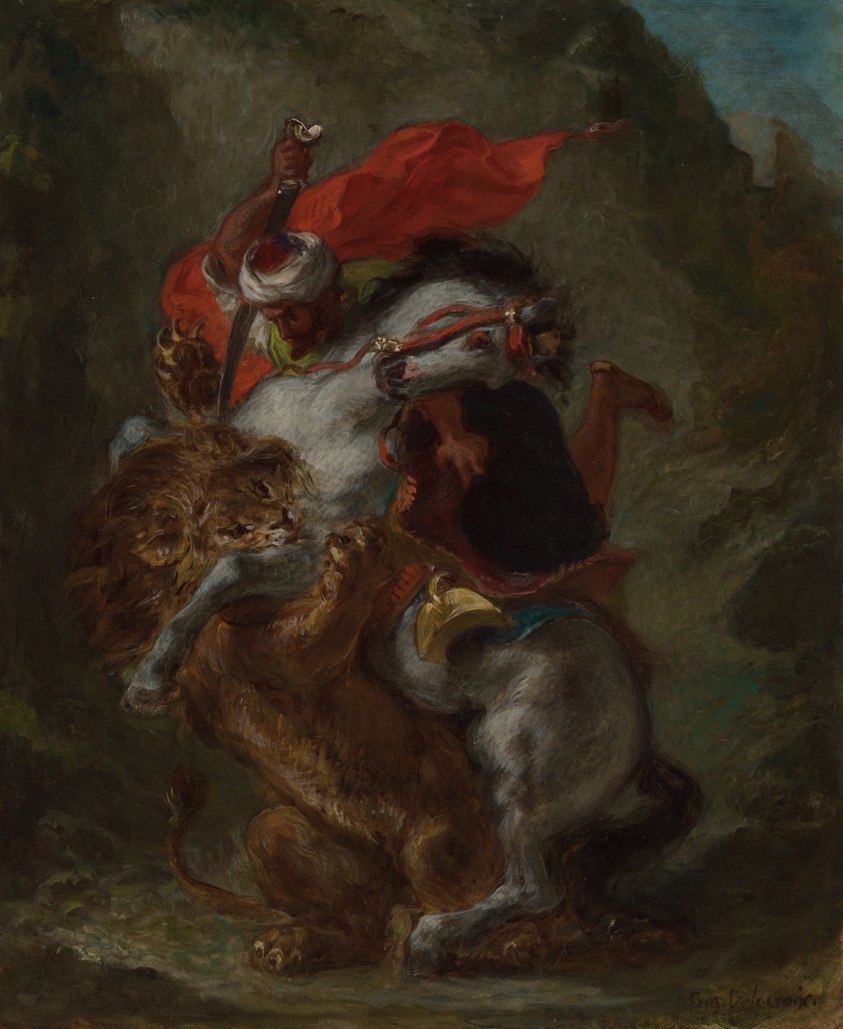
Delacroix stages the hunt as a knot of movement, bodies, and opposing forces rather than a calm report. Delacroix organizes the hunt around movement and collision rather than a single calm viewpoint. Figures, horses, and animal bodies make the action difficult to separate into neat episodes. The tension between controlled composition and apparent chaos is part of the picture’s drama. Now set it beside Arab Horseman Attacked by a Lion. Delacroix drives horse, rider, and lion into a compressed scene of danger and expressive movement. Delacroix compresses rider, horse, and lion into a forceful encounter. The subject gives him a way to explore pressure, movement, and contrasting bodies. The image also belongs to a European tradition of picturing North Africa, a context that deserves attention alongside its formal energy. Both works are linked below this profile, with their own object records and images. They reward comparison because they show Eugène Delacroix making different decisions, sometimes with a different material, even when a familiar concern carries across the two.
Delacroix beyond the spectacle
His 1832 journey to North Africa profoundly affected his visual vocabulary. Delacroix’s notebooks and paintings show a painter studying dress, architecture, animals, and light, even as modern viewers must consider the colonial setting in which those images were made. Later painters admired his handling of color. That influence is part of the story, but his works also ask how historical events and other cultures are staged for an audience. A third work, The Combat of the Giaour and Hassan, complicates any account built from a single celebrated picture. Delacroix stages a violent literary encounter through the motion of horses and bodies, testing how painting can hold action together. Riders, horses, and fallen figures meet in a compressed rush. Delacroix makes the struggle readable through opposing gestures and light rather than a calm, centered account of the literary scene. Read beside the earlier works, this object makes the arc of Eugène Delacroix’s career less predictable. Its survival lets us notice decisions a short label might hide.
The Lion Hunt and Arab Horseman Attacked by a Lion place animals and humans in scenes of collision. The Combat of the Giaour and Hassan draws on a literary conflict, yet it also depends on the physical tension of horses and riders. The works show Delacroix organizing action rather than merely reporting it. Their force comes from how bodies are set against one another and against the limits of the picture.
Explore Romanticism ↗