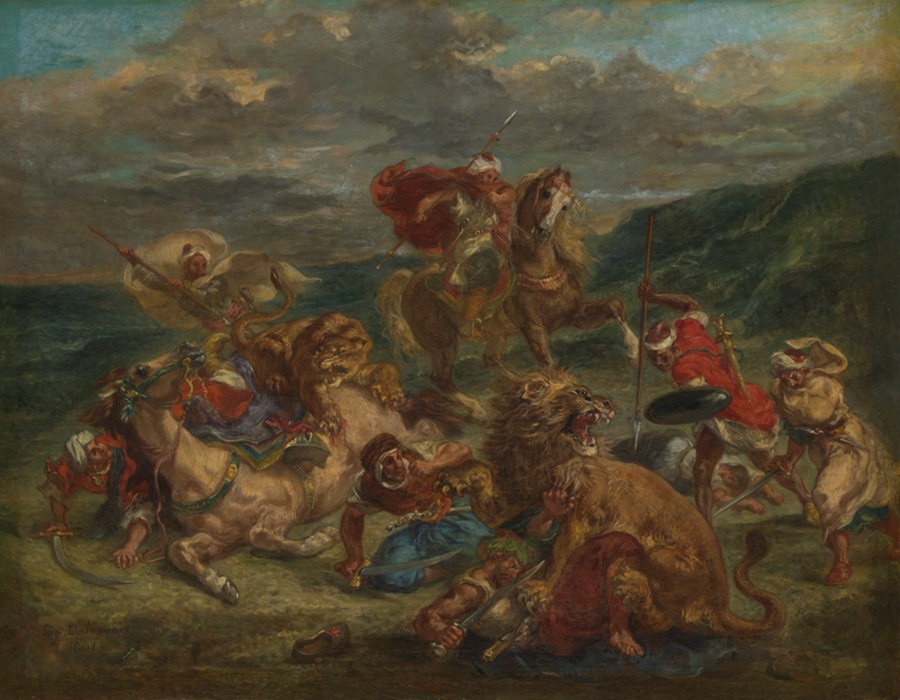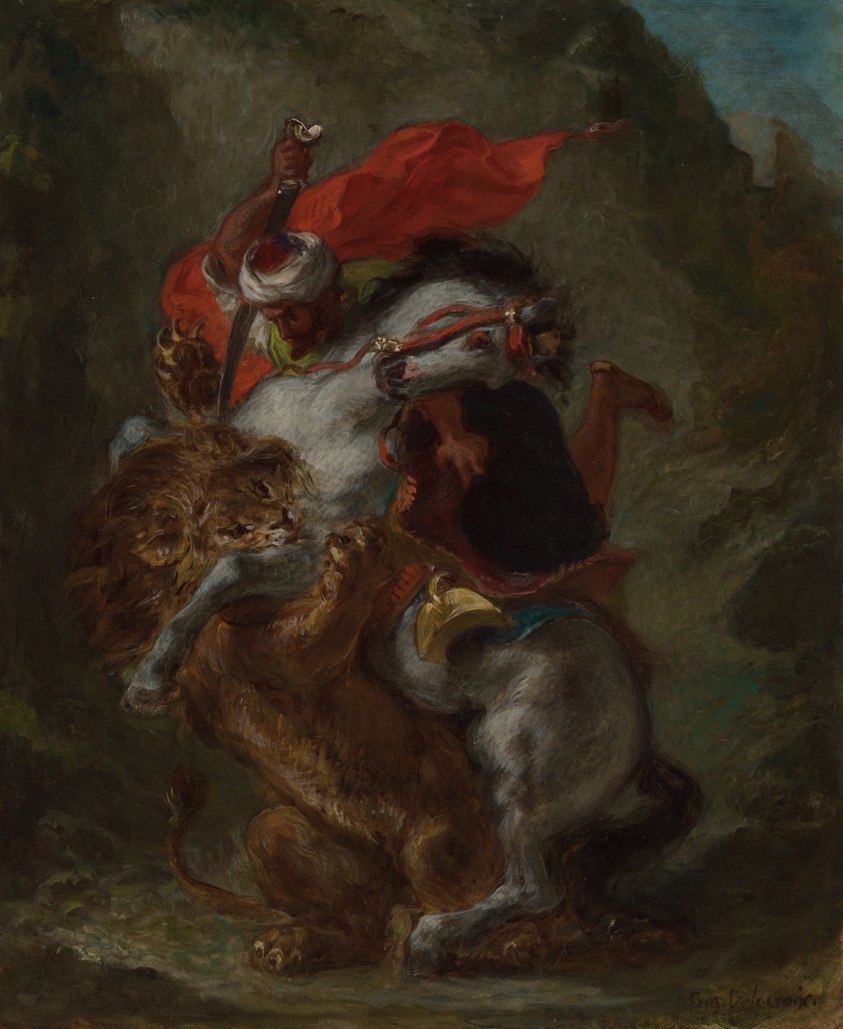
Arab Horseman Attacked by a Lion in its time
Delacroix drives horse, rider, and lion into a compressed scene of danger and expressive movement. Arab Horseman Attacked by a Lion is dated 1849–50 and is held by Art Institute of Chicago. The source record names it “Arab Horseman Attacked by a Lion.” The listed facts locate Arab Horseman Attacked by a Lion in history, while its visible choices give the viewer something to discover directly.
A closer view
Delacroix compresses rider, horse, and lion into a forceful encounter. The subject gives him a way to explore pressure, movement, and contrasting bodies. The image also belongs to a European tradition of picturing North Africa, a context that deserves attention alongside its formal energy. Try reading Arab Horseman Attacked by a Lion from its outer edge inward. The first feature you noticed may no longer dominate. Artists can distribute attention so that a picture unfolds gradually rather than all at once.
What the medium can tell us
The collection records Arab Horseman Attacked by a Lion as oil on paperboard. Contrasts of warm and cool color create much of the motion in his pictures. A crowded composition can feel coherent because the eye follows color and gesture through it. Looking at Arab Horseman Attacked by a Lion as an object means asking what the listed materials allow the artist to revise, repeat, or leave visible. Return to the image of Arab Horseman Attacked by a Lion for the arrangement of forms, then use the source link to learn what kind of object carries them.
Eugène Delacroix and this work
His 1832 journey to North Africa profoundly affected his visual vocabulary. Delacroix’s notebooks and paintings show a painter studying dress, architecture, animals, and light, even as modern viewers must consider the colonial setting in which those images were made. Horse, rider, and lion meet in a compressed knot. Delacroix makes the viewer feel the instability of the encounter while the subject also recalls a European taste for imagined North African scenes. In Arab Horseman Attacked by a Lion, the viewer meets a work rather than a shorthand for Eugène Delacroix. Arab Horseman Attacked by a Lion benefits from a slower encounter. Its subject, medium, and visible emphasis may seem consistent with other works, or they may reveal a different route. Those shifts are easier to recognize when the works are treated as objects with dates and materials. Each work had its own audience and task, and each can change the story we tell about the career. The choices visible in Arab Horseman Attacked by a Lion make one part of Eugène Delacroix’s career tangible without reducing that career to a single signature look.
The world around Arab Horseman Attacked by a Lion
A work dated 1849–50 has a longer life than the moment of making. Arab Horseman Attacked by a Lion has been seen by later audiences in new settings, while its source records a particular historical object. The world of 1849–50 was the first setting for Arab Horseman Attacked by a Lion. Its later life in collections and reproductions has changed how easily, and how often, people see it. The image of Arab Horseman Attacked by a Lion and its source record belong together: one offers a close view, the other identifies the object and its material.
Image and object record
Art Institute of Chicago identifies Arab Horseman Attacked by a Lion as a work by Eugène Delacroix from 1849–50 and records its medium as oil on paperboard. The collection credits the object to Potter Palmer Collection. Follow the linked object record for its catalogue entry and any further notes on its history.