
Northern landscapes and private feeling
Friedrich placed small human figures before seas, mountains, and clouded horizons. His landscapes are carefully composed invitations to contemplate nature, mortality, and the limits of sight. Caspar David Friedrich (1774–1840) worked in Germany. Working in Dresden, Friedrich made landscapes that are composed rather than simply transcribed. His northern European settings carry personal and cultural associations of memory, faith, and loss. A life is easier to understand when its objects stay close. The linked works let Caspar David Friedrich’s choices appear in several forms, not only in a familiar story.
The figure facing away
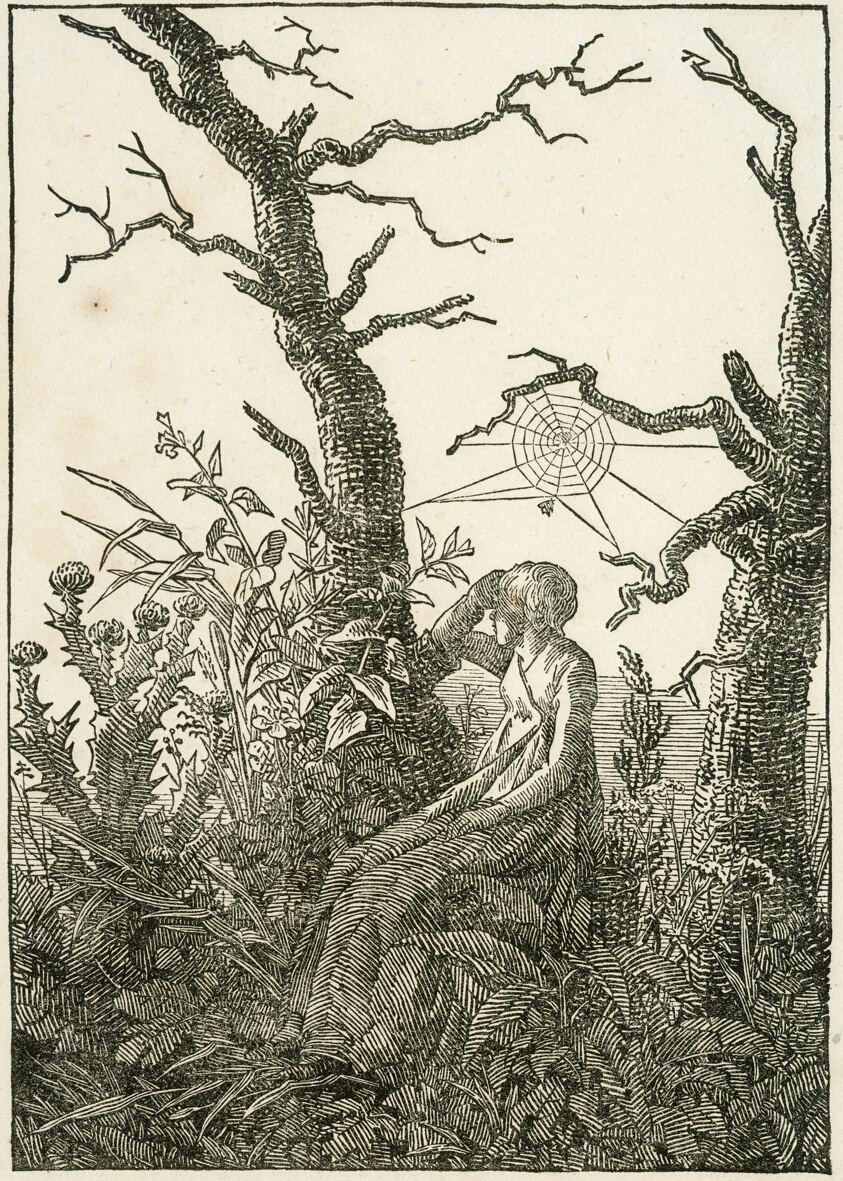
A figure seen from behind often gives the viewer a position inside the image without resolving what the figure thinks. Empty space and an interrupted path can become expressive devices. The method is visible in Woman with Spider's Web Between Bare Trees, but it is worth looking at the other linked objects before calling it a fixed style. Caspar David Friedrich had room to revise a familiar solution.
A landscape for reflection
Wanderer above the Sea of Fog is famous because its apparently commanding viewpoint also meets a field of obscurity. The view does not surrender all of its information. Look at the projects through the material objects that survive. Woman with Spider's Web Between Bare Trees records one moment of making, not a complete account of Caspar David Friedrich’s intention. Its subject and visible form can be set beside the other works on this page. One may ask for close private attention; another may have been made to address a broader audience. Those conditions make the differences meaningful, even when a shared hand or concern remains easy to recognize.
Romanticism and its limits
Caspar David Friedrich is associated with Romanticism. Romantic artists explored feeling, imagination, history, and the power of nature. A landscape might suggest freedom, fear, memory, or the limits of human control. The movement crossed borders and media, taking very different forms in Friedrich’s quiet horizons, Turner’s weather, and Delacroix’s color. Use the movement as a route into Caspar David Friedrich’s world, then allow Woman with Spider's Web Between Bare Trees to complicate the route. The date and medium attach the work to a real moment of making. Its subject and arrangement may answer a shared question in a way no other artist chose. This is how a broad term can serve close looking without replacing it.
A closer look at Woman with Spider's Web Between Bare Trees
Friedrich's spare image brings a woman, bare trees, and a web together in a scene of fragile, unsettling stillness. Friedrich places the woman among spare trunks and a delicate web, making the landscape feel like a place of reflection. The close details and open distance ask for different kinds of attention. Nothing in the setting offers a simple narrative, yet every element contributes to an atmosphere of pause. Now set it beside Young Man Lying on a Grave. Friedrich's young man and grave make landscape a setting for memory, loss, and a difficult pause. Friedrich places the figure close to a grave, turning the landscape into a site of memory and mortality. The scene asks viewers to read posture and setting together without supplying a complete story. Its quietness gives the emotional question room to remain open. Both works are linked below this profile, with their own object records and images. They reward comparison because they show Caspar David Friedrich making different decisions, sometimes with a different material, even when a familiar concern carries across the two.
Friedrich’s later audiences
A viewer often shares the position of a figure seen from behind, looking outward into uncertain space. His paintings helped define Romantic landscape and later inspired artists interested in solitude, scale, and spiritual feeling. Later audiences have projected many meanings onto these landscapes. Their continuing force lies partly in the distance they keep between a specific place and an open question. A third work, Self-Portrait, complicates any account built from a single celebrated picture. Friedrich presents himself through the direct lines of a woodcut, offering a different encounter from the landscapes for which he is best known. The woodcut presents a sober profile within a plain border. Compared with Friedrich's landscapes, the close scale shifts attention to an individual face and the cut line that describes it. Fame draws attention to certain pictures, but this additional object widens the view. Caspar David Friedrich’s work remains open to new comparisons as collections and records are studied.
A woman among bare trees, a young man near a grave, and Friedrich’s own woodcut profile offer three different distances from a human figure. The landscapes ask a viewer to read posture within spare surroundings; the self-portrait draws attention to the person making the images. Their quietness has been influential, but it is a constructed quietness. Placement, line, and the amount of space left around a body all contribute to it.
Explore Romanticism ↗
