
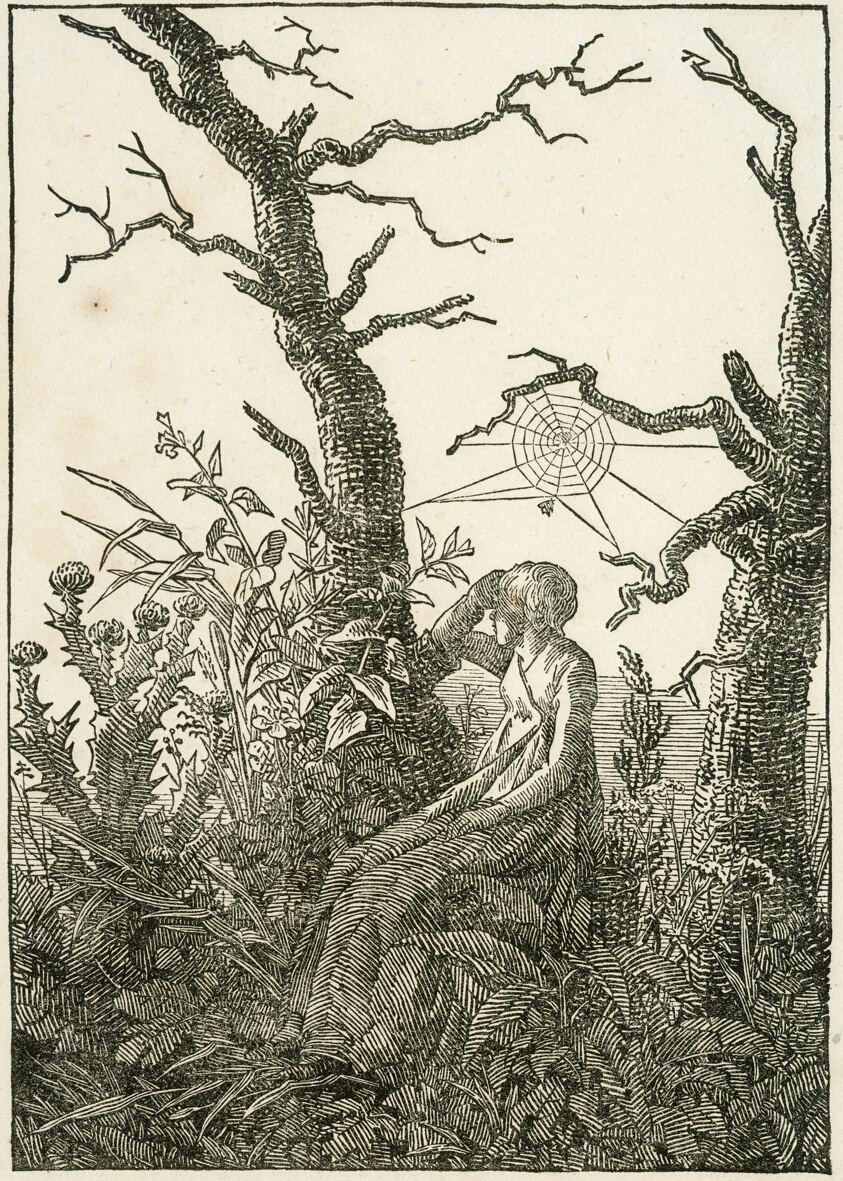
Woman with Spider's Web Between Bare Trees in its time
Friedrich's spare image brings a woman, bare trees, and a web together in a scene of fragile, unsettling stillness. Woman with Spider's Web Between Bare Trees is dated 1803 and is held by Art Institute of Chicago. The source record names it “Woman with Spider's Web Between Bare Trees.” These details make Woman with Spider's Web Between Bare Trees traceable to a collection, and they leave room for a closer encounter with the image.
Where the eye settles
Friedrich places the woman among spare trunks and a delicate web, making the landscape feel like a place of reflection. The close details and open distance ask for different kinds of attention. Nothing in the setting offers a simple narrative, yet every element contributes to an atmosphere of pause. In Woman with Spider's Web Between Bare Trees, compare the most firmly defined passage with one left open. The contrast can be a way to direct attention, or a trace of the artist testing how much description the image needs.
The surface of the work
The collection records Woman with Spider's Web Between Bare Trees as woodcut on ivory wove paper. The medium recorded for Woman with Spider's Web Between Bare Trees gives this image a physical scale and process. A screen can show its design, while the source record preserves what is known of the object itself. The source record for Woman with Spider's Web Between Bare Trees preserves the medium as well as the subject. Both matter when looking closely at an historical object. The image of Woman with Spider's Web Between Bare Trees can be enlarged and revisited here. The linked record keeps that view connected to a particular historical object.
Caspar David Friedrich and this work
Friedrich placed small human figures before seas, mountains, and clouded horizons. His landscapes are carefully composed invitations to contemplate nature, mortality, and the limits of sight. The web is slight beside the bare trunks, but its delicacy changes the weight of the whole scene. Friedrich sets a human figure among forms that can suggest both connection and vulnerability without prescribing one story. The questions raised by Woman with Spider's Web Between Bare Trees may also appear elsewhere in Caspar David Friedrich’s work, but the material object cannot be replaced by that comparison. The picture may look effortless at first; its organization asks how forms, marks, and empty areas were made to work together. Its subject, medium, and visible emphasis may seem consistent with other works, or they may reveal a different route. Compare its source record with another work by Caspar David Friedrich; what changes is often as revealing as what persists. Each work had its own audience and task, and each can change the story we tell about the career. Woman with Spider's Web Between Bare Trees carries its own subject and process. Following Caspar David Friedrich into another work makes the wider practice easier to see.
The world around Woman with Spider's Web Between Bare Trees
Working in Dresden, Friedrich made landscapes that are composed rather than simply transcribed. His northern European settings carry personal and cultural associations of memory, faith, and loss. In 1803, Woman with Spider's Web Between Bare Trees belonged to a world of particular makers, patrons, buyers, or readers. The record can identify the object even where those encounters are harder to recover. The collection facts attached to Woman with Spider's Web Between Bare Trees are worth following, especially where the image leaves its original setting hard to recover.
Image and object record
Art Institute of Chicago identifies Woman with Spider's Web Between Bare Trees as a work by Caspar David Friedrich from 1803 and records its medium as woodcut on ivory wove paper. The collection credits the object to Alfred E. Hamill Collection. Follow the linked object record for its catalogue entry and any further notes on its history.

