
Self-Portrait in its time
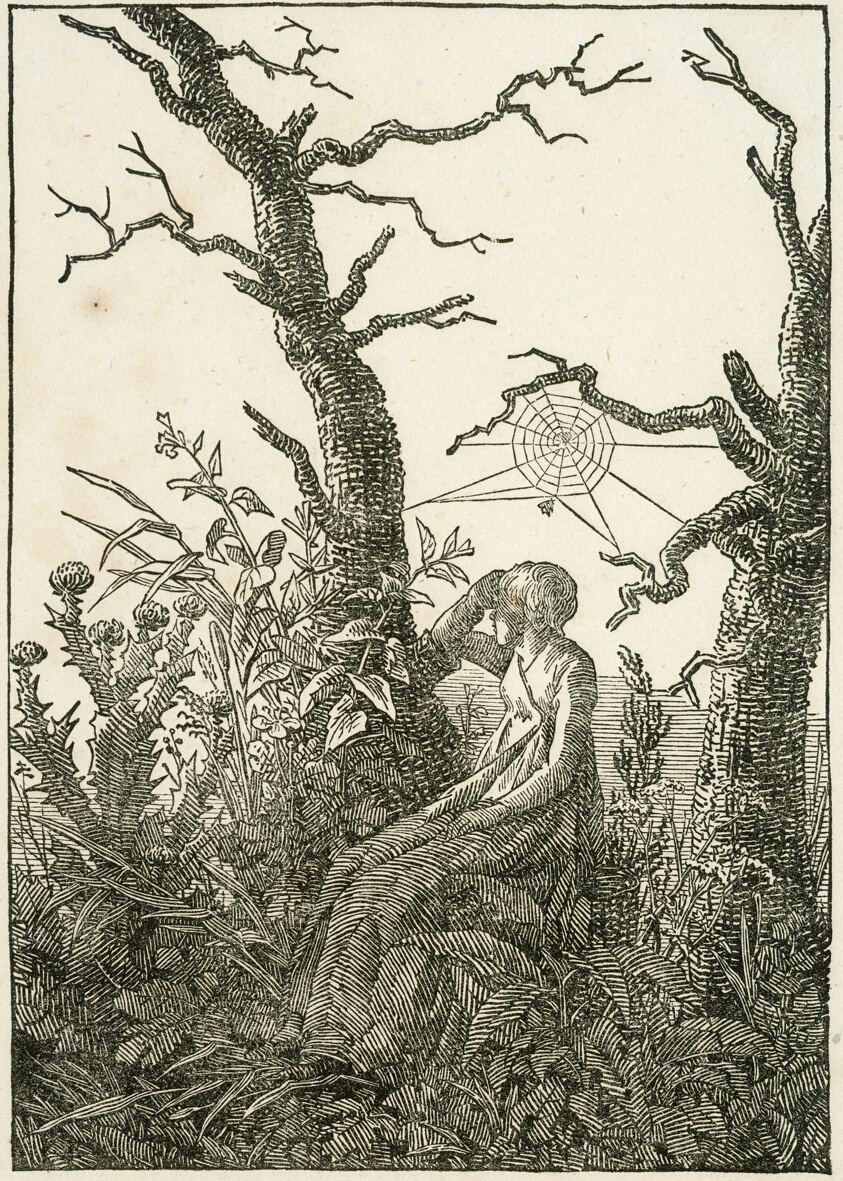
Friedrich presents himself through the direct lines of a woodcut, offering a different encounter from the landscapes for which he is best known. Self-Portrait is dated n.d. and is held by Art Institute of Chicago. The source record names it “Self-Portrait.” The listed facts locate Self-Portrait in history, while its visible choices give the viewer something to discover directly.
Where the eye settles
The woodcut presents a sober profile within a plain border. Compared with Friedrich's landscapes, the close scale shifts attention to an individual face and the cut line that describes it. In Self-Portrait, compare the most firmly defined passage with one left open. The contrast can be a way to direct attention, or a trace of the artist testing how much description the image needs.
How it was made
The collection records Self-Portrait as woodcut on paper. The medium recorded for Self-Portrait gives this image a physical scale and process. A screen can show its design, while the source record preserves what is known of the object itself. Looking at Self-Portrait as an object means asking what the listed materials allow the artist to revise, repeat, or leave visible. Return to the image of Self-Portrait for the arrangement of forms, then use the source link to learn what kind of object carries them.
Caspar David Friedrich and this work
Wanderer above the Sea of Fog is famous because its apparently commanding viewpoint also meets a field of obscurity. The view does not surrender all of its information. The direct profile and cut line make this a different sort of self-presentation from Friedrich’s distant figures in landscapes. The woodcut keeps attention on the face and on the act of defining it. The questions raised by Self-Portrait may also appear elsewhere in Caspar David Friedrich’s work, but the material object cannot be replaced by that comparison. Its surface and arrangement hold decisions made for this image alone. Its subject, medium, and visible emphasis may seem consistent with other works, or they may reveal a different route. Compare its source record with another work by Caspar David Friedrich; what changes is often as revealing as what persists. Treating each object as a fresh decision makes room for change, experiment, and the practical conditions under which an artist worked. The choices visible in Self-Portrait make one part of Caspar David Friedrich’s career tangible without reducing that career to a single signature look.
The world around Self-Portrait
Later audiences have projected many meanings onto these landscapes. Their continuing force lies partly in the distance they keep between a specific place and an open question. The world of n.d. was the first setting for Self-Portrait. Its later life in collections and reproductions has changed how easily, and how often, people see it. The image of Self-Portrait and its source record belong together: one offers a close view, the other identifies the object and its material.
Image and object record
Art Institute of Chicago identifies Self-Portrait as a work by Caspar David Friedrich from n.d. and records its medium as woodcut on paper. The collection credits the object to Hamill Fund. Follow the linked object record for its catalogue entry and any further notes on its history.