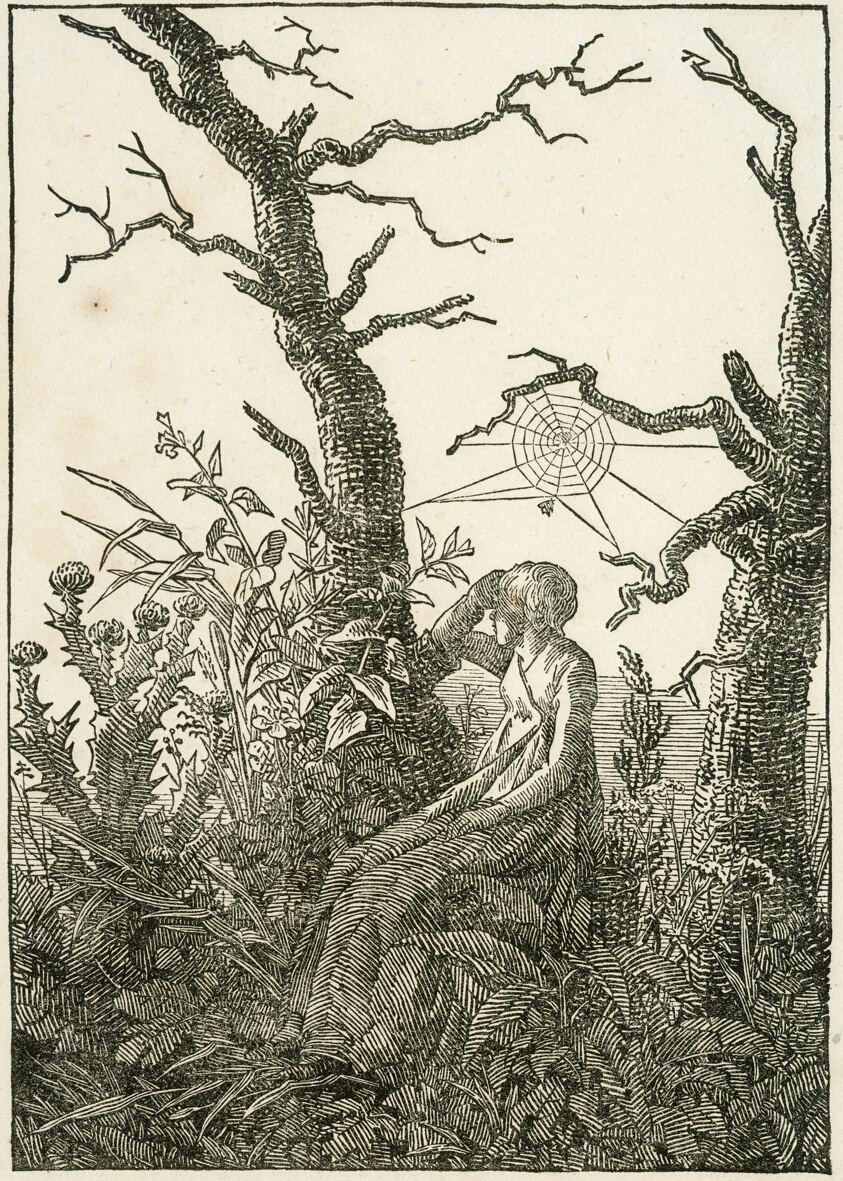
Young Man Lying on a Grave in its time
Friedrich's young man and grave make landscape a setting for memory, loss, and a difficult pause. Young Man Lying on a Grave is dated 1803–04 and is held by Art Institute of Chicago. The source record names it “Young Man Lying on a Grave.” For Young Man Lying on a Grave, the collection label is a starting point. The work’s arrangement asks for time beyond the facts of its title.
What appears at first glance
Friedrich places the figure close to a grave, turning the landscape into a site of memory and mortality. The scene asks viewers to read posture and setting together without supplying a complete story. Its quietness gives the emotional question room to remain open. One way into Young Man Lying on a Grave is to notice what the image withholds. A face may turn away, an action may be incomplete, or a space may continue past the frame. Such openings allow the viewer to keep looking.
The material object
The collection records Young Man Lying on a Grave as woodcut on paper. A figure seen from behind often gives the viewer a position inside the image without resolving what the figure thinks. Empty space and an interrupted path can become expressive devices. The medium named for Young Man Lying on a Grave tells us about a physical object, including the surface on which its composition first took shape. A closer view of Young Man Lying on a Grave may reveal decisions missed at first glance. The collection record helps place those decisions on a particular surface and scale.
Caspar David Friedrich and this work
A viewer often shares the position of a figure seen from behind, looking outward into uncertain space. His paintings helped define Romantic landscape and later inspired artists interested in solitude, scale, and spiritual feeling. The body’s closeness to the grave makes the ground more than a setting. Friedrich withholds an account of the young man’s thoughts, leaving posture and place to bear the weight of memory. The public life of Young Man Lying on a Grave can make it seem inevitable that Caspar David Friedrich would have made it this way. That combination matters more than a quick description of the artist’s usual style. Another image by the same maker may use a related method toward another end, or change the method altogether. Compare its source record with another work by Caspar David Friedrich; what changes is often as revealing as what persists. Its differences from nearby works are worth noticing; they restore a little of the uncertainty and invention within the practice. Set Young Man Lying on a Grave beside another work by Caspar David Friedrich; the comparison can reveal a recurring interest handled through a different image.
The world around Young Man Lying on a Grave
For Young Man Lying on a Grave, 1803–04 is an anchor rather than a full explanation. The linked institution identifies the object, but its first setting and audience require further historical questions. For Young Man Lying on a Grave, the date 1803–04 brings the image back into a specific career. The source record anchors the object while later viewers bring new questions to it. The linked entry for Young Man Lying on a Grave gives verifiable object facts. Its composition still asks questions that a catalogue cannot answer by itself.
Image and object record
Art Institute of Chicago identifies Young Man Lying on a Grave as a work by Caspar David Friedrich from 1803–04 and records its medium as woodcut on paper. The collection credits the object to Hamill Fund. Follow the linked object record for its catalogue entry and any further notes on its history.