
A life in Rome and on the road
Caravaggio brought sacred stories into the world of ordinary bodies and sharply directed light. His figures look tangible: worn feet, rough hands, and expressions caught at a moment of decision. These choices unsettled some patrons and electrified other painters. Caravaggio (1571–1610) worked in Italy. Working in Rome at a time of intense church patronage, Caravaggio made biblical scenes press into the viewer’s space. Success brought major commissions even as disputes and violence disrupted his career. A life is easier to understand when its objects stay close. The linked works let Caravaggio’s choices appear in several forms, not only in a familiar story.
Light that enters the scene
He built drama with a limited cast, tightly cropped action, and light that falls selectively. The worn and ordinary bodies matter because they refuse to keep sacred history safely distant. The method is visible in The Musicians, but it is worth looking at the other linked objects before calling it a fixed style. Caravaggio had room to revise a familiar solution.
Sacred stories at human scale
The Calling of Saint Matthew gives a familiar story the uncertainty of an event happening in real time. The direction of a hand and the arrival of light become parts of the narrative. Look at the projects through the material objects that survive. The Musicians records one moment of making, not a complete account of Caravaggio’s intention. Its subject and visible form can be set beside the other works on this page. One may ask for close private attention; another may have been made to address a broader audience. Those conditions make the differences meaningful, even when a shared hand or concern remains easy to recognize.
Baroque and its limits
Caravaggio is associated with Baroque. Baroque art often brings a scene close to the viewer through dramatic light, dynamic composition, and vivid emotion. Courts, churches, and private collectors all shaped its variety. In Caravaggio’s work, the sacred can look startlingly everyday; elsewhere, movement and ornament expand toward spectacle. Use the movement as a route into Caravaggio’s world, then allow The Musicians to complicate the route. The date and medium attach the work to a real moment of making. Its subject and arrangement may answer a shared question in a way no other artist chose. This is how a broad term can serve close looking without replacing it.
A closer look at The Musicians
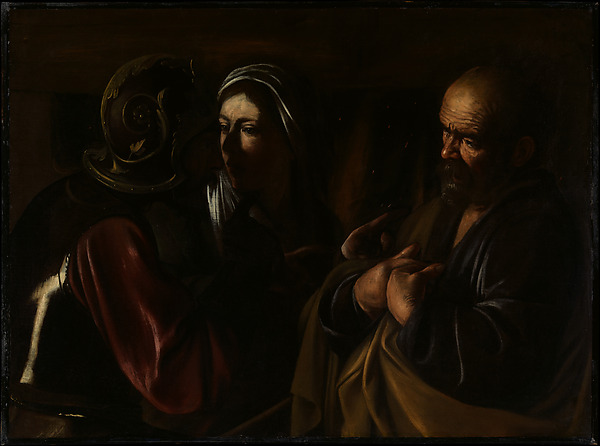
Caravaggio gathers young musicians in a close, ambiguous room where performance and observation meet. Caravaggio gathers the young performers close to the picture plane. Music is suggested through instruments and shared attention, yet the scene does not settle into a straightforward performance. The nearness of bodies and objects makes an allegorical subject feel immediate and physical. Now set it beside The Denial of Saint Peter. Caravaggio places Peter's denial in a dark, compressed scene where pointing hands and selective light carry the drama. Hands identify and deny Peter amid darkness and selective light. Caravaggio keeps the action close, so a biblical narrative is felt as an immediate human choice. Both works are linked below this profile, with their own object records and images. They reward comparison because they show Caravaggio making different decisions, sometimes with a different material, even when a familiar concern carries across the two.
Beyond the legend of his life
His dramatic contrast of illumination and darkness shaped painters across Europe. The turbulence of his life often dominates his legend, but the paintings deserve close attention for their staging: each gesture and beam of light guides the viewer through a human event. Accounts of his turbulent life are tempting shortcuts. The paintings are stronger evidence of his craft: he gave artists across Europe a way to make looking feel immediate and consequential. A third work, Judith Beheading Holofernes, complicates any account built from a single celebrated picture. Caravaggio brings Judith, Holofernes, and an attendant close to the viewer, using light and gesture to intensify a biblical story. Judith's action is held at the center by the bodies around her and a sharp fall of light. Caravaggio turns a familiar biblical episode into a tense encounter. Fame draws attention to certain pictures, but this additional object widens the view. Caravaggio’s work remains open to new comparisons as collections and records are studied.
The Musicians, The Denial of Saint Peter, and Judith Beheading Holofernes do not offer the same kind of drama. One gathers young figures around music; the others bring a moment of moral danger close to the viewer. Caravaggio’s light changes its work from scene to scene, picking out an instrument, a pointing hand, or a violent action. Those differences are more revealing than an account built only around the events of his life.
Explore Baroque ↗