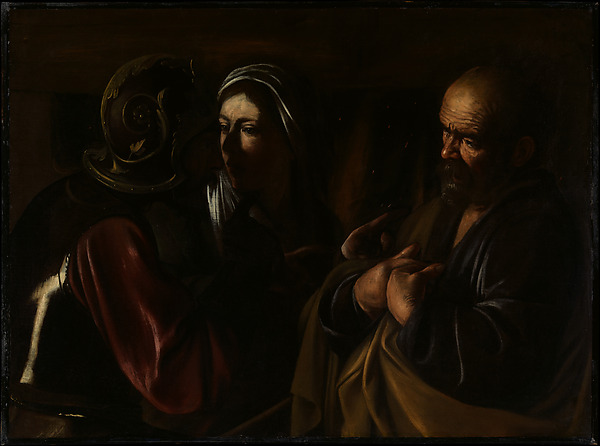

Judith Beheading Holofernes in its time
Caravaggio brings Judith, Holofernes, and an attendant close to the viewer, using light and gesture to intensify a biblical story. Judith Beheading Holofernes is dated 1599 and is listed by Artvee public-domain collection. The source record names it “Judith Beheading Holofernes.” The listed facts locate Judith Beheading Holofernes in history, while its visible choices give the viewer something to discover directly.
A closer view
Judith's action is held at the center by the bodies around her and a sharp fall of light. Caravaggio turns a familiar biblical episode into a tense encounter. Try reading Judith Beheading Holofernes from its outer edge inward. The first feature you noticed may no longer dominate. Artists can distribute attention so that a picture unfolds gradually rather than all at once.
How it was made
The Artvee listing uses a broad material description for Judith Beheading Holofernes: Oil on canvas. The stated materials of Judith Beheading Holofernes limit what we can reasonably claim about its making. Follow the record for those details, then return to the image to look for their visible effects. Looking at Judith Beheading Holofernes as an object means asking what the listed materials allow the artist to revise, repeat, or leave visible. Return to the image of Judith Beheading Holofernes for the arrangement of forms, then use the source link to learn what kind of object carries them.
Caravaggio and this work
The Calling of Saint Matthew gives a familiar story the uncertainty of an event happening in real time. The direction of a hand and the arrival of light become parts of the narrative. The action is terrible, yet Caravaggio organizes it around faces, hands, and a fall of light. The compressed space makes a familiar biblical story immediate without making it simple. In Judith Beheading Holofernes, the viewer meets a work rather than a shorthand for Caravaggio. Even when two objects share a subject, they need not share the same emphasis. Its subject, medium, and visible emphasis may seem consistent with other works, or they may reveal a different route. Another work from the same career may answer those questions differently. Its differences from nearby works are worth noticing; they restore a little of the uncertainty and invention within the practice. The choices visible in Judith Beheading Holofernes make one part of Caravaggio’s career tangible without reducing that career to a single signature look.
The world around Judith Beheading Holofernes
Accounts of his turbulent life are tempting shortcuts. The paintings are stronger evidence of his craft: he gave artists across Europe a way to make looking feel immediate and consequential. The world of 1599 was the first setting for Judith Beheading Holofernes. Its later life in collections and reproductions has changed how easily, and how often, people see it. The image of Judith Beheading Holofernes and its source record belong together: one offers a close view, the other identifies the object and its material.
Image and object record
Artvee lists Judith Beheading Holofernes as public domain and provides the image credited on this page. Its material label is broad, so a holding collection would be the place to seek fuller object and provenance information. The linked listing shows the details available here.