
Inside the Impressionist circle
Morisot was a founding participant in the Impressionist exhibitions and a painter of remarkable speed and sensitivity. Her domestic and outdoor scenes use broken brushwork and open edges to suggest experience in motion. Berthe Morisot (1841–1895) worked in France. Morisot took part in the first Impressionist exhibition and remained central to the group’s public identity. Social restrictions on women shaped where she could work without exhausting what she could invent. The works gathered below bring this setting into view through their subjects and materials. They offer several entrances to Berthe Morisot’s career rather than one defining image.
Paint that keeps moving
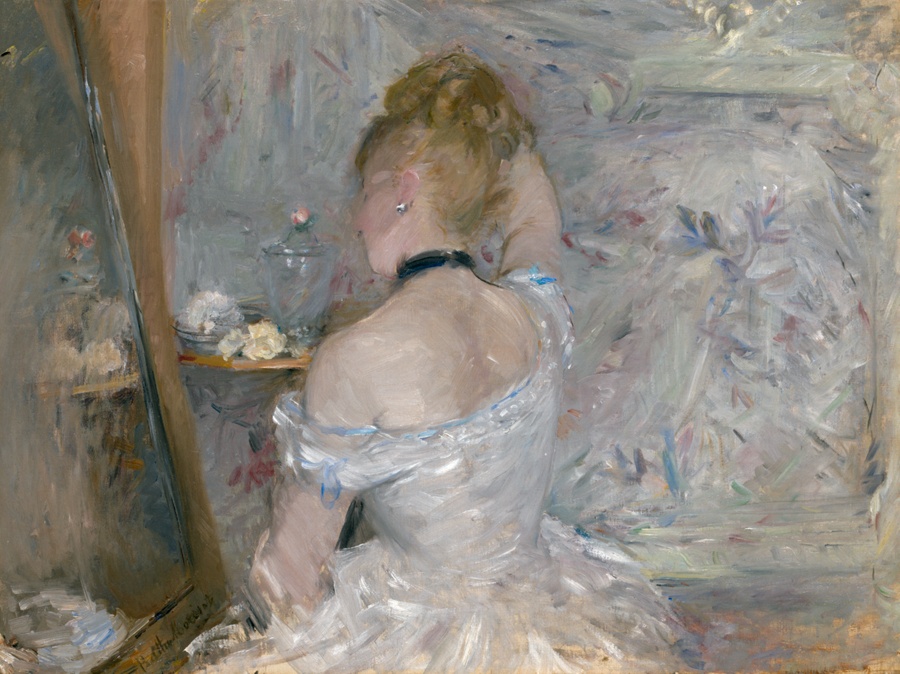
Quick marks, open edges, and unusual cropping make a settled room or garden feel momentary. Her pictures often hold a tension between a figure’s presence and the space around her. In Woman at Her Toilette, that approach meets a particular subject. A second work can show whether the same visual concern changed when Berthe Morisot worked with another material or audience.
Private spaces, public work
The Cradle is one example of how a domestic subject can become an experiment in looking, privacy, and the framing of a relationship rather than an anecdote. Those projects give a sense of sustained effort rather than one isolated flash of invention. Woman at Her Toilette offers a smaller, checkable place to study that effort. Notice how its subject has been arranged and what the material allows the artist to emphasize. Then turn to another work on this page. The change in scale, theme, or process may be modest, yet it tells us how Berthe Morisot kept testing possibilities across a career.
Impressionism and its limits
Berthe Morisot is associated with Impressionism. The Impressionists made changing light, modern leisure, and everyday experience central to painting. Their independent exhibitions challenged the authority of the official Paris Salon. Open brushwork and unusual cropping varied from artist to artist; the group included Monet’s outdoor studies, Degas’s rehearsal rooms, and Morisot’s intimate scenes. The label helps connect Berthe Morisot to other makers and institutions, but it does not decide what any one picture shows. Woman at Her Toilette gives us an object on which to test the history. Place it near a work by another artist from the same period; shared concerns may appear beside real differences of medium and audience. Those differences keep the movement useful as a map while leaving the artist’s own choices visible.
A closer look at Woman at Her Toilette
Morisot makes a private interior lively through open brushwork, pale light, and the sitter's absorbed gesture. Morisot treats a private moment through light marks and an open surface. The mirror and figure create a scene about looking, but the person does not become a posed display for the viewer. The looseness of the paint is carefully placed within an intimate, spatially complex image. Now set it beside On the Balcony. Morisot uses the balcony to place a figure between the privacy of a room and the changing world outside. Morisot uses the balcony as a threshold between an intimate setting and the world beyond. Figures and distance share the picture rather than forming a simple foreground and backdrop. Light brushwork keeps that relationship mobile, as though the scene were still unfolding. Both works are linked below this profile, with their own object records and images. They reward comparison because they show Berthe Morisot making different decisions, sometimes with a different material, even when a familiar concern carries across the two.
Morisot in the larger story
Women artists faced limits on where they could travel and work, but Morisot turned familiar settings into experiments in perception. Her paintings are central to the movement, not a footnote to it. Treating her as a supporting character in a male-centered story misses her formal contribution. Her career changes the definition of what counted as modern public art. A third work, Woman in a Garden, complicates any account built from a single celebrated picture. Morisot places a woman among garden growth, allowing the figure and setting to meet through open brushwork. The garden surrounds the figure with patches of color and foliage. Morisot keeps the person visible without forcing a strict separation between sitter and outdoor setting. The third work keeps the career from collapsing into one familiar example. Later reputation can simplify an artist; the objects restore its changes and uncertainties.
Woman at Her Toilette, On the Balcony, and Woman in a Garden all place a figure within a surrounding space that refuses to remain passive. A mirror, a railing, and dense foliage each alter how close the viewer feels to the person pictured. Morisot’s open surface is no single shorthand for spontaneity. It is a choice she adapted to rooms, thresholds, and outdoor settings with different relationships between figure and place.
Explore Impressionism ↗
