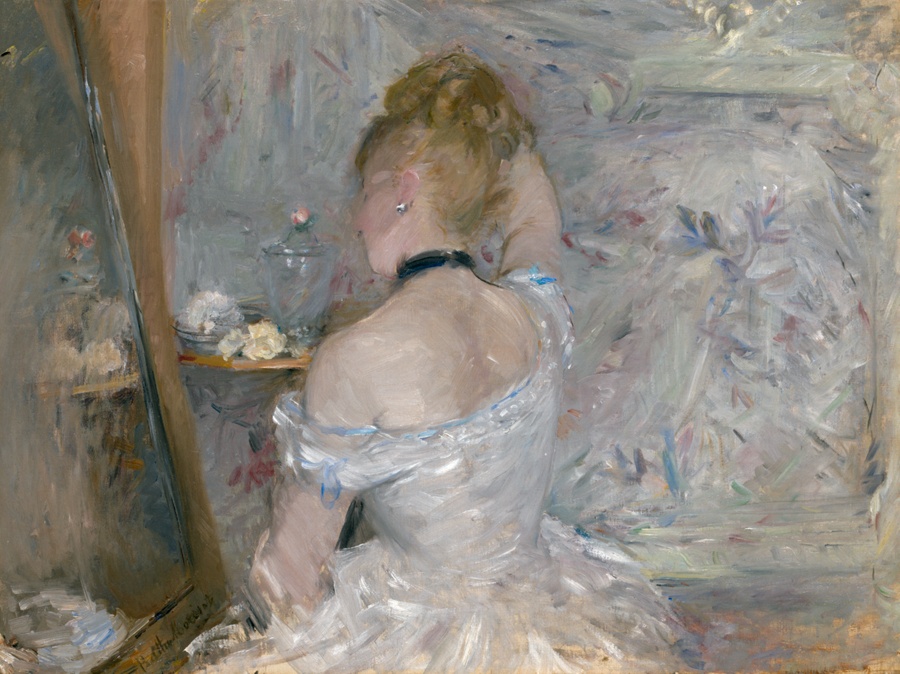
On the Balcony in its time
Morisot uses the balcony to place a figure between the privacy of a room and the changing world outside. On the Balcony is dated 1871/72 and is held by Art Institute of Chicago. The source record names it “On the Balcony.” The source tells us which object this is. Looking at On the Balcony reveals decisions that no short catalogue line could contain.
How the picture holds together
Morisot uses the balcony as a threshold between an intimate setting and the world beyond. Figures and distance share the picture rather than forming a simple foreground and backdrop. Light brushwork keeps that relationship mobile, as though the scene were still unfolding. The subject named in On the Balcony is only one part of the encounter. Edges, intervals, and changes of emphasis control how much time the viewer spends in each area of the work.
What the medium can tell us
The collection records On the Balcony as watercolor, with touches of gouache, over graphite, on off-white wove paper. Quick marks, open edges, and unusual cropping make a settled room or garden feel momentary. Her pictures often hold a tension between a figure’s presence and the space around her. In On the Balcony, process and appearance meet; the materials in the record help explain what kind of surface carried these choices. Compare On the Balcony with another work by the artist. Its medium and size can help explain why the two works meet the eye differently.
Berthe Morisot and this work
Women artists faced limits on where they could travel and work, but Morisot turned familiar settings into experiments in perception. Her paintings are central to the movement, not a footnote to it. The balcony is neither fully inside nor fully outside. Morisot uses that threshold to keep the figures and distant view in conversation, with watercolor allowing the atmosphere to remain light and mobile. On the Balcony sits among other attempts, commissions, or studies made during Berthe Morisot’s working life. A subject can be revisited without producing the same picture twice: scale, material, and audience all alter the problem. Another image by the same maker may use a related method toward another end, or change the method altogether. Then follow another work by the artist and see whether a similar concern survives a change of subject. A biography becomes more convincing when actual objects are allowed to disagree with a tidy summary. The other works linked from Berthe Morisot’s profile give On the Balcony a useful company: their differences make this image more specific.
The world around On the Balcony
The source places On the Balcony in 1871/72. Compare that historical point with the way the work is presented now; its meaning can shift as settings and viewers change. The date attached to On the Balcony, 1871/72, is more than a period marker. It places the work among the people and circumstances in which its first audience could encounter it. With On the Balcony, the source entry anchors attribution and materials; it does not settle every possible reading of the work.
Image and object record
Art Institute of Chicago identifies On the Balcony as a work by Berthe Morisot from 1871/72 and records its medium as watercolor, with touches of gouache, over graphite, on off-white wove paper. The collection credits the object to Gift of Mrs. Charles Netcher in memory of Charles Netcher II. Follow the linked object record for its catalogue entry and any further notes on its history.