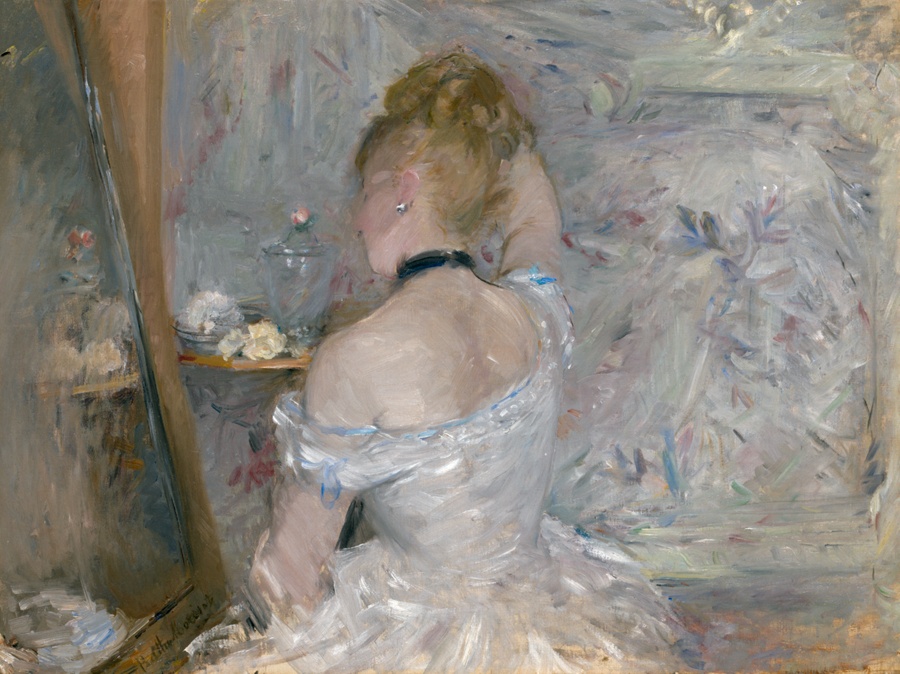
Woman in a Garden in its time
Morisot places a woman among garden growth, allowing the figure and setting to meet through open brushwork. Woman in a Garden is dated 1882–83 and is held by Art Institute of Chicago. The source record names it “Woman in a Garden.” For Woman in a Garden, the collection label is a starting point. The work’s arrangement asks for time beyond the facts of its title.
Inside the composition
The garden surrounds the figure with patches of color and foliage. Morisot keeps the person visible without forcing a strict separation between sitter and outdoor setting. A first glance at Woman in a Garden may be drawn to its subject. Look again at the spaces around that subject. Their proportions and pauses give the visible forms a particular pace.
What the medium can tell us
The collection records Woman in a Garden as oil on canvas. In Woman in a Garden, materials help determine how marks could be laid down and how the result met its first viewers. The collection entry describes the surface on which those choices were made. The medium named for Woman in a Garden tells us about a physical object, including the surface on which its composition first took shape. A closer view of Woman in a Garden may reveal decisions missed at first glance. The collection record helps place those decisions on a particular surface and scale.
Berthe Morisot and this work
The Cradle is one example of how a domestic subject can become an experiment in looking, privacy, and the framing of a relationship rather than an anecdote. The garden does not serve as a passive backdrop for Morisot’s figure. Color and foliage cross the space around her, making the person part of the outdoor atmosphere. For Berthe Morisot, Woman in a Garden brought a subject into contact with a chosen material. Even when two objects share a subject, they need not share the same emphasis. Another image by the same maker may use a related method toward another end, or change the method altogether. Ask what this subject allowed the artist to test here and which decisions depend on its particular size or material. Treating each object as a fresh decision makes room for change, experiment, and the practical conditions under which an artist worked. Set Woman in a Garden beside another work by Berthe Morisot; the comparison can reveal a recurring interest handled through a different image.
The world around Woman in a Garden
Treating her as a supporting character in a male-centered story misses her formal contribution. Her career changes the definition of what counted as modern public art. For Woman in a Garden, the date 1882–83 brings the image back into a specific career. The source record anchors the object while later viewers bring new questions to it. The linked entry for Woman in a Garden gives verifiable object facts. Its composition still asks questions that a catalogue cannot answer by itself.
Image and object record
Art Institute of Chicago identifies Woman in a Garden as a work by Berthe Morisot from 1882–83 and records its medium as oil on canvas. The collection credits the object to A Millennium Gift of Sara Lee Corporation. Follow the linked object record for its catalogue entry and any further notes on its history.