
Woman at Her Toilette in its time
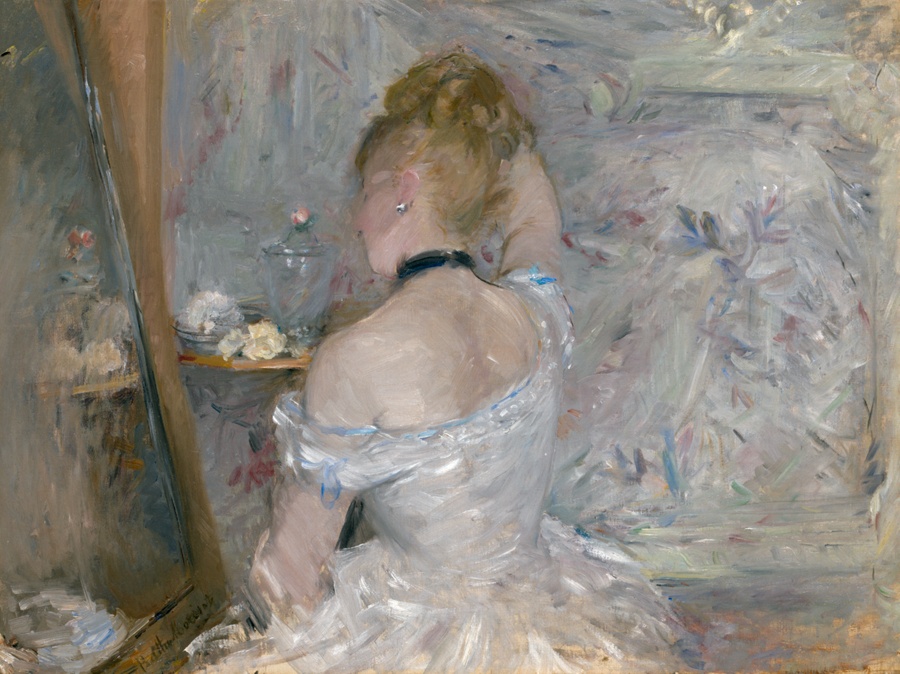
Morisot makes a private interior lively through open brushwork, pale light, and the sitter's absorbed gesture. Woman at Her Toilette is dated 1875–80 and is held by Art Institute of Chicago. The source record names it “Woman at Her Toilette.” The source tells us which object this is. Looking at Woman at Her Toilette reveals decisions that no short catalogue line could contain.
Inside the composition
Morisot treats a private moment through light marks and an open surface. The mirror and figure create a scene about looking, but the person does not become a posed display for the viewer. The looseness of the paint is carefully placed within an intimate, spatially complex image. A first glance at Woman at Her Toilette may be drawn to its subject. Look again at the spaces around that subject. Their proportions and pauses give the visible forms a particular pace.
The material object
The collection records Woman at Her Toilette as oil on canvas. In Woman at Her Toilette, materials help determine how marks could be laid down and how the result met its first viewers. The collection entry describes the surface on which those choices were made. In Woman at Her Toilette, process and appearance meet; the materials in the record help explain what kind of surface carried these choices. Compare Woman at Her Toilette with another work by the artist. Its medium and size can help explain why the two works meet the eye differently.
Berthe Morisot and this work
Morisot was a founding participant in the Impressionist exhibitions and a painter of remarkable speed and sensitivity. Her domestic and outdoor scenes use broken brushwork and open edges to suggest experience in motion. The sitter faces her own moment rather than posing for the viewer. Morisot’s mirror and light strokes make looking the subject, while keeping the woman from becoming a tidy illustration of private life. For Berthe Morisot, Woman at Her Toilette brought a subject into contact with a chosen material. Woman at Her Toilette is valuable precisely because it gives that broad name a specific subject and set of visual choices. Another image by the same maker may use a related method toward another end, or change the method altogether. Ask what this subject allowed the artist to test here and which decisions depend on its particular size or material. Each work had its own audience and task, and each can change the story we tell about the career. The other works linked from Berthe Morisot’s profile give Woman at Her Toilette a useful company: their differences make this image more specific.
The world around Woman at Her Toilette
Morisot took part in the first Impressionist exhibition and remained central to the group’s public identity. Social restrictions on women shaped where she could work without exhausting what she could invent. The date attached to Woman at Her Toilette, 1875–80, is more than a period marker. It places the work among the people and circumstances in which its first audience could encounter it. With Woman at Her Toilette, the source entry anchors attribution and materials; it does not settle every possible reading of the work.
Image and object record
Art Institute of Chicago identifies Woman at Her Toilette as a work by Berthe Morisot from 1875–80 and records its medium as oil on canvas. The collection credits the object to Stickney Fund. Follow the linked object record for its catalogue entry and any further notes on its history.

