
A life in graphic art
Mucha’s posters made the streets of Paris a place for elegant, theatrical graphic art. His flowing lines, stylized flowers, and halo-like ornaments became signatures of Art Nouveau. Alphonse Mucha (1860–1939) worked in Czech lands and France. A commission for actress Sarah Bernhardt helped make Mucha’s Paris posters widely visible. The street and theater became important exhibition spaces for his graphic language. Each documented work on this page occupies one point in a longer career. Together they make a more varied account of Alphonse Mucha than a single celebrated image can give.
The rhythm of poster design
Long, flowing contour connects hair, flowers, clothing, lettering, and frame. A poster has to arrest a passerby’s glance while continuing to reward a closer look. No single technique explains every part of Alphonse Mucha’s career. Zodiaque is a starting point for noticing both continuity and experiment in the other works.
Art made for the street
Commercial designs brought recognition, yet the later Slav Epic shows a very different ambition: monumental historical paintings concerned with the experiences of Slavic peoples. The projects in this life were made for viewers, patrons, or buyers with their own expectations. Zodiaque reached them through a particular material and format. Its arrangement can be studied without treating it as a perfect illustration of what Alphonse Mucha always did. A second work may keep an interest but reverse the balance of color, line, or subject. That difference is evidence of an artist working through new demands rather than repeating a formula.
Art Nouveau and its limits
Alphonse Mucha is associated with Art Nouveau. Art Nouveau carried sinuous lines and organic pattern across posters, architecture, jewelry, furniture, and painting. Its designers wanted art to live in everyday spaces as well as galleries. Mucha’s graphic work and Klimt’s ornament show two distinct expressions of this ambition. A movement name can tell us about exhibitions, markets, or a later historian’s way of grouping works. For Alphonse Mucha, its value depends on what it explains in a specific object. Return to Zodiaque and describe the subject before reaching for the label. Which visual problem does it share with nearby artists, and where does it take another path? A good comparison can sharpen the historical category without making it rigid.
A closer look at Zodiaque
Mucha combines a woman's profile, ornate hair, and a zodiac circle in a design made for reproduction. Mucha arranges the face, hair, ornaments, and zodiac signs within a circular design. The image works as graphic art intended to be reproduced and seen beyond a gallery. Its elegance depends on the balance between an individual figure and a repeatable printed composition. Now set it beside The Seasons. Mucha organizes four seasons as a sequence of figures and decorative motifs, joining commercial printmaking to a coherent visual cycle. Four linked panels let Mucha vary the figure and foliage while preserving a common design. The work is both a sequence and a single decorative idea. Both works are linked below this profile, with their own object records and images. They reward comparison because they show Alphonse Mucha making different decisions, sometimes with a different material, even when a familiar concern carries across the two.
Mucha beyond one style
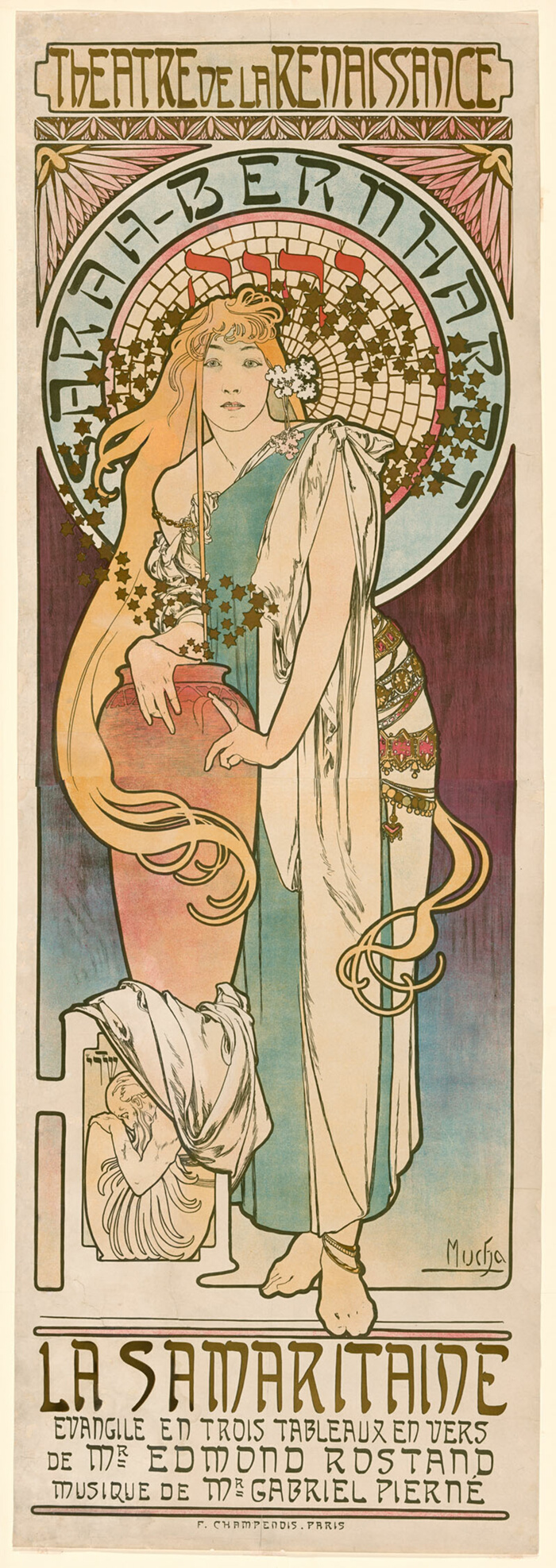
Commercial success gave him a wide audience, but his ambitions extended beyond advertising. He later devoted years to the Slav Epic, a series of monumental canvases about the histories and aspirations of Slavic peoples. His career resists a tidy division between advertising and serious art. It also asks how a style circulates when images can be reproduced and seen far beyond a gallery. A third work, La Samaritaine, complicates any account built from a single celebrated picture. Mucha designs a theatrical poster for La Samaritaine, using a vertical figure and graphic ornament to catch attention at a distance. The tall format makes a figure, lettering, and ornament work together at poster scale. Mucha has to hold a viewer's eye quickly while rewarding attention to the print's details. The difference among these objects is part of Alphonse Mucha’s legacy. It asks later viewers to remember a working artist rather than a fixed style.
Zodiaque brings profile, signs, and hair into a circular design. The Seasons extends a related decorative language across four linked images, while La Samaritaine uses the tall reach of a theater poster. Each print needed to meet a viewer at a different scale or speed. Mucha’s lines remain recognizable, but their job changes with the format, audience, and words that share the surface.
Explore Art Nouveau ↗