Art history has often placed women inside pictures while leaving their names outside the story. That pattern obscures artists who trained, worked, exhibited, taught, and built networks under unequal conditions. Their careers reveal the institutions that shape what becomes visible.
Berthe Morisot was central to the Impressionist exhibitions, not merely connected to them through family. Mary Cassatt developed a distinct compositional language and helped American collectors discover French art. Both show how domestic scenes can be formally adventurous rather than narrow.
The story extends across places and periods. Artemisia Gentileschi pursued a major Baroque career. Rosa Bonheur painted animals on a scale usually reserved for grand historical subjects. Suzanne Valadon built searching portraits and nudes in early twentieth-century France.
Recovering these artists is only one step. We also need to ask why certain subjects, materials, and working spaces were valued more than others. A fuller art history changes the questions we bring to every work, not just the names on a list.
A story with missing names
Look beyond the question of whether a woman artist was “allowed” to work. Ask where she trained, what she could exhibit, which subjects were considered suitable, and whether her name survived on the object. These practical conditions shaped careers long before later historians decided which names to repeat.
When an artist is missing from a familiar account, ask where the account came from. Who could train in a studio, show in an exhibition, own a workshop, or secure a commission? Which objects were later collected and catalogued? These practical questions help explain why some makers became easy to name while others did not. They also keep the story from turning into a simple correction of a list. What counted as important art was itself shaped by unequal access.
Two careers, different aims
The domestic interior is not a minor subject by definition. Morisot could make a threshold or gesture unstable and immediate; Cassatt could use pattern and angle to make a relationship structurally complex. Morisot’s rare self-portrait and Cassatt’s carefully framed women stage different forms of self-presentation.
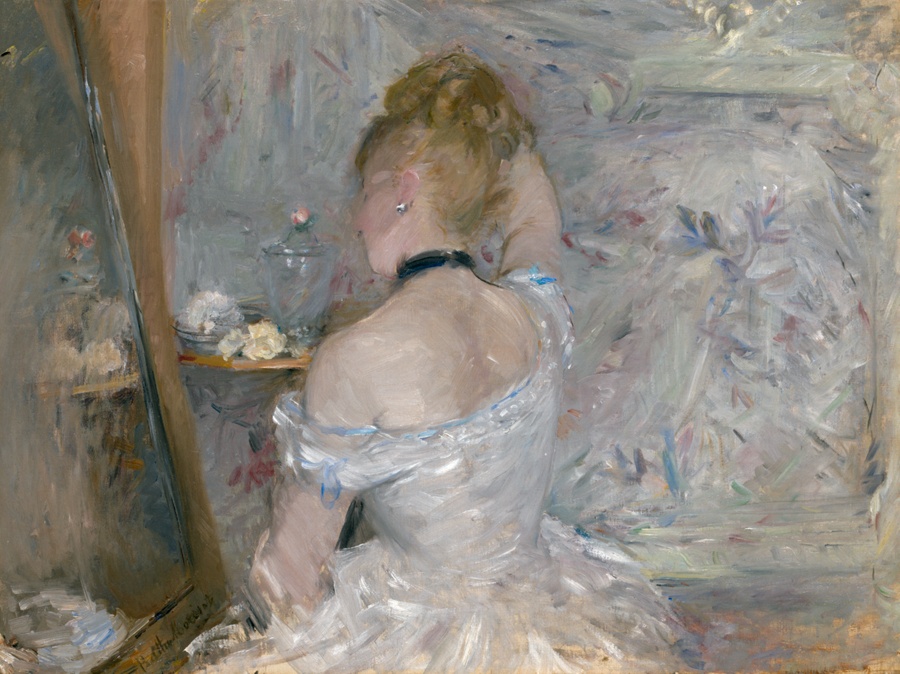
Look closely at Cassatt and Morisot without asking them to stand for all women artists. Cassatt’s The Child’s Bath holds figures and floor together through pattern and a high viewpoint. Morisot’s Woman at Her Toilette keeps the surface airy while the sitter remains absorbed in her own space. Their differences are as instructive as their shared exhibition history. From there, move to De Morgan’s allegories or another century and notice how the questions change with the conditions of work.
Access and recognition
Adding names to a timeline is necessary but incomplete. Collections, labels, markets, and teaching still determine what counts as central. A fuller account also changes the questions we ask of male artists: who posed, collaborated, supported a studio, prepared materials, or was represented without control over the result?
An artist’s absence from a familiar survey is not evidence that she did not work. Training, membership, commissions, exhibition access, and the later survival of records all affect whose work becomes easy to find. These conditions varied across centuries and places; there is no single experience called “being a woman artist.” Looking at institutions alongside the paintings helps explain why certain careers were long treated as marginal and why the recovered record changes the shape of art history itself.
Cassatt beside Morisot
Cassatt’s The Child’s Bath and Morisot’s Woman at Her Toilette share an interest in a private setting but solve different pictorial problems. One builds intimacy through a high viewpoint and patterned floor; the other keeps the surface open and the figure absorbed. Grouping both under a single “women artists” style would erase what makes each image inventive. Their comparison is valuable because it makes that erasure obvious.
Compare Cassatt’s The Child’s Bath with Morisot’s Woman at Her Toilette. Both scenes take place close to the figure, but their viewpoints and painted surfaces do different work. Cassatt’s high angle binds bodies and patterned floor; Morisot lets light marks and a mirror complicate the act of looking. Then visit each artist’s other works. The comparison should open two separate careers, not turn them into representatives of one supposedly feminine subject or style.
Widen the picture
A wider story of makers, subjects, and institutions. A fuller art history should change how we read any object, including pictures by artists whose names were never forgotten. Who supported a maker’s training? Who prepared the materials, paid for the commission, or could enter the place shown? These are concrete questions, not an obligation to admire every recovered work equally. They lead back to the paintings, drawings, and prints, where artists made distinct choices under circumstances that were never identical.